

Hi folks, hope you’ve had a great week!
Our team at Markets is always reading, often much more than what might be considered healthy. So, we thought it would be nice to have an outlet to put out what we’re reading that isn’t part of our normal cycle of content.
So we’ve started “What We’re Reading”, where every weekend, our team outlines the interesting articles — even books — that put our brains in seventh gear (if that even exists).
We also host a book club every Saturday, that we talk about at the end. If you’d like to read with us, please feel free to join!
We’d also love to know what has piqued your interest, too! Please feel free to let us know in the comments.
What Pranav is reading
Devesh Kapur and Arvind Subramanian, A Sixth of Humanity: Independent India’s Development Odyssey (Amazon link)
I just completed a book I had been reading, on and off, for the better part of half a year.
It was a terribly depressing experience.
The book is an unflinching look at India, and more specifically, its government. A lot of it isn’t exactly news, of course — no Indian needs a reminder of the dysfunction they live through. But it is unflinching. It refuses to pull its punches for over 600 pages, forcing you to look, as long as you’re willing to read, at how things have gone wrong.
We’re sometimes criticised, at Markets, for being overly negative about India. To that, let me say: I’m constantly upset by how little my wife eats, or how stressed my mother always seems to be, or how the paint keeps peeling off the walls of my verandah. I am endlessly critical of myself: my sleepy disposition, my paunch, my scraggly beard, my inability to assert myself, and on and on. On the other hand, if I met you, dear stranger, I would only see positive things to say. Respectfully, that is because I do not give two farts about you.
But “negative” is hardly the apt description for what this book makes you feel. “Negative” is what you feel when you flinch; when, within two seconds of seeing a reel shot in a slum, your finger queues up the next video. It is the feeling of a tourist. You cannot merely be negative over 600 pages of reading. You can’t despair, and do nothing else, for a few dozen hours.
No. This book forces you to wade into the muck, have it seep through your pores and harden your skin. Halfway in, the dysfunction no longer stings; it is simply part of the background. You’re left with the optimism of a hard man.
That is when good work can happen.
Ours is a remarkable country; a “precocious democracy” whose original sin was to care, equally, for all its people. And yes, it crumbled under the weight of that enormous undertaking. But it is a country where miracles happen; where a balance-of-payment crisis can spark an incredible, multi-decadal growth story, or a currency disaster can spawn the world’s most advanced payment system. Our quota of miracles is not done yet. The world’s most populous country will, through sheer odds alone, birth incredible stories.
But for that, we must learn not to look away from the ugliness that stares at us.
Read it if you dare.
What Kashish is reading
How bad analytics built a Tottenham team that might get relegated (link)
This is a fascinating piece on sports analytics and more importantly, on how it can go wrong.
It starts with a classic Moneyball-style anecdote: even back in the 70s and 80s, teams were already using data, but often only to justify decisions they had already made. That thread runs through the entire article that data isn’t always used to discover truth, but sometimes it’s used to defend bias.
Fast forward to today, and sports analytics has become incredibly sophisticated. We can now track almost everything a player does from movement, speed, off-ball runs to physical intensity and what-not and assign a number to it. In theory, this should make decision-making better than ever.
But the Tottenham example shows the flip side.
Clubs today are increasingly leaning on newer, flashier datasets with things like athleticism scores, speed, and physical output. Tottenham, for instance, ended up building a squad full of explosive, high-speed players with elite physical metrics. On paper, this looks like a very “modern” team.
The problem? They forgot the most basic thing that actually matters in football: passing.
The piece points out that passing is the single most frequent action in a match as teams attempt hundreds of passes per game, far more than shots, dribbles, or tackles. And yet, Tottenham have only two players ranked among the top 150 passers in the league.
So what you get is this strange paradox: we have more data than ever before, but we may actually be worse at identifying what matters.
That’s what makes this piece so interesting. It’s not anti-data, if anything, it argues for better use of data.
The closing line captures it perfectly which is a twist on Moneyball’s famous question:
Not “but can he hit?”
But, in this case:
“But can he pass?”
We have a book club!
This feels like a great segue to remind you of something that we’re pretty bad at advertising: our book club.
So here’s an image of our fairly-impressive book collection to attract you. Yes, they’re not just for show, and we do read them, alongside some coffee/tea and sandwiches.
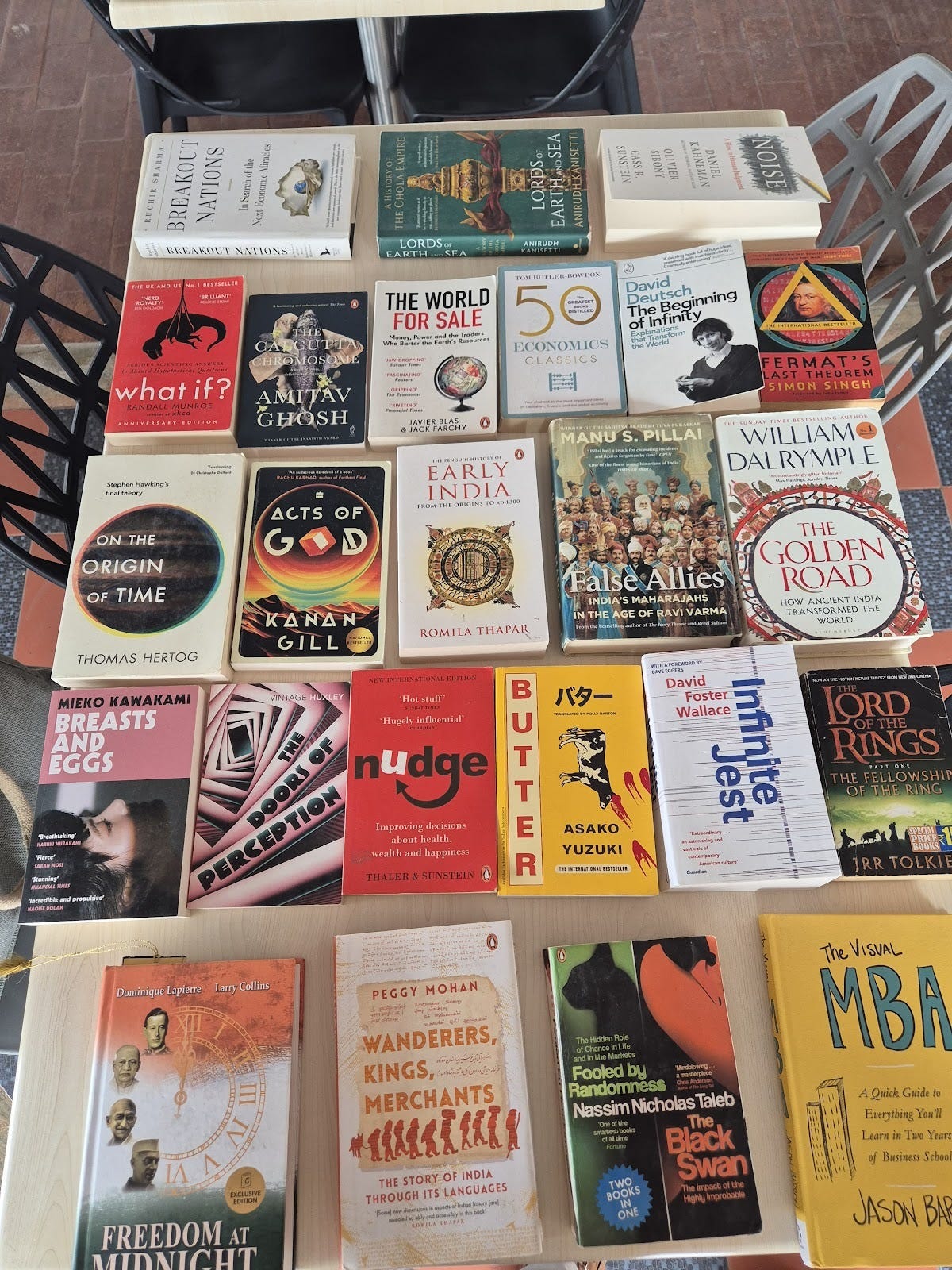
The Markets book club has been running for nearly a year. We have some avowed loyalists who come almost every weekend and nerd about their readings with us. But really, it’s become a great spot for many of us to talk to each other - even forge new friendships - without being distracted by any screen. It’s this in-person community that we’re really proud of building.
So, we’d love for you to join us! We host the book club every Saturday, 10:30-1 pm, at the Ditto office in JP Nagar. Unfortunately, this location is fixed - we understand JP Nagar may be far for some. But this is the only place where we can host it smoothly. And we don’t host sessions online, either.
If you’d like to attend the book club, please keep the above in mind, and please reach out to: pranav.manie@zerodha.com!
Only two people, c'mon no one else is reading ?
Loved the analogy of family and strangers!