
What We're Reading #5
With one video game included.

Hi folks, hope you’ve had a great week!
Our team at Markets is always reading, often much more than what might be considered healthy. So, we thought it would be nice to have an outlet to put out what we’re reading that isn’t part of our normal cycle of content.
So we’ve started “What We’re Reading”, where every weekend, our team outlines the interesting articles — even books — that put our brains in seventh gear (if that even exists).
Unlike our last, fairly sad edition, this one has more “joie de vivre”, as the French say. It has a video game recommendation, some business history, some classic economics, a China sprinkle here and there.
We also have an important announcement at the end if you'd like to read with us.
We’d also love to know what has piqued your interest, too! Please feel free to let us know in the comments.
What Manie is playing/reading
Cyberpunk 2077 (+ the Phantom Liberty DLC) (link)
My boss Bhuvan told me to have fun with What We’re Reading. So this is me, having a lot of fun in this edition by telling you about a video game instead of an article/book.
I’ve been playing the hit role-playing game Cyberpunk 2077 for a couple of months now. It’s one of the best games of the decade, nothing short of a movie. If you’ve seen the Blade Runner movies, or The Matrix, or Minority Report, you’re probably familiar with the cyberpunk aesthetic.

The cyberpunk environment is an overwhelming, nauseating world, where capitalism has basically been replaced by feudalism of a few companies, high-technology and poverty exist simultaneously alongside a side-plate of urban loneliness, everyone’s finding escapism in screens and devices, and the line between being human and being robot doesn’t exist. One might say that’s a bit like our world (though I mostly disagree, it’s still capitalism).
Of course, AGI has been achieved in this world. There’s nice AI agents, there’s rogue AI agents who are separated from the new internet by a Trump-style firewall, and then there are dead humans who have turned into digital souls.
But the game doesn’t necessarily present AGI itself as a fear. It deals with a much bigger, and in my view, a very realistic concern.
See, in the economics of the game, the dominant companies are called Militech and Arasaka. They’re mega-corporations that seem to have spread their tentacles in many industries. But most importantly, they’re all in the business of AI-native weapons and smart surveillance. They also have their own military forces and armed robots, much of which is autonomous. That’s not really a marker of even the largest companies of the modern world, like Apple or TSMC or Reliance.
In the normal world, competition between companies takes place through business and product strategy. Of course, sometimes, a firm may have underhand dealings with the government and indulge in some rent-seeking. But rarely does competition take the form of actual guns blazing between them. The main mode of war is the price mechanism, and usually, that’s a good thing.
But, in the cyberpunk world, “business success” literally translates to “kill or be killed”. The game has corporate wars, where people / employees were killed and companies send spies to their rivals’ offices. It’s like seeing the British East India Company battle with the Dutch East India company, but with missiles guided by AI prompts and drones that can think for themselves.
What I’m getting at is that the militarization of AI is the biggest elephant in this earth-sized room of ours. Our last edition had a lot of literature about understanding Palantir, which does sound a lot like the companies in the game. But this isn’t just about them. The Russia-Ukraine war uses a lot of Chinese drones, and so does Israel’s bombing of Gaza. AI’s chumminess with the surveillance and defense industries has always been worrying.
The game’s dissection of how AI intersects with private entities that hold military power as big as small nations is dizzying. If AGI were merely about economic outcomes like large-scale unemployment, it might still be solvable. But this isn’t. It feels more helpless. Not a lot about Cyberpunk 2077 might make sense to you, but this stream of consciousness has depressingly been on the money.
The Untold Story Behind Saudi Arabia’s 41-year US Debt Secret (link)
My second recommendation is earnestly far more down to Earth. Yet somehow, it’s still stranger than fiction.
I wrote the petrodollar story on The Daily Brief last week. I generally reserve myself from writing on currencies, because I still don’t understand how reserve currencies work. But there’s nothing like a nice little self-imposed deadline to speed up learning.
The petrodollar is a strange entity. The story is that in the 1970s, when the US was facing an extremely costly crude oil import bill, it decided to strike a deal with Saudi Arabia, which was having issues of its own. Saudi would agree to price all its oil exports in $, while the US magnanimously offers its security umbrella. This, of course, strengthened the dollar’s status as the dominant currency of the world.
But this story has one problem: no one truly knows whether it happened, because this deal never had a formal contractual arrangement. At least, that’s the counter-argument.
However, I found a scintillating piece of investigation from Bloomberg on this whole episode. The deal was supposedly brokered by then-US Treasury Secretary William Simon. Simon used to be a bond trader known to have an extremely hot temper and an elephant-sized ego. By no means should he have been close to any form of dealmaking that would require geopolitical tact and a careful choice of words.
However, his expertise in bonds also meant that he understood how US government debt worked, and why it was so appealing to everyone as the world’s premier safe asset. So he just needed to convince the Saudis of that. One could argue that that doesn’t necessarily require a diplomat - although, allegedly (and only allegedly), Simon went on a bender on his flight to Riyadh.
All of this was personally confirmed to Bloomberg by Gerry Parsky, who was Simon’s deputy at the time.
So even if there wasn’t an actual deal of sorts, there was some semblance of an understanding between both nations. Even if the petrodollar doesn’t have the strength it used to, in some shape or form, it might have existed. Just after this supposed meeting in Riyadh, the Gulf suddenly became the biggest provider of credit to the US.
How much this deal really mattered in the grand scheme of things is a different debate, though. The dollar’s reserve status is now driven by a lot of other factors. The petrodollar arrangement itself has become far less potent. That, perhaps, we’ll leave for another article :)
What Pranav is reading
Wang Xiaolu: Why More Stimulus Has Meant Weaker Demand in China (link)
This one’s a little long, and perhaps a little dry (nothing a couple of AI queries can’t help you through, of course). We’re recommending it anyway, because it is fascinating.
In a sense, it’s an account of the costs of being China. It maps the endless rounds of stimulus that China has pumped into its economy, and how, contra Keynes, government spending isn’t a simple formula to make people buy things.
If you understand that one fact, a lot of China becomes a little easier to understand. Why do Chinese companies constantly end up in a supply glut? Why can’t its billion-plus market absorb the output of its industrial base? Why is the Chinese state struggling to pull things around, despite understanding the basic issue it faces? Wang takes you through it all.
This isn’t partisan hackery of the sort you would expect out of someone sitting in an American think tank, looking at China from afar; Wang Xiaolu is a Chinese economist, who works at China’s National Economic Research Institute. You might or might not agree with what he says, but it’s hard to dismiss this as some sort of psy-op.
Must-read, if you like thinking about macro-economic issues.
Rahul Sanghi, NUI #9 - Manam Chocolate (link)
I’m not one for conspiracy theories, but there’s one that I believe deeply: I think Rahul Sanghi is me from the future. There’s something to how he writes: that willingness to shift from history to chemistry to economics without taking a beat, that penchant for terrible-but-clever jokes, that unvarnished love for business as process… his writing is everything that I think (more like hope) I will some day grow into.
Some day, I shall find him, and I will finally learn why I had to come back in a time machine and teach all of India about business.
In the meanwhile, though, do check out his long-read on Manam Chocolate.
It’s an incredible tale, because Rahul isn’t just telling you about a company. He begins with the history of chocolate, as it touched the Indian sub-continent — of British-era cocoa plantations, of the genetics of Indian cocoa, and the “pragmatism” it bred, of Cadbury Dairy Milk’s bid to become part of India’s mithai culture, and more.
In short, Rahul makes you understand chocolate. By the time he’s done, Manam’s success explains itself. It’s a masterpiece of business writing.
What is Kashish reading?
A Generative Theory of the Marginal Revolution (link)
Marginal utility is one of the first ideas you encounter in economics. But Tyler Cowen’s argument is that marginal thinking isn’t just an economic tool — it’s a way of understanding how ideas, behaviors, and even institutions evolve.
One example that stuck with me is deeply unsettling. In parts of China, there have been reported cases where drivers run over accident victims a second time to ensure death. Why? Because the marginal cost of killing someone (a one-time compensation) can be lower than the lifetime liability of supporting a severely injured survivor. When the incentives are structured this way, the “rational” decision at the margin becomes horrifying. It’s a stark reminder that people don’t respond to total costs — they respond to incremental ones.
The same logic shows up in more ordinary settings too. Think of a marriage where one partner feels they can never meet the other’s expectations. At some point, the marginal benefit of trying harder drops to zero. When effort no longer changes outcomes, people stop optimizing for approval and start optimizing for themselves. This leads to even the current level of efforts to go down from the partner, which even worsens the marriage.
Cowen uses marginalism to explain not just decisions, but the evolution of ideas — how small, incremental changes compound into entirely new ways of thinking. You don’t have to agree with everything, but it’s one of those frameworks that, once seen, is hard to unsee.
We have a book club!
This feels like a great segue to remind you of something that we’re pretty bad at advertising: our book club.
So here’s an image of our fairly-impressive book collection to attract you. Yes, they’re not just for show, and we do read them, alongside some coffee/tea and sandwiches.
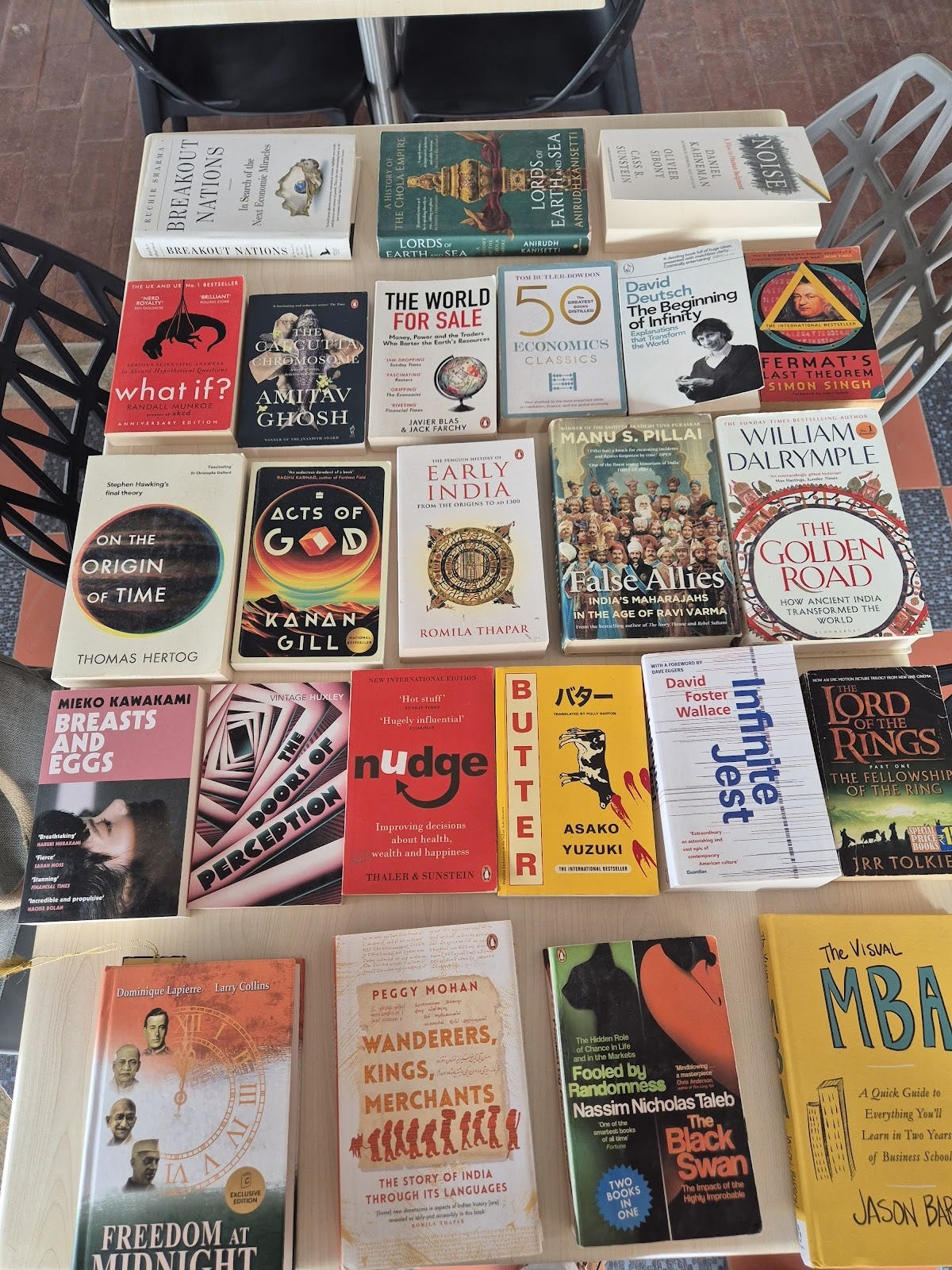
The Markets book club has been running for nearly a year. We have some avowed loyalists who come almost every weekend and nerd about their readings with us. But really, it’s become a great spot for many of us to talk to each other - even forge new friendships - without being distracted by any screen. It’s this in-person community that we’re really proud of building.
So, we’d love for you to join us! We host the book club every Saturday, 10:30-1 pm, at the Ditto office in JP Nagar. Unfortunately, this location is fixed - we understand JP Nagar may be far for some. But this is the only place where we can host it smoothly. And we don’t host sessions online, either.
If you’d like to attend the book club, please keep the above in mind, and please reach out to: pranav.manie@zerodha.com!