
What we're reading #3


Hi folks, hope you’ve had a great week!
Our team at Markets is always reading, often much more than what might be considered healthy. So, we thought it would be nice to have an outlet to put out what we’re reading that isn’t part of our normal cycle of content.
So we’ve kickstarted “What We’re Reading”, where every weekend, our team outlines the interesting articles — even books — that we read recently and put our brains in seventh gear (if that even exists).
Spoiler alert: this edition is deep-fried, and we don’t mean to be cheeky when we say that. Oil, they say, is still the new oil. If you read our recent Daily Brief story, you’d know its pervasiveness in the world is far underestimated. Even if it gets surpassed by solar in the world’s energy mix, there’s still an endless number of daily-use objects where it continues to get used.
Oil is not going anywhere soon. And, well, neither are our team’s two favorite topics: technology (or AI) and China. Oops — actually, there’s a third, and that’s tech x China. Those round up the buffet we’re serving to you today.
We’d also love to know what has piqued your interest, too! Please feel free to let us know in the comments.
What Aakanksha is reading
King of Oil, by Daniel Ammann
It’s probably too eerie, and too real a time to be reading a book about oil — more so as I see people scrambling through shortages of it. Yet, here we are.
King of Oil is about a savvy commodity trader Marc Rich. I had first encountered Rich as a character in the book “The World for Sale” by Javier Blas and Jack Farchy, an incredible book about commodity traders who rapidly shuffle resources from resource-rich countries to the rest of the world. So this pushed me to pick up this one.
Rich was a Jewish refugee who fled the Nazis as a boy, arrived in America with nothing, and started in the mailroom at Philipp Brothers, a metals trading house. By the time he was in his thirties, he had done something nobody thought was possible: he broke the stranglehold of the Seven Sisters, the cartel of giant oil companies that controlled everything from the wellhead to the petrol pump, by creating the spot market for crude oil. Before Rich, oil moved through rigid long-term contracts, but after him, it became a tradeable commodity. Every modern trading house — like Glencore and Trafigura — is built on the model he pioneered.
The moment I keep coming back to is the 1979 Iranian Revolution. The Shah falls, American hostages are taken, and President Carter slaps sanctions on Iran. What does Marc Rich do? He increases his business with Iran. His argument was that his company was Swiss, not American, and Swiss law didn’t prohibit the trade. He bought Iranian crude that nobody else would touch, and sold it across the world.
What makes this book more than a biography, though, is what it reveals about how commodities actually move around the world. The global economy isn’t an abstraction, it has a very strong physical aspect. It’s tankers in narrow waterways, pipelines through contested territory, and cylinders of gas that arrive (or don’t) at household and restaurant kitchens in India. Marc Rich understood this better than almost anyone alive.
On any other day, this book would have read like a thriller. But right now, it reads like a manual for going through the current state of the world.
What Kashish is reading
AI vs Human Writing — A Blind Taste Test (link)
Kevin Roose, the New York Times tech columnist, recently ran a small experiment: a blind taste test asking readers to choose between AI-written and human-written passages. The results were… uncomfortable. A surprising number of readers preferred the AI.
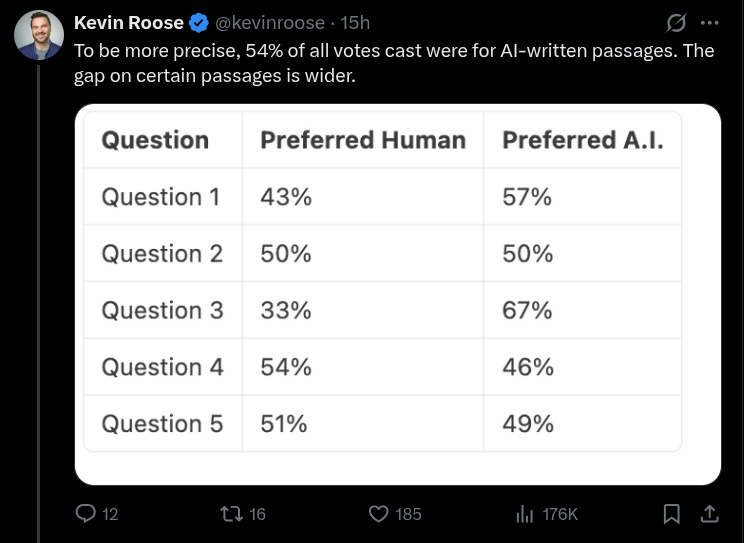
I tried the test myself, expecting to side with the human writing. Instead, I found myself repeatedly choosing the AI’s version. That raised a slightly unsettling question for someone whose job involves writing: what exactly counts as good writing anymore?
It’s surprisingly hard to define. The basic checklist—grammar, coherence, clarity—was solved years ago. Even GPT-3 could write sentences that made sense. But the new models can do something more interesting: they can write in ways that feel creative, persuasive, even stylistically distinct. At times, the difference between AI and human writing is becoming genuinely difficult to spot.
Which makes the whole idea of “good writing” slippery. Most of us probably can’t define it cleanly. But we feel it when we see it.
There’s another possibility that I keep coming back to. In my work, I consume an enormous amount of text—both human-written and AI-generated. Over time, it’s possible that my brain has simply adapted to the rhythms of AI writing. If that’s true, then my preference for AI text might not be a judgment about quality at all. It might just be familiarity.
What this eerily implies is that if we keep reading AI-written text long enough, we might slowly train ourselves to prefer it. Not because it’s better. Just because it’s what we’re used to.
Private credit’s stupidly simple problem is turning into a stupidly large one, FT (link)
When I first started reading about private credit, it sounded alien. But it’s actually stupidly simple. These are just loans given in private markets, which means they’re not publicly traded. And a lot of these loans — especially to software companies — do not look as creditworthy today as they did when they were given.
A big part of that seems to be that AI is eating into the businesses of some of these software firms, which makes the loans sitting on top of them look shakier. That, by itself, is a simple problem: you gave a loan, and now it doesn’t look like it’ll be repaid in the same way, so you have to mark it down.
But the issue is that private credit funds have a lot of discretion in how they value these loans. And then there’s the second problem: these funds don’t just raise money from investors, they also borrow from banks and layer leverage on top. So banks also get exposed to private credit without directly being in private credit.
That is where it starts getting stupid. Because once leverage enters the picture, even a small problem in the underlying loans starts causing much bigger ripples across the financial system. That’s also why stories around withdrawal pressure at Blackstone’s flagship private credit fund and warnings that private credit could amplify the next financial crisis are getting attention.
So long story short: economically, this may just be a case of a few software business models getting hit and some loans going bad. But because there is so much private credit sitting on top of that, and so much leverage sitting on top of private credit, it starts turning into something much larger than it should be.
Unfortunately, or fortunately, it still doesn’t look fully out of place right now. But that’s only for now.
What Pranav is reading
The Brand Age, by Paul Graham (link)
Whenever I read Paul Graham, I’m left wondering why I don’t read more Paul Graham. Maybe because I’m lazy and have terminal internet-brain. Sad.
This time around, he recounts the story of the Swiss watch-making industry. During the end of the Second World War, they were the greatest at the game. Then, the Japanese began closing the gap, and within a generation, they had caught up. Many Swiss watch-makers went bankrupt. The ones that survived, though, did so by making the transition from being a tool to, essentially, an expensive piece of men’s jewellery. They did so on the strength of their brand.
It is the creation of these brands that Graham is trying to unravel.
His conclusions aren’t nice. One’s brand, it appears, is more important than making a good product. Often, things sold for their brand, and not their function, could seem positively abhorrent to someone that cares about form. In fact, good design can actually be bad for branding. Good branding could, maybe should, be loud and gaudy.
And if we’re being honest, for a long time, the story of natural diamonds was run just like this — until lab-grown diamonds came along.
Maybe that pinches you, if you prize your sense of taste. If you want to do good work, maybe the answer is to avoid focusing on branding completely; maybe it’s better to find problems worth solving, and leave the luxury profits for someone else.
What you can’t do is trying to make exceptional profits on the back of good, sensible choices. Those will eventually be eaten away.
GOAT: Who is the Greatest Economist of all Time and Why Does it Matter? By Tyler Cowen (link)
Tyler Cowen wrote a book on the greatest economists ever. To be frank, I haven’t read most of it. I’m sure it’s an enjoyable read — Tyler always is — but that’s not what this recommendation is about.
What got me curious was that, unlike most book authors, Tyler, as always, is keen on pushing more AI, not shying away from it. Here, he seems to have customised his own AI assistant that will talk to you about the book.
To be honest, it’s not great. It seems to plug into older models, which are distinctly dumber, and it feels somewhat clunkier than just uploading a PDF to an AI model and talking to it. But it did make me wonder if the next generation e-reader will have an AI assistant that you can constantly use: from gathering backstory as you read, to telling you what to read in full if you plan to skim something, to drafting a “simple English” version of a tough text while keeping its structure and soul alive.
Because this is the era we live in, Claude Code’s already whipping up a prototype. If it works, you might see it here next week!
China’s growth target is a global problem, by Ruchir Sharma (link)
Unlike most countries that only discover their growth rates in retrospect, China decides a GDP target — and like that famous called shot by Babe Ruth — regularly hits them.
This should not be possible. And yet, we’ve seen it happen repeatedly.
Ruchir points to the cost of these targets, and how it creates a problem of constant overinvestment in its economy. This creates the uniquely Chinese problem of a never-ending supply glut. At the first instance, these reach you as the cheap Chinese goods that have made life so convenient. But there’s a flip side — the hollowing out of entire economies that cannot keep up with Chinese factories — and over time, that has bred a deep resentment in much of the world.
The targets make China’s problems the world’s problems. But there’s only so long the world will comply.
What Krishna is reading
The Beginning of History, by Ed Zitron (link)
The good thing about starting this weekly newsletter is that I now deliberately open the newsletters to read the piece and not just to clear my inbox.
This one is written by Ed Zitron, who runs a fun, if provocative newsletter called “Where’s Your Ed At?” His piece starts from the ongoing war and specifically the closure of the Strait of Hormuz — a 24-mile-wide channel through which 20% of the world’s oil and LNG flows — and how this has screwed up the whole supply chain for oil. This leads to inflation, which leads to higher interest rates, which leads to debt becoming more expensive. And since the AI bubble runs almost entirely on debt, this is bad.
The chain of thought is that, let’s say I am someone with a lot of money and I obviously want to put my money in alts that I can brag about at dinner parties. I hand over a potload of cash to the PE funds of the world, and then they bet on companies where they think they can return a neat return for me.
Except, this new war has caused inflation to go up and the interest rates to rise, and the risk of lending to private institutions goes up. I can now earn more money by parking it in a government bond.
And it’s not just the funding chain that gets hit. Since gas turbines cost more to run, the physical cost of building data centers, which are often gas-powered, goes up. Flying NVIDIA chips from Taiwan gets pricier, too.
But the real gut punch in the piece is about Anthropic. A court filing by Anthropic’s own CFO states that their lifetime revenue “to date” is $5 billion. The press has been reporting figures like “$14-19 billion in annualized revenue” — which turns out to be one month of revenue multiplied by 12. When Ed adds up all those reported monthly figures himself, they already exceed $6 billion, which means the actual 2025 revenue was almost certainly nowhere near the $4.5 billion everyone was reporting.
As Ed puts it, companies are being used to peddle information with the intent of deception, and reporters go along with it:
“They assume that a company would not tell everybody something untrue or impossible, because accepting that companies do this undermines the structure of how reporting takes place, and means that reporters have to accept that they, in some cases, are used by companies to peddle information with the intent of deception.”
The broader point he’s making is that journalism keeps mapping this moment onto past bubbles —- dot com, crypto, and now AI — and calling it fine. He thinks this era is different enough that the comparison is lazy. I’m not sure I have a view on that yet, but Anthropic numbers alone make this worth reading.
What Manie is reading
Chinese Open Source: A Definitive History, by Kevin S Xu (link)
Kevin S Xu is one of the best authorities on Chinese entrepreneurship and technology. He led GitHub’s international business strategy, worked for the White House while Barack Obama was the President of the United States, and runs an excellent newsletter called Interconnected. I couldn’t recommend his piece on BYD’s founder, Wang Chuanfu, enough. What a resume.
Recently, Xu dropped a long treatise into China’s open-source software history on X. With how major Chinese large-language models (DeepSeek, MiniMax, Kimi) are actually open-source, I was always left wondering if this was something that came out of the blue, or if it was indicative of a trajectory far older than me. It’s the latter that’s true.
Interestingly, there wasn’t a massive top-down government push for open-source, although the government has been using their own version of Linux for a while now — aptly called Red Flag Linux. But, like most other places, China’s open-source community was spontaneously created. The government only truly doubled down when they realized how strong this movement was, and how it could add further to China’s economic strength.
Xu’s history doesn’t have a start, but the first major inflection point in this timeline is Alibaba. They were dependent on Western providers like Oracle and IBM for their server needs. But as their e-commerce orders scaled, their cost bill with these providers only got more inflated.
So, Jack Ma called a…doctorate in psychology called Wang Jian to fix this problem. Jian didn’t know how to code, yet he played the biggest role in helping Alibaba wane off the costly kool-aid it was drinking.
I don’t really like a lot of the sloppy essays published on Twitter / X these days, but this was a gem. It gives importance to open-source not just within a technological context, but also within the frame of national security and sovereignty. I now have a much longer reading list that dives specifically into this intersection, and it’ll be fun to dive into it when I have the time.
There’s so much noise on platforms like podcasts and YouTube; if you guys find something worth the attention, add that too!
Superb. Thank you for sharing.