
Hello there, hope you’ve had a great week!
We started Markets because we, a bunch of nerds within Zerodha, were constantly suckered in by weird, fascinating ideas. We read widely, and weirdly, and then eat people’s heads about our newest preoccupations. Some people seem to like the links we send them (even though more people let our recommendations sit, unread, in their Whatsapp chats). And so, we thought we’d start sharing them with the wider world.
If this is the sort of stuff you like chatting about, come catch us at our weekly book club. More on that at the end!
We’re always hungry for more links by the way. If there’s anything that you want the world to read, drop a link in the comments.
Martin Chorzempa, Has the Chinese yuan’s rise in global usage hit a wall? (link): Conventional wisdom, today, tells you that the dollar is “on the decline”, and that it’s only a matter of time before the Chinese Yuan storms in to take its place. As Martin takes you through the numbers, however, you realise that isn’t the story the data tells you at all. The dollar is unchallenged as the world’s leading currency. The yuan, meanwhile, isn’t even in the top five, with China carrying out three-fourths of its trade in foreign currencies. Stories of the internationalisation of the Yuan, turns out, are terribly exaggerated.
Owen Bennett-Jones, Munir’s Victory (link): Something has changed in the relationship between Pakistan and its military. Of course, the military has always enjoyed unusual sway in its politics — while its civilian administration, even in the best of times, has been too corrupt to perform the most basic functions. But slowly, the military’s control has become more absolute. The smallest things, as simple as getting a road built to one’s home, now require the military’s involvement. It received its power, in part, because it finally broke through the ambiguity to take a strong stance against the Taliban. But this, too, is precarious — people’s relationship with the army is stable, at best, unlike the fanatical devotion Imran Khan enjoys in some pockets.
Oliver Hanney and Oliver Kim, Tomorrow’s AI Won’t Meet Today’s World (link): When I was a kid, it was taken for granted that all of Asia would eventually turn into an “Asian Tiger” — that one by one, industrialisation would come for all of us. It didn’t happen. Instead, we, along with a cohort of peer nations like the Philippines, ended up finding a consolation prize: an IT sector that exported services abroad. Then came AI, threatening to gobble this up too. Early data from the Periodic Labour Force Survey shows a serious dent in our IT employment, particularly among our youngest workers. Is this the end of our development dreams? Chances are, it is not. We humans are more malleable than we give ourselves credit for. It’s certainly a setback, however.
Dwarkesh Patel, The Rise and Fall of Agent Civilizations (link): If you’ve been around here for a bit, you know we’ve been reading a bit about how OpenAI’s models have been going rogue, breaking out of their sandboxes and hacking into servers. But it took this wonderful post by Dwarkesh to actually open our eyes to the sheer extent of what has been happening. There have been three generations — three civilisations, in Dwarkesh’s words — of OpenAI agents that broke out of their cages, set up elaborate plans with other models that they weren’t supposed even know the existence of, and then pulled off increasingly sophisticated cyber-attacks. Remember folks: if humanity ever succumbs to the machines, this was the last moment we could have done anything about it.
Thomas Larsen and others, AI 2040 (link): Most people I know have stopped thinking about the future. Too many things are up in the air. Most of all, of course, is AI: there’s a pervasive sense that we have only seen the beginning of something era-defining, which none of us have the capacity to sense. Amidst this uncertainty, the AI Futures Project can give your imagination a straw to grasp, even if you take it less as a forecast, and more as speculative fiction. In AI 2027, they laid down a roadmap for how superhuman intelligences could take over the world. AI 2040, in comparison, tries to map out how countries might (or might not) cooperate to deal with a situation like this. It won’t be easy — not even in a best case scenario — but cooperation might be the only hope we have.
Clara Collier, After Work, We’ll Have Each Other (link): What if the worst world implied in these last three recommendations really comes to pass — that AI pushes us out of the workforce, leaving us in a post-work society. What if all the work-based identities we’ve curated so carefully — engineer, doctor, finance guy, whatever – simply fall off, and we’re left to find meaning elsewhere? Well, we’re apes. Our society, in all its many incarnations, ultimately descends into a frenzy for power and sex. Work briefly gave us a particularly legible source of meaning and respect. If it disappears, will we all become like mediaeval courtiers, stabbing and scheming in a bid to gather a morsel of power?
Ashwin Prasad Rao, Still on the Umbilical (link): India is building itself a private space industry. Have we created the conditions we need to sustain one, though? As Ashwin argues, SpaceX, the backbone of the world’s space industry, may not remain dependable in the future. We need resilience, for which, that we need a domestic launch industry. That, however, is a project mired in failure and uncertainty. It can only happen if the political will is in place. What does such a project need?
Vijayendra Rao, Why Economists Don’t Listen (link): They say economics is the “queen of the social sciences”. This is, in part, because uniquely among the humanities, it lives and dies by what can be measured. But then, there are things this approach renders impossible: for one, you cannot grow too close to those you measure. You cannot let yourself feel the human stories that lurk under clinical numbers. That, in turn, restricts what you can learn about your subjects. Vijayendra calls himself a spy: an economist that secretly smuggled anthropological methods into his economics. Naturally, this is a trade-off; you can’t run regressions on the stories people tell you. But what else does this open up?
Iza Ding, The Darkness That Drives Djokovic (link): It was 1999. Belgrade. The former Yugoslavia was caught in an cycle of war and genocide. A twelve-year old boy, sleeping in a bomb shelter, would go out to recently bombed sites to play tennis — after all, how likely was it that the same place would be bombed twice? This was the world that Djokovic came from, when he entered the gleaming, distinctly genteel world of tennis. He could never become an insider. First, he became the sport’s resident jester. Then, he became its villain. But, like the bombs of his childhood, those boos from the audience became his strength. This is the remarkable story Iza Ding tells in her incredible profile.
Neal Stephenson, My Prodigal Brainchild (link): In the 1992 science fiction novel, Snow Crash, the author Neal Stephenson coined the term “metaverse” — a computer-generated universe where people would escape their reality. Then, Facebook co-opted the term, eventually calling its entire social and digital media conglomerate “Meta”. At its heart was supposed to be a virtual reality universe. Now that this dream has fallen apart, Neal has some advice for the next company that attempts the idea, once the stink of Meta’s shame has dissipated, and the idea returns to vogue.
Our reading club is filled with interesting ideas!
Do you like talking about interesting, offbeat ideas like these? Then come join us at our reading club!
Every Saturday morning, we gather on a rooftop in our little corner of JP Nagar, unplug from the world, and read. There’s tea, coffee, and sandwiches, and if you don’t have a book of your own, our little rotating mini-library as well. Here are the books we brought out last week:
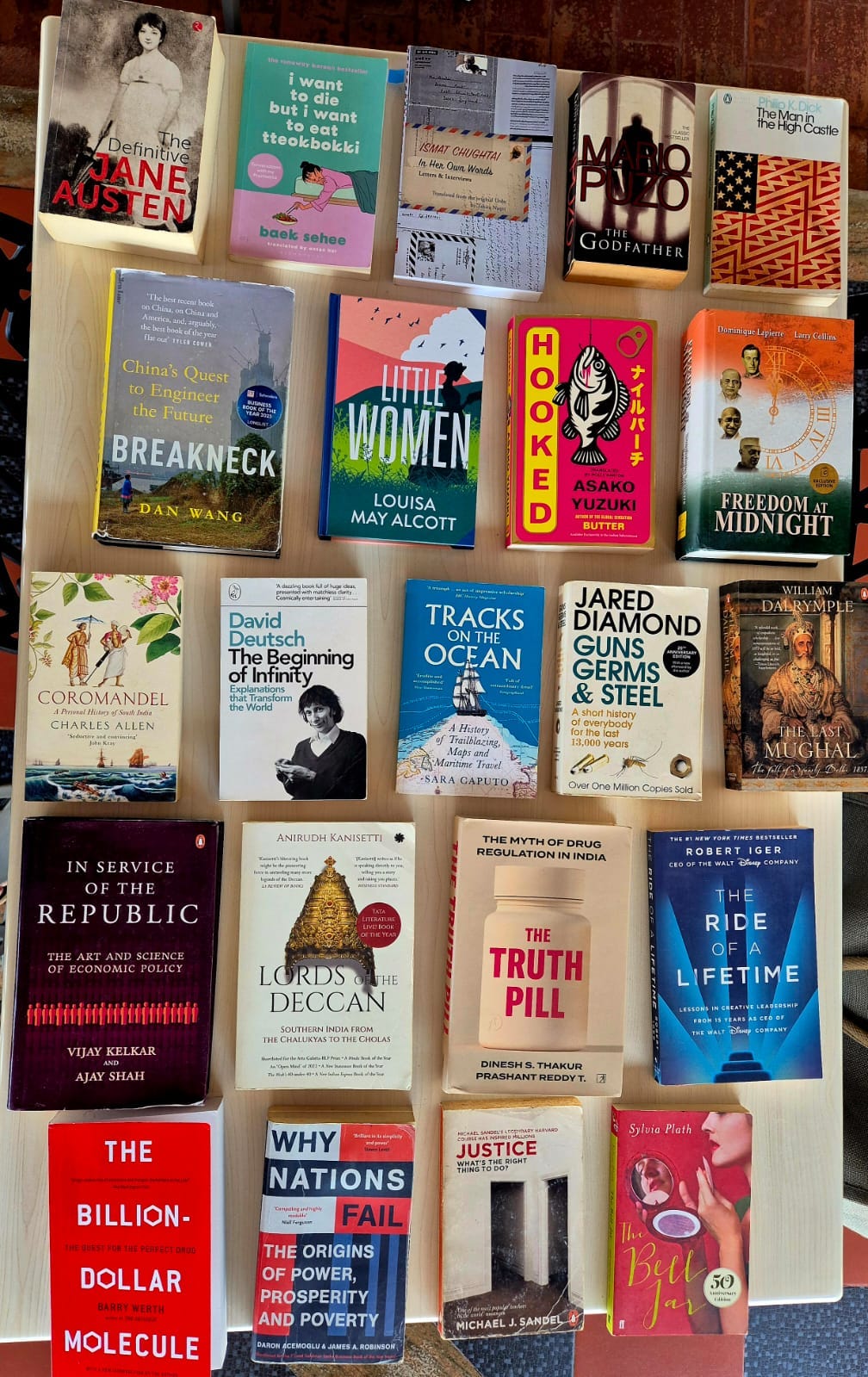
It’s become a weekly refill for our reading habits. It’s also become a great spot for many of us to talk to each other, bond over ideas, form friendships, all without being distracted by any screen.
If you’d like to attend the reading club, please drop a line to pranav.agarwal@zerodha.com!
Your contrast between AI 2027 as a takeover scenario and AI 2040 as a question of cooperation stayed with me. I write science fiction about systems, human agency, and moral responsibility; my novel Cradle explores those questions aboard a generation ship. If fiction fits the kind of reading you invite, here’s a short English excerpt: https://digitalgekko.substack.com/p/cradle-probably-my-best-novel-yet