

Hello there, hope you’ve had a great week!
We started Markets because we, a bunch of nerds within Zerodha, were constantly suckered in by weird, fascinating ideas. We read widely, and weirdly, and then eat people’s heads about our newest preoccupations. Some people seem to like the links we send them (even though more people let our recommendations sit, unread, in their Whatsapp chats). And so, we thought we’d start sharing them with the wider world.
If this is the sort of stuff you like chatting about, come catch us at our weekly book club. More on that at the end!
We’re always hungry for more links by the way. If there’s anything that you want the world to read, drop a link in the comments.
The Ken, The FMCG Company in a Cigarette Pack: ITC (link): Full disclosure: Zerodha funded this series. But honestly, we only did it because it’s the kind of thing that really should exist. Their story begins all the way back at tobacco, the plant, and how it first took root in Central America. From there, they unleash a gorgeous tale, tracing ITC through the eras — from the British era, where it sent salespeople to teach Indians how to smoke a cigarette, to independent India, and how they pioneered market research, to how the company moved away from its nicotine-stained origins into new industries, from hotels to biscuits. Don’t just listen to the podcast, by the way — make sure you check out their gorgeous microsite.

Palak Shah, The Night SEBI Forgot I Was A Journalist (link): This piece may well have been called “The Night I Forgot They Were SEBI”. Read it not for what it teaches you, but for a sense of who regulators are as people, at a party, once the mask of authority slips off and they seem ordinary. You could recognise them from your own life: the friendly one, the guy with an embarrassing story from another party, the one that listens closely but rarely talks, all letting their hair down.
Anthropic Frontier Red Team, Patterns and problems in emerging multiagent systems (link): Artificial intelligence repeatedly teaches us how our own intelligence works, by making us confront alien modes of thinking. Here’s one example from Anthropic: as agents gather in swarms, we’re learning how poor they are at coordinating with one another. Perfectly well-meaning agents, gathered in teams, start failing in surprising ways. Sometimes, they trust each other too easily. Sometimes, they’re overly combative. There’s something important hidden in the human experience of different people learning to work together, which we can’t seem to replicate virtually (at least so far).
Tyler Cowen and Sonia Farrell Pearson, Capitalizing Untethered AI Agents (link): There are some things we can say, with a fair degree of confidence, will be true of the future. A society where AI agents do a lot of work is functionally like a society made of psychopaths — where accountability is hard to enforce because agents hardly care about anything. But what if you could give agents something to lose? What if you could turn AI agents into persistent entities with assets, which could legally be deducted if the agent misbehaved in some manner? Could this be more effective than merely trying to train models to be good?
Tim Fist and others, 23 low-regret recommendations for AI policy (link): AI safety discourse, especially since the OpenAI-Huggingface incident, appears deeply polarised. Two camps have opened out — one, which seems to accept any drag on progress for safety, including a complete shutdown, and another, which treats all safety measures as luddism. In a guest post on Noah Smith’s blog, however, various authors come together to suggest a middle course: from required reporting of risks, to creating additional capacity in the government to understand and respond to AI, to creating public hardware testbeds. These aren’t flashy proposals, and you might not agree with all of them (I don’t), but they’re worth a read.
Nabeel S. Qureshi, How To Understand Things (link): What pushes someone to understand something — not to merely flirt with an idea, as a dilettante, but to feel it in your bones? To Nabeel, one’s ‘intelligence’ doesn’t come from their raw intellectual capacity alone, but from their habits. It is instead a virtue; a commitment to understanding. There’s an honesty to chasing ideas doggedly until you understand them, even at the cost of seeming stupid or obsessive. This isn’t convenient. If you really want to understand something, you must often take in raw, inconveniently messy information, and from there, reason your way all the way to understanding. But that is where clarity and truth comes from.
Henrik Karlsson & Johanna Karlsson, Cultivating a state of mind where new ideas are born (link): Ideas, even great ones, begin in a weak state of infancy. The world has an instinct for ideas that feel intuitive; this kills terrible ideas, but also radical-but-important ones. New ideas, then, need space — away from others, away, even, from one’s own instinct to self-censor — to solidify. One needs solitude, often spent pondering over unique questions, wading through confusion, inventing little rituals to keep ideas protected, before great ideas come to you.
Kostis Kiriakis, A Day At The Park (link): Spiritually, this resembles the last piece by the Karlssons, although the medium is different. This is a comic strip. Two creatures meet in a park, both collectors. One collects questions. The other collects answers. They mock and challenge one another, but the discussion isn’t really about their discussions, but about how you, dear reader, should live your life. Give it a look!
Krzysztof Tyszka-Drozdowski, Latin Empire (link): Global culture is suffering from a vacuum. The world’s wealth centres have middling cultural output. The West is in decline. China punches below its weight. Where does the next wave of great art come from? To Krzysztof, Latin America may be an interesting place to watch. On one hand, pro-growth policies are picking up steam, and it is wealth centres where art usually flourishes. On the other, Latin America has a penchant for leisure that is missing in so much of the world. Will this come true? No idea. But I’m curious.
Adam Mastroianni, I like ‘em thick (link): What makes art great? My father once told me that great books reveal something new every time you return to them. Adam gets to something similar, when he talks of the “thickness” of a piece of art. Great art, he says, rewards attention and care. The more you try to unravel it, the more depth it reveals to you. This sort of work isn’t for everyone. It’s hard for those addicted to Reels (as I am) to appreciate Dostoevsky. Those that do, however, may find themselves moved endlessly by a single paragraph, or even a single line. What does this mean for the art of our coming AI era?
Our reading club is filled with interesting ideas!
Do you like talking about interesting, offbeat ideas like these? Then come join us at our reading club!
Every Saturday morning, we gather on a rooftop in our little corner of JP Nagar, unplug from the world, and read. There’s tea, coffee, and sandwiches, and if you don’t have a book of your own, our little rotating mini-library as well. Here are the books we brought out last week:
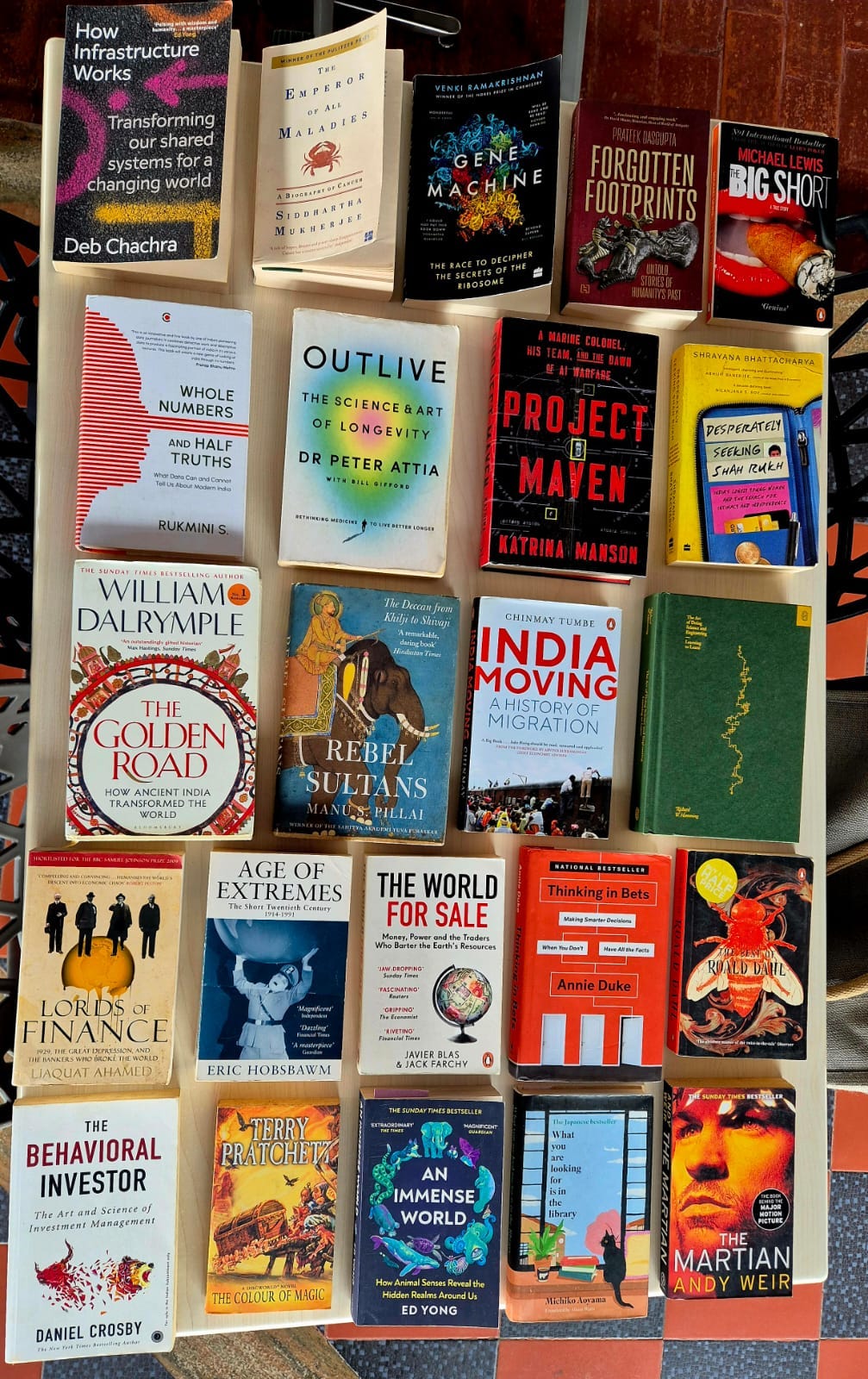
It’s become a weekly refill for our reading habits. It’s also become a great spot for many of us to talk to each other, bond over ideas, form friendships, all without being distracted by any screen.
If you’d like to attend the reading club, please drop a line to pranav.agarwal@zerodha.com!
hie team, if we can get summary of book which are interesting it’s helpful