
What we’re reading #24
10 reads for the week

Hello there, hope you’ve had a great week!
We started Markets because we, a bunch of nerds within Zerodha, were constantly suckered in by weird, fascinating ideas. We read widely, and weirdly, and then eat people’s heads about our newest preoccupations. Some people seem to like the links we send them (even though more people let our recommendations sit, unread, in their Whatsapp chats). And so, we thought we’d start sharing them with the wider world.
If this is the sort of stuff you like chatting about, come catch us at our weekly book club. More on that at the end!
We’re always hungry for more links by the way. If there’s anything that you want the world to read, drop a link in the comments.
Ajay Shah, The journey of Indian finance (link): Indian finance used to be under the strict control of the state; in fact, the state treated it as one of its main instruments to shape India’s economy. This had to change as we liberalised. Old state monopolies had to retreat, as private firms entered sectors ranging from banking, to insurance, to securities. The pace of this retreat varied. In some sectors, while the state ceded ownership, it maintained control through tight regulation. A striking exception, to Shah, was the equity market: where India evolved an incredibly effective set of institutions — something that Shah himself worked on — and then permitted the market to do the rest. This is a fascinating story, and essential reading for anyone interested in finance.
Douglas Irwin, Dismantling the license raj: The long road to India’s 1991 trade reforms (link): Consider this a prequel to the last one. In a magisterial account, Douglas Irwin takes you through India’s economic journey before liberalisation. It begins at the point of independence, and then snakes all the way through, to Manmohan Singh’s 1991 reforms. There are seminal moments, in this journey, that you may know very little about: how the License Raj started, why India is so traumatised by the rupee falling, or the fiery backlash that came with liberalisation. If you want to understand why our country looks the way it does, this is a good place to start.
Sam Harsimony, Tech I’m skeptical of and why (link): Most technological breakthroughs, before they happen, seem like absurd, misguided ideas. That is why, perhaps, nobody else attempted before. Then again, the absurdity of an idea is no guide to its success, and there’s a lot that a timely critique can improve. Sam has excellent mental models for how to assess a wild idea — like the “idiot index”, a heuristic to extrapolate how much something would cost, if you knew the price of its underlying raw material. Using these, he details his skepticism around all the deeply hyped ideas of the day: from space data centres, to fusion energy, to quantum computing. This isn’t an invitation to reject them, just one to be a little more clear-eyed in why one supports them.
Leah C. Stokes, Bidenomics Was More Successful Than People Think (link): Conventional wisdom tells you that Biden was terrible for America’s economy, and moreover, did little for the Democrat’s political agenda. At first glance, that seems obvious. They lost the elections, after all? But that flattens a lot of the world’s complexity into a simple win-loss binary. But Stokes’ research indicates that Biden’s policies did, in fact, give them an electoral bump — just not enough to win. Those same policies also proved to be surprisingly resilient: surviving many Trump-era cuts. For all the bad name laws like the Inflation Reduction Act attracted, it looks like the core idea — of pulling in investment into future-oriented industries — might have made sense after all.
Tim Harford, Nudge or tax? At last, some data (link): Imagine you’re a policymaker that wants people to stop smoking (while staying within your constitutional limits, that is). You have two options: one, you can try the more coercive approach of adding a tax to smoking; or two, you can nudge them off cigarettes, for example by telling them exactly how horrible the consequences could be. What is better? Economists have been debating this for a while, but finally, it looks like there’s some evidence. Turns out, if you’re interested in getting the most bang for your buck, nudges are the way to go. But they have a ceiling. For the most absolute impact, taxes are still your best bet.
Chia Jen Yang, An introduction to RAG and simple / complex RAG (link): You’ve probably used AI to sort through huge masses of documents by now. A simple use would have told you this: the models don’t hunt for keywords any more, the way the old search engines did. Then what do they do? Well, many use what’s called ‘Retrieval-Augmented Generation’, or RAG: breaking documents into little chunks of meaning. This allows it to go a step beyond search engines, carrying out chains of reasoning in how it searches. This is admittedly a little dry, and I had to ask ChatGPT to brutally infantilise me until I got through it, but check it out if you’re curious about how the new world works.
Nathan Tankus, “*Sigh* No Ed Zitron, AI bond issuance is not AI’s “Subprime Mortgage Crisis” (link): Journalist Ed Zitron would tell you that the AI data centre build-out is creating a massive credit bubble. If the core thesis doesn’t pan out — if AI earnings don’t come to justify these spends — it could trigger the next financial crisis. Tankus pushes back, however. He doesn’t deny that the investments are large. But to him, they’re being made by enormously cash-rich big tech companies, which can afford to take a few punches. That isn’t to say the investments won’t go wrong. Only, it isn’t entirely clear if there are pathways through which a failed investment boom could infect the wider economy, and drag it into collapse.
Claudio Borio and Piti Disyatat, Global imbalances and the financial crisis: Link or no link? (link): There’s a popular story: that the world’s savings caused the 2008 financial crisis. The world’s savings, the argument goes, created an infinite spigot of money in the United States — with which the country funded its housing boom. When that house of cards collapsed, destruction followed. In this 2011 paper — part of one of BIS’ major bodies of work — Borio and Disyatat tried to break this story. They argue that this story comes from a simplistic view of money, almost as a barter system with extra steps — which makes “too many savings” sound intuitive. What really happened, to them, wasn’t an imbalance in the real economy, but from the weirdness that financial and monetary systems created. If that’s true, it completely changes the lessons to draw from that crisis.
Tara Tan, What Deepseek isn’t doing (link): If Tan is to be believed, Deepseek does not want users. They want AGI. To founder Liang Wenfeng, the small number of users they can attract, and the revenue that they can create right now, are hardly a prize worth competing for. Their goal is more interesting — to get as close to the frontier as possible with one-twentieth the cost, and then ride the lift-off to AGI. Everything else is secondary, business considerations included.
Julian Waller, After Putin (link): There shall be a time, perhaps not far from now, when Vladimir Putin will no longer rule Russia. It isn’t clear what comes next. The system that helped him maintain an iron-grip on Russia, all these years, has kept Russia from developing a new generation of leaders. Now, he shows no signs of having planned his succession, even as his allies are all aging. Expect then, that as he leaves, a mad-dash for power shall follow. But this leaves entire generations that have never had a shot at real power. What does that mean for the country’s future?
Our reading club is filled with interesting ideas!
Do you like talking about interesting, offbeat ideas like these? Then come join us at our reading club!
Every Saturday morning, we gather on a rooftop in our little corner of JP Nagar, unplug from the world, and read. There’s tea, coffee, and sandwiches, and if you don’t have a book of your own, our little rotating mini-library as well. Here are the books we brought out last week:
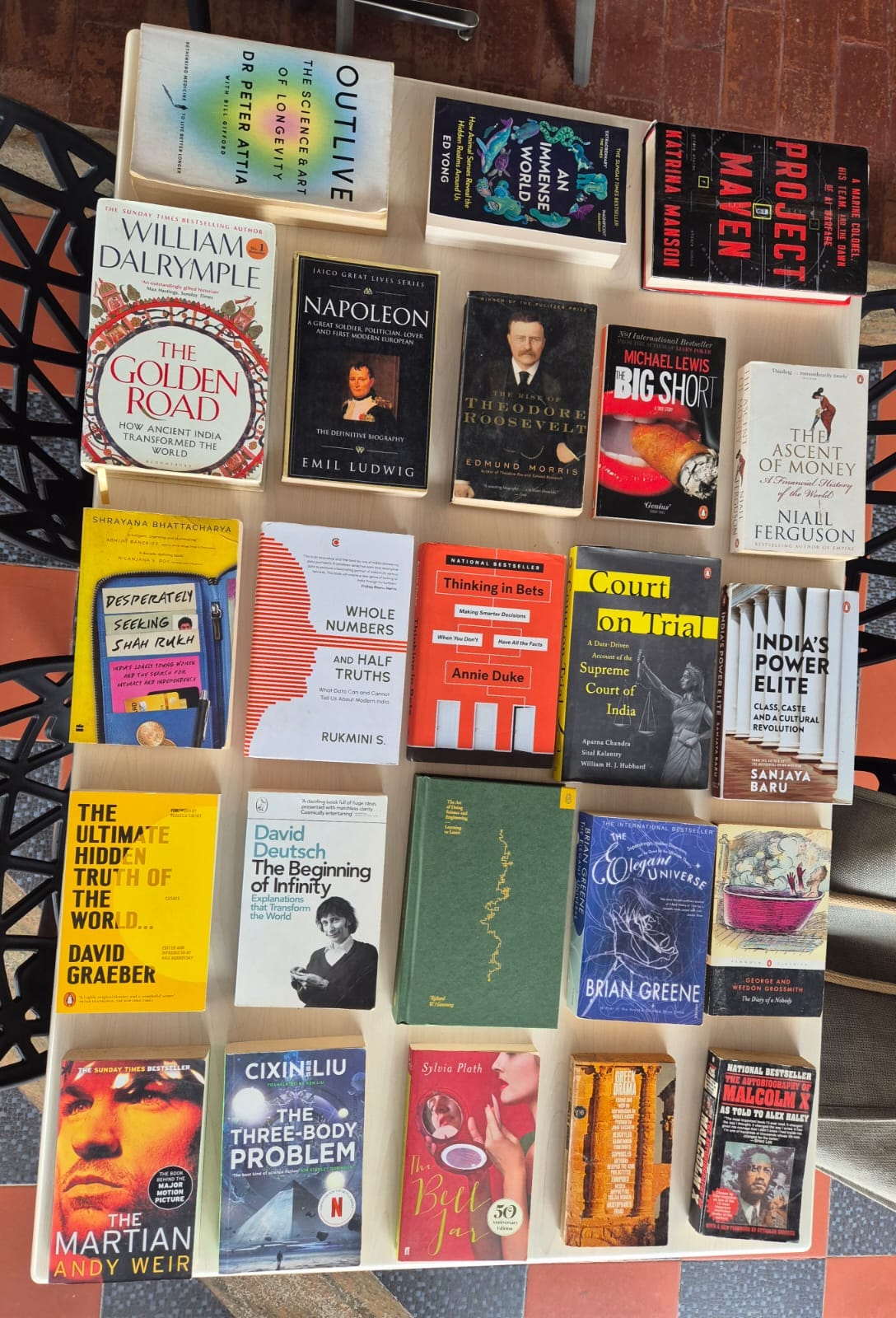
It’s become a weekly refill for our reading habits. It’s also become a great spot for many of us to talk to each other, bond over ideas, form friendships, all without being distracted by any screen.
If you’d like to attend the reading club, please drop a line to pranav.agarwal@zerodha.com!