
What We're Reading #21
Homer's Odyssey, open-source AI, Game of Thrones, dollar power, parmesan cheese, unlimited economic growth, and luck.

Hi folks, hope you’ve had a great week!
Our team at Markets is always reading, often much more than what might be considered healthy. So, we thought it would be nice to have an outlet to put out what we’re reading that isn’t part of our normal cycle of content.
So we’ve started “What We’re Reading”, where every weekend, our team outlines the interesting articles — even books — that put our brains in seventh gear (if that even exists).
We also host a book club every Saturday that we talk about at the end. If you’d like to read with us, please feel free to join!
We’d also love to know what has piqued your interest, too! Please feel free to let us know in the comments.
What Krishna is watching/listening
Troy (link)
The Odyssey: Hero of Trojan Horse (link)
Like everyone else, I’m excited for Nolan’s Odyssey and can’t wait to see what he does with it. On Twitter I saw a bunch of people recommending watching Troy before the movie releases, so I did. In parallel, I also came across The Rest is History’s two-part podcast on the Trojan War. I’ve finished part one and it pairs beautifully with the film.
First things first, Troy is easily one of the best movies I’ve watched in a very long time. I’d always heard the names growing up, Achilles, Odysseus, the Trojan Horse, but they never really meant anything to me because I had no context for any of it. The movie fixed that.
It isn’t centered on Odysseus specifically, though he has a very important part to play. It’s really the story of Achilles, the greatest warrior to have ever lived, and how the Greeks unite to attack Troy. And all of it happens because of one single event: Paris, the prince of Troy, brings home Helen, supposedly the most beautiful woman on earth and the wife of the Greek king Menelaus.
That one act triggers the entire Trojan War, with all the Greek kings coming together, Odysseus included, sailing to Troy to bring her back.
But if you combine the movie with the podcast, you get so much additional context, not just about the war itself but the smaller human stories inside it. My favourite is how Odysseus never even wanted to go to war in the first place.
He just wanted to stay home in Ithaca with his wife Penelope and their infant son. So when they came to recruit him, he pretended to have gone mad, ploughing the beach like a lunatic hoping they’d leave him alone. They called his bluff by placing his baby son right in the path of the plough. Odysseus had to swerve to save him, which proved he was perfectly sane, and off to war he went.
And then of course there’s the Trojan Horse itself, myth or reality, you’ll have to listen to the podcast to find out.
Part one ends with the war over and Odysseus simply trying to get home, cursed at every turn, going through unimaginable things just for the chance to see his family again.
What Pranav is reading
David Siegel, I argued with the father of open source for 2 years. Now the AI fight is the same — only bigger (link)
As a lawyer, but one born into the digital era, intellectual property rights always struck me as having shaky foundations. Of course, nobody likes their work copied, and nobody certainly wants others to make money off one’s ideas. But the core justification — that a society, to innovate, necessarily needs a long, rigid, statutorily defined “hands off!” period where anyone can be sued into smithereens for using anything resembling your idea? That always sounded like it was based on a dogma.
After all, the internet, that wellspring of endless innovation, exists because of open source.
Siegel writes of a different era — the 1980s — where this fact was not so obvious. He describes arguing endlessly with Richard Stallman, the man that pioneered the idea of open source software. To him, back then, it may have seemed obvious. Software could only grow if companies could profit from making it. To give people the ability to copy it, tinker with it, or modify it was worse than hippie nonsense — it was a security disaster. Ultimately, though, Stallman won the debate. Not by constructing the most elegant argument, that is, but by spawning an endlessly energetic movement that birthed so much innovation in the real world.
The internet has since been partitioned and occupied. Proprietary platforms have colonised large parts of it, not because they were more innovative, necessarily, but because that’s what the economics rewarded. AI, when it was born, came into a closed world, with single companies and individual executives exerting overwhelming control on its trajectory.
That wouldn’t be the problem if there were other models that were completely open, and the world could learn from and contribute to them. In fact, the enormous scale of frontier models can perhaps only come out of a closed system, where enough money can accumulate to fund titanic build-outs. But this is now the only paradigm. Even “open weight” models run on software that is hidden. They let you see an enormous range of numbers in a database, but no more.
What do we miss, in this world? That is what David pushes you to consider.
George RR Martin, Dying of the Light (link)
In a break from regular programming, I’m going to talk about some fiction.
Dying of the Light is the first novel by George RR Martin, who you probably know from the A Song of Ice and Fire (Game of Thrones, if you’re a normie) series. Even in that first book, you can see his genius. He has a knack for creating rich worlds — where histories believably shape cultures, and cultures believably shape people. In his worlds, you feel like you could step out of the story, shake off the words that bind you in place, and go exploring — as though there’s more just around the corner.
The book plays out on a rogue planet, Worlorn. For a few brief centuries in its lonely, starless existence, it transitions past a multi-star system, and becomes habitable. The nearby planets — the “outerworlds” — terraform it and colonise it, knowing fully well that this brief interlude shall come to an end. It is a wasteful exercise. It is hubristic. It is still beautiful, however, despite its impermanence.
But now, the planet is drifting back out into the darkness. The light is dying. Life is fading. The characters you meet, the environs you see, all of them are ghosts of civilisations past. They have their stories — desires, challenges, tragedies — but these play out in the deeper melancholy of a world passing into ruin.
The book was published fifty years ago, in 1977. Its fate, now, mirrors the planet it’s set in. It feels forgotten. There’s no shared built experience around it — no fan art, no theories, no online communities, no fan fiction. Perhaps its cities and characters were once alive in the imagination. Now, they’ve collapsed to a handful of forgotten paragraphs on a dusty bookshelf.
And yet, there remains a ghostly beauty to it.
What Kashish is reading
Naomi Klein, Hot Money (link)
I’ve only read about half of Hot Money so far, but it’s one of the more sensible books on climate I’ve come across.
A lot of climate writing tends to oscillate between fear-mongering on one end and techno-optimism on the other. Naomi Klein doesn’t entirely escape having strong views, but the economic arguments she makes are thoughtful enough that they’ve kept me reading.
The broader argument of the book is that our economic system has become deeply dependent on perpetual growth. She traces how globalization and ever-expanding international trade have dramatically increased emissions, but argues that these are really symptoms of a deeper problem: we’ve built an economy where “more” is almost always considered better.
What particularly stood out to me, though, was this passage.
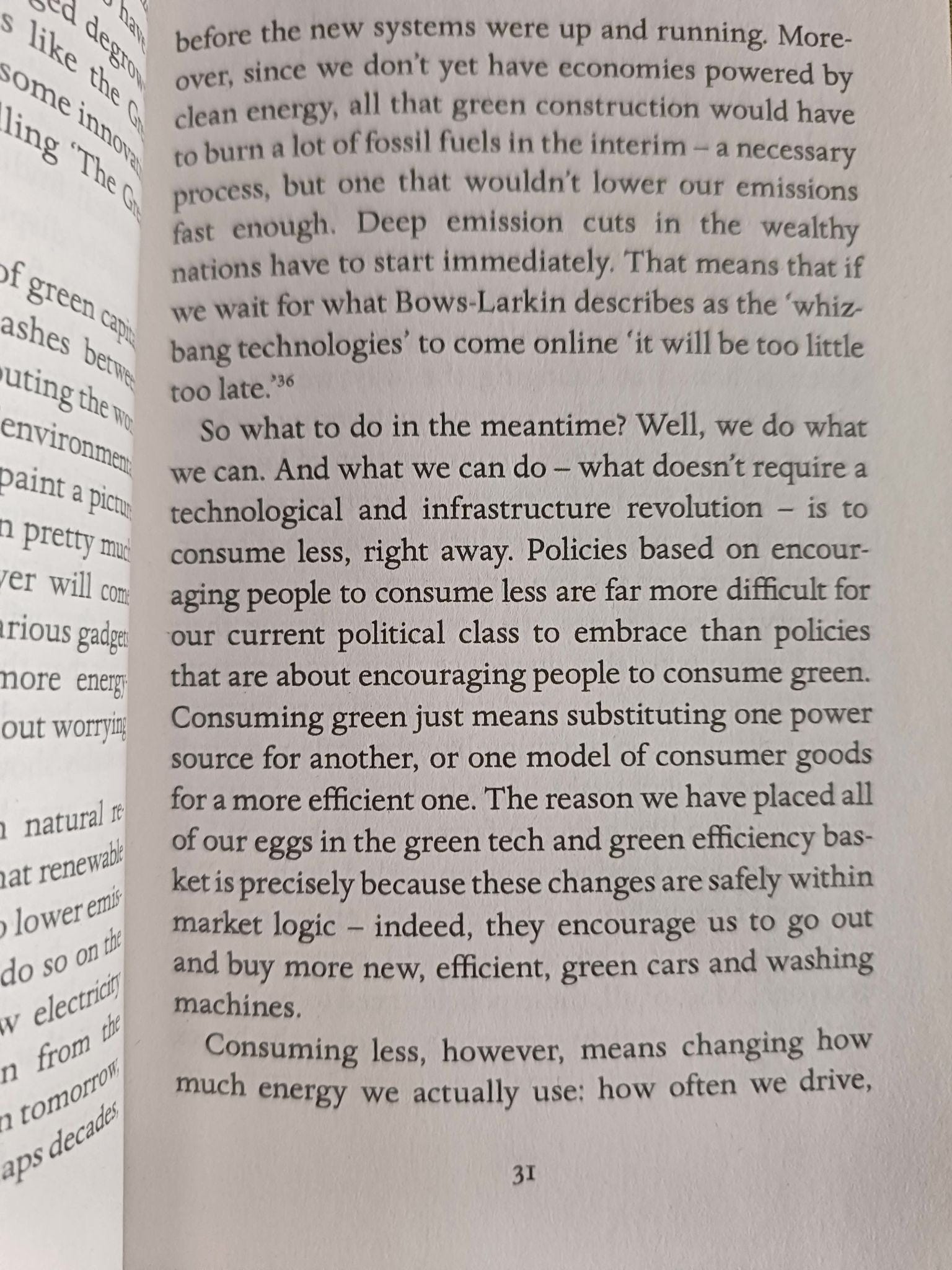
One of the dominant ideas in climate policy today is that we can largely solve the problem by consuming green instead of consuming less. Buy an electric car instead of a petrol one. Replace your old appliances with energy-efficient ones. Install solar panels. In other words, keep consuming—just make sure what you consume is greener.
Klein argues that while this certainly helps, it doesn’t address the underlying issue. If affluent societies continue to consume ever more resources, even greener consumption has limits. The harder conversation is whether richer countries need to simply consume less.
She also makes an interesting political observation. Encouraging people to buy greener products fits neatly within our existing economic model. Encouraging people to buy fewer things altogether does not. One supports growth; the other challenges it. Unsurprisingly, the former is a much easier political sell than the latter.
I’m only halfway through the book, so I don’t yet know whether I’ll end up agreeing with all of her conclusions. But I do think it’s a refreshing perspective. Even if you disagree with the idea of “degrowth,” the book forces you to ask whether technology alone can solve climate change, or whether consumption itself deserves more scrutiny than it usually gets.
What Bhuvan is reading
The Economist, Storm clouds gather over America’s financial supremacy (link)
For the last three to four years—especially since Russia’s invasion of Ukraine—”de-dollarization” has been the hottest topic of discussion in macro circles. But as the old saying goes: de-dollarization shows up everywhere except in the data.
It is not that countries don’t want to move away from the greenback. The only slight, tiny problem? There is no viable alternative. So, that’s the imperfect world we are living in.
That being said, I recently read a fascinating piece in The Economist that highlights where the real shift is actually happening. While countries can’t ditch the dollar, they are making substantial progress in reducing their dependence on US-controlled payment systems like Visa, Mastercard, and SWIFT.
I hadn’t realized just how much progress was being made on this front. From Brazil and Europe to China and Russia, nations are actively building workarounds. As the article notes, we may be heading into a future where the world’s financial settlement architecture splinters. We are watching regional arrangements take shape, driven entirely by a growing animosity toward the capriciousness of the US-based financial architecture.
The Irony? This move toward financial self-sufficiency will likely increase global financial frictions and completely stall the progress the world was making in reducing remittance costs.
Weird times we live in.
What Kulsum is reading
Why climate change is putting parmesan at risk (link)
Many premium foods exist only because of the specific local conditions in which they are produced. Champagne comes from France, Kona coffee from Hawaii, and similarly, Parmesan exists only in Italy. Their climate, geography, and traditional production methods are such an integral part of their identity that these products cannot simply be replicated elsewhere.
Now, because of climate change, the Parmesan cheese industry is being affected deeply.
Authentic Parmigiano Reggiano (Parmesan) can only be produced in a small region of northern Italy. The rules are extremely strict: the cows must be raised in that specific region, they must eat locally sourced grass and hay, and the cheese is made using just milk, salt, and rennet before being aged for at least 12 months.
This entire process depends on specific environmental conditions. But with frequent heatwaves and ongoing climate change, temperatures in the region have been rising above 40°C regularly, creating major challenges for producers.
The rising temperature is not only affecting the storage of cheese, but also the cows themselves. Heatwaves often bring drought, which means less rainfall, poor grass growth, and lower hay production. As a result, farmers cannot harvest enough fodder and the cows end up being underfed. Since the rules for making Parmigiano Reggiano do not allow farmers to simply buy fodder from elsewhere, they have very limited options.
To cope with the heat, many farms have installed industrial fans and water-misting systems, but these consume large amounts of electricity. Even after the cheese is made, it must be stored at controlled temperatures for one to three years, requiring even more energy. One major storage operator has said that electricity usage has risen by around 30% because of the additional cooling.
Now, why does this matter?
Beyond the welfare of the cows, Parmesan is a €4.5 billion industry, with more than half of its production exported globally. If climate change reduces milk production while electricity and farming costs continue to rise, producers will face both lower output and higher production costs.
This eventually means lower profits for farmers and more expensive Parmesan for consumers. What appears to be an environmental problem is also becoming an economic risk for agriculture, regional industries, and global food exports.
What Mridula is reading
Fluke by Brian Klaas (link)
We often tell that every outcome can be backed up with a clear cause but fluke challenges that angle. Many might explain the world as if every major event was inevitable, but Brian Klaas argues that chance plays a far bigger role than we’re willing to admit. Rather than seeing history, careers, or success as chains of cause and effect, he tells us how small, seemingly insignificant events can create consequences that ripple beyond what anyone could have predicted.
Fluke isn’t really about luck it’s about humility. We naturally build stories that make the past feel predictable, but the book reminds us that multiple alternative outcomes were always possible.
It has changed the way I look at outcomes now. Instead of asking why something was destined to happen, I now started wondering how many other paths could have unfolded.
We have a book club!
Here’s another reminder of something that we’re pretty bad at advertising: our book club.
So here’s an image of our fairly-impressive book collection to attract you. Yes, they’re not just for show, and we do read them, alongside some coffee/tea and sandwiches.
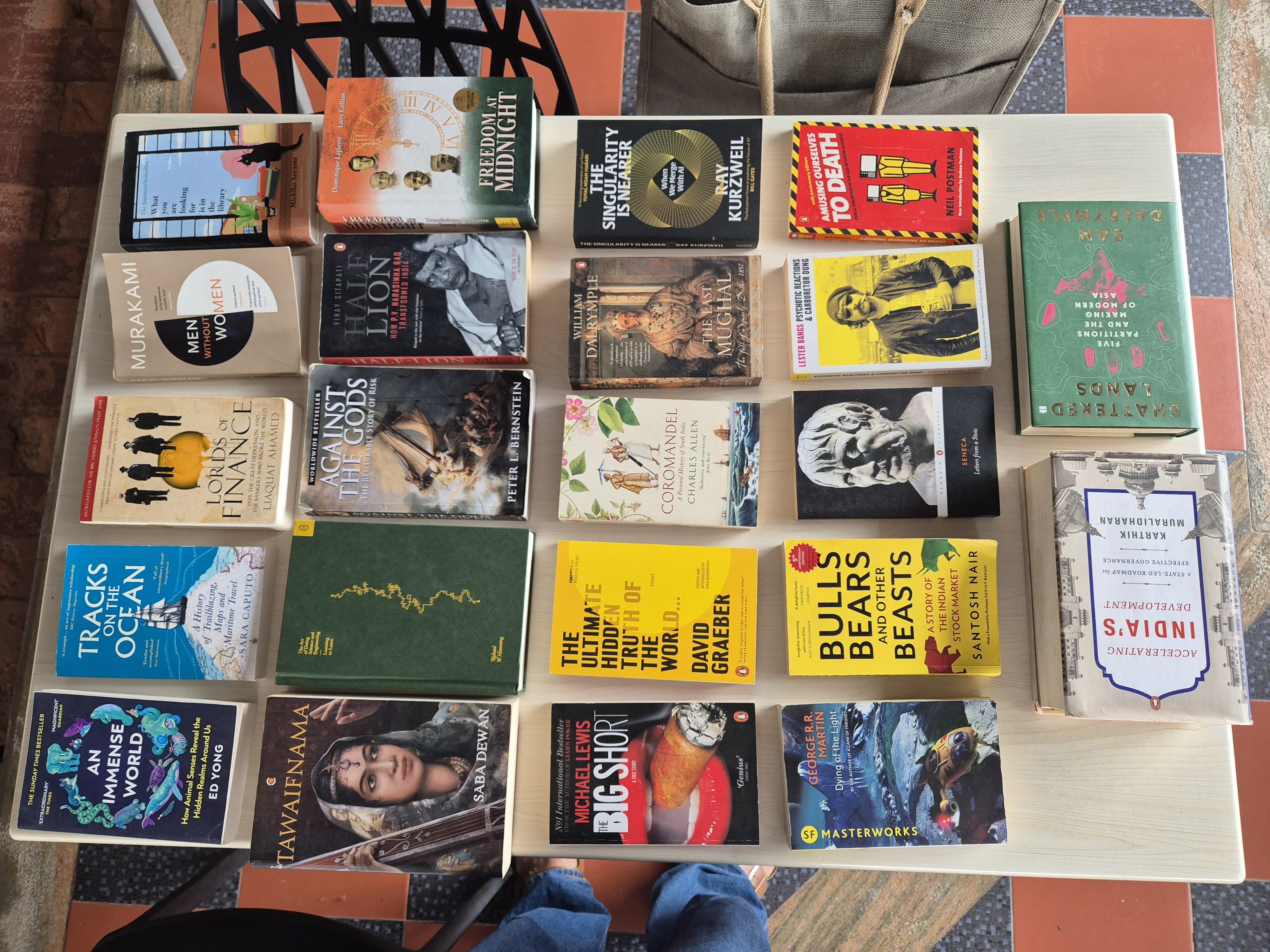
The Markets book club has been running for nearly a year. We have some avowed loyalists who come almost every weekend and nerd about their readings with us. But really, it’s become a great spot for many of us to talk to each other - even forge new friendships - without being distracted by any screen. It’s this in-person community that we’re really proud of building.
So, we’d love for you to join us! We host the book club every Saturday, 10:30-1 pm, in JP Nagar 4th Phase. Unfortunately, this location is fixed - we understand JP Nagar may be far for some. But this is the only place where we can host it smoothly. And we don’t host sessions online, either.
If you’d like to attend the book club, please keep the above in mind, and please reach out to: pranav.manie@zerodha.com!
Really curious to read Fluke - as someone who has dabbled with models examining species evolution (random chance ie. drift vs. forces of selection), I would be inclined to see what this book highlights in other spheres.
And YES, super excited to watch the new Nolan!