
What We're Reading #19
How QR codes began, the economics of compressed biogas, James Bond, and how Morocco built an auto industry

Hi folks, hope you’ve had a great week!
Our team at Markets is always reading, often much more than what might be considered healthy. So, we thought it would be nice to have an outlet to put out what we’re reading that isn’t part of our normal cycle of content.
So we’ve started “What We’re Reading”, where every weekend, our team outlines the interesting articles — even books — that put our brains in seventh gear (if that even exists).
We also host a book club every Saturday that we talk about at the end. If you’d like to read with us, please feel free to join!
We’d also love to know what has piqued your interest, too! Please feel free to let us know in the comments.
What Krishna is listening
Unsung Science, The Man Who Invented QR codes (link)
Last week in the reading edition, I mentioned I was listening to the Intermission episode on Bajaj Finance. I finally finished it after a long time, and it’s genuinely good — not just about the business, but about the people behind it, how obsessive and meticulous they were. It left me thinking that in most companies, the people are the business model, not the other way round. But that’s a separate thought.
Coming to the topic: in that podcast, Rohin mentioned that QR codes were invented by a man named Masahiro Hara. I looked him up and found a podcast episode where he tells the story himself, and it’s a great listen.
A few things stood out. First, QR codes are barely thirty years old, which is hard to believe given how much we depend on them today — you couldn’t get from point A to B in most Indian cities anymore without one. Hara worked at Denso, a car-parts subsidiary of Toyota, and the idea came to him during a lunch break in 1993, while he was playing Go, the Chinese board game. The two-dimensional grid of black and white stones on the board was the spark — he realised a barcode didn’t have to be a single line of stripes, it could be a grid.
The problem with regular barcodes was that they were one-dimensional: scratch them, tilt the scanner at the wrong angle, and they wouldn’t read. A two-dimensional code fixed that — it could be read from any angle, at any distance, and would still work even if a third of it was damaged or covered.
It took about twenty years for QR codes to catch on in India, with Paytm leading the charge around 2015-16 pushing QR payments at scale. And in the decade since, it’s become the backbone of how the country pays for things.
Worth a listen if you want to hear Hara describe the whole arc himself — including how his bosses weren’t impressed for the first six years.
What is Kashish watching?
Gobardhan, SATAT, and the economics of compressed biogas (link)
I stumbled upon this video while trying to understand the Gobardhan scheme, mostly because I was confused about how it differed from the SATAT scheme, which we had covered earlier.
It turns out the two aren’t really competing schemes. Gobardhan has increasingly become the umbrella under which India’s compressed biogas (CBG) ecosystem is being built, while SATAT is one of the mechanisms that creates demand for that gas.
That led me down a rabbit hole on the economics of the industry, and I found the underlying problems much more interesting than the policy itself.
The biggest one is geography. Biogas plants have to be located close to feedstock—crop residue, cattle waste, municipal waste, and so on—because transporting raw waste over long distances simply doesn’t make economic sense. But the demand for gas is concentrated in cities. Bridging that gap isn’t easy. Either you inject the gas into a pipeline network, which many plants don’t have access to, or you transport it in cylinders, which creates another logistics problem altogether.
Then there’s the question of pricing.
Compressed biogas is generally more expensive than conventional natural gas, which means city gas distributors and oil marketing companies have little incentive to buy it purely on economics. It becomes attractive only when fossil fuel prices spike or because blending mandates require them to procure it. That’s an important reminder that not every clean-energy technology succeeds because it’s the cheapest option from day one.
Finally, unlike many commodities, CBG doesn’t lend itself to a neat national price. A plant connected to a gas pipeline has very different economics from one trucking cylinders hundreds of kilometres away. Feedstock differs. Logistics differ. End markets differ. The economics are intensely local.
The video itself is fairly introductory, but it sent me down an interesting line of thinking. Sometimes the hardest part of the energy transition isn’t building the technology but figuring out the logistics and market design that make the technology economically viable. And compressed biogas is a great example of that.
What Manie is playing / reading
IO Interactive, 007: First Light (watch the review)
In all fairness, I use this IP to tell you about the fun things I can’t tell you about anywhere else on Markets. I enjoy playing video games, I believe they can be very informative as long as you don’t skip the story, and I’ve promoted one game before.
I will use this edition to promote another game today. It’s probably wrong of me to do so, but hey, if I can convince you why there’s educational material in this, why not?
IO Interactive is the game studio behind the legendary Hitman series, where you’re Agent 47, and you have a million creative paths at your disposal to kill one person in each mission. You may have even spent a good part of your childhood playing editions like Blood Money, Contracts, and Absolution.
The same studio is at the helm of the newest James Bond game in more than a decade. Having received the rights from Amazon, they decided to put their own spin on the storied British spymaster. I just finished the game, and it is, as they say, absolute cinema.

But I don’t talk about this game unless it has something relevant to say about the world today. And, believe it or not, despite the reputation of the franchise being one of not being realistic enough, this has plenty of commentary on the use of AI in espionage.
I won’t spoil the story much, but in this game, espionage is also grappling with the division of labor between human spy agents and AI agents. There’s talk of an all-seeing, all-knowing machine, made by a private British company, which MI6 supposedly uses to call airstrikes, drone strikes, and sometimes send human spies to get jobs done. You know, a lot like the Pentagon and Palantir.
But espionage is also a profession where craft couldn’t be more important. How do you act under pressure? Can you create an opportunity out of thin air when new constraints arise? How do you make hard choices which have no right answers? Can you make both those choices, or do you die trying?
On the other hand, what if the AI makes mistakes?
Say you’re examining an area that’s only suspected of some sort of criminal activity, and the AI determines a high 90% probability that someone it has surveilled is a terrorist, on the basis of which it recommends that you pull the big guns out.
But a probability is still short of a definitive answer. If we regular humans work with LLMs and it hallucinates with its answers, it doesn’t really mean the end of the world. But in the world of hidden maneuvers and secret killings, if it’s the other 10% which ends up being true, then you’ve made the gravest mistake of murdering a civilian. You can never come back from that stain on your clandestine organization.
To be sure, this sort of accident has likely happened without AI too, but that doesn’t excuse the role of a superintelligence in potentially amplifying this problem manifold.
And say that mistake happens anyway with this AI. What is the role of the private company that helped you build this machine, and is responsible for its entire maintenance and operations? And since it isn’t in their financial interest to stop this, what do they do next?
Some of these seem like they might be hypothetical situations in a different world. But that’s what espionage is: a different, often disgustingly ugly world where power is the only language. And fiction is usually a by-product of the world we currently inhabit, or might do so in the near future. First Light has done a great job of getting you to deal with those questions.
Vizier, How Morocco Built an Automotive Industry from Scratch (link)
The world’s automotive industry is a prized goose that no country can stop chasing. Nations that managed to create their own assured high levels of economic development. It was Europe and the US in the 20th century, then it was East Asia in the 1990s and 2000s, continuing well unto today. There are others with a decent enough auto base, like India and Thailand, but they aren’t as highly-developed as the other examples we mentioned.
Interestingly, as per this impressive blog, Morocco has been trying to add itself to this enviable list. It is probably the only African country with a solid auto-industrial base, and the journey started with a robust industrial policy effort.
The Moroccan state relied quite heavily on FDI. The earliest companies to set up factories in the country were Renault (who bought Morocco’s biggest car brand Somaca) and Stellantis, who were courted using special economic zones that had tax breaks and subsidies. There was also strong political alignment which deliberately deepened the relationships with both companies:
“The Renault partnership accelerated in 2007. Ghosn was exploring Romania as a possible location for expanding Renault manufacturing when he was approached by Jettou while in Paris. Jettou convinced Ghosn to instead pursue this strategy in Morocco, arguing that the Moroccan government would do everything possible to smooth the path and become a true strategic partner to Renault. Jettou and Ghosn finalised plans for a $1.4 billion factory in Tangier within just five months of negotiations. Part of this deal would be the development of the Tanger Med port, which will be discussed later.”
Of course, Morocco’s unique geographical position helped. It’s a trade hub that directly connects Europe with Africa. The Tanger Med, which is also where many of the country’s car factories are located, is the busiest port in the Mediterranean region, being just 15 kilometers away from the nearest border of Spain. It is the gateway to and fro the Strait of Gibraltar. The Tanger Med ecosystem also accounts for a whopping half of all Moroccan exports.
For a long time, these factories were primarily assembly work only. Moroccan workers would get high-value parts from outside the state, and just stitch the final product together. But, with time, value addition began increasing. Renault set up a massive plant in the city of Tangier which was vertically-integrated: so it did much more than just assembly.
Yes, you may be thinking that Renault is a dying company, and so are the many companies now being threatened by the rise of electric vehicles. Well, Morocco is working on inviting EV makers as well. Chinese EV battery maker Gotion has set up a billion-dollar facility to make lithium battery cathodes. Stellantis has also kickstarted EV production in the country. Interestingly, for its size, Morocco does have quite a bit of lithium that it’s looking to mine.
Morocco isn’t just stopping there, though. It got Hyundai to do a tech transfer deal for double-decker trains. It is working with French companies to build its first-ever high-speed rail. It is still far from being rich, but there is good reason to be optimistic not just about having another success story of economic development, but also a success story from a continent that has been starving of one for very, very long.
We have a book club!
Here’s another reminder of something that we’re pretty bad at advertising: our book club.
So here’s an image of our fairly-impressive book collection to attract you. Yes, they’re not just for show, and we do read them, alongside some coffee/tea and sandwiches.
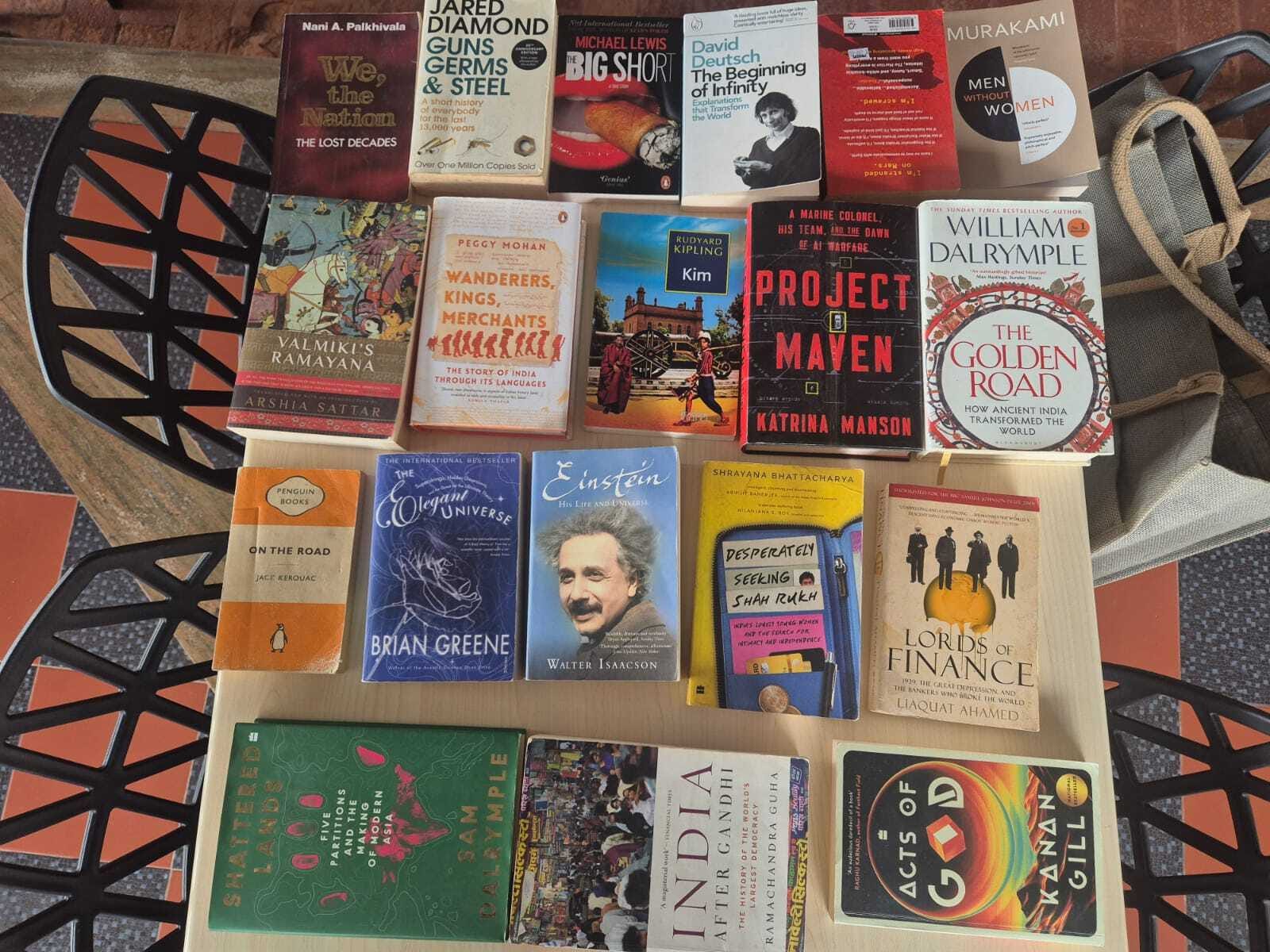
The Markets book club has been running for nearly a year. We have some avowed loyalists who come almost every weekend and nerd about their readings with us. But really, it’s become a great spot for many of us to talk to each other - even forge new friendships - without being distracted by any screen. It’s this in-person community that we’re really proud of building.
So, we’d love for you to join us! We host the book club every Saturday, 10:30-1 pm, in JP Nagar 4th Phase. Unfortunately, this location is fixed - we understand JP Nagar may be far for some. But this is the only place where we can host it smoothly. And we don’t host sessions online, either.
If you’d like to attend the book club, please keep the above in mind, and please reach out to: pranav.manie@zerodha.com!
This newsletter is worth keeping as a Saturday curiosity read. It teaches you how industries actually work without making you feel like you are studying for an exam ha ha ha
Love the section on First Light.
I relate to this a lot.
Also, I sent an email to join the book club, and I still haven’t received a reply. Not sure if you got my email…
Shashanknadig1997@gmail.com