
What We're Reading #18
Bajaj Finance, a legendary Wall Street tale, the China squeeze, stars, Chinese AI, development finance banks, global debt

Hi folks, hope you’ve had a great week!
Our team at Markets is always reading, often much more than what might be considered healthy. So, we thought it would be nice to have an outlet to put out what we’re reading that isn’t part of our normal cycle of content.
So we’ve started “What We’re Reading”, where every weekend, our team outlines the interesting articles — even books — that put our brains in seventh gear (if that even exists).
We also host a book club every Saturday that we talk about at the end. If you’d like to read with us, please feel free to join!
We’d also love to know what has piqued your interest, too! Please feel free to let us know in the comments.
What Krishna is listening to
The Ken, Intermission E02: Bajaj Finance (link)
I’ve been a fan of Acquired for a long time. The way they go really deep on one company, the whole arc of it, it is something I hoped we have in the Indian context as well. People at The Ken launched Intermission which is doing just that and its extremely good.
The second episode is on Bajaj Finance. I’ve only heard about half of it and I’m hooked.
When the Bajaj family split in 2009, Rajiv kept the motorcycle business. Sanjiv got the financing arm, which was basically a small lender helping people buy Bajaj scooters on EMI. It was 8% of Bajaj Auto’s market cap at the time. Today it’s bigger than Bajaj Auto.
What makes the episode good is the small stories inside the big story. One that stayed with me: in the early days, when Bajaj Finance sent a collection agent to a borrower’s home, the agent would first knock on the neighbor’s door and ask for the borrower by name. The neighbor would ask why. The agent would apologize and move on. The whole lane now knows someone nearby is paying off a loan. No campaign, no ads. Just the slow, slightly awkward spread of the idea that buying things on credit was a normal thing to do.
A lot more like this in there. It is definitely worth listening to.
What Pranav is reading
Michael Lewis, Liar’s Poker (link)
This is the first time in years that I’ve finished a book cover-to-cover in less than a week. That is an achievement owed, in part, to our book club (details below). If you like the idea of having a reading habit, but can’t seem to figure out how to get one, come join us every Saturday morning!
Liar’s Poker is a book about Wall Street. Specifically, it’s an account of three years spent at the legendary Wall Street firm, Salomon Brothers. It is incredible at giving you a feel for what it must have been like, wheeling and dealing at the commanding heights of capitalist excess in the late 1980s.
The book shows you, in gory detail, how millionaires are minted. It shows you the kind of genius it takes to actually make that sort of money, as well as how unscrupulous you have to be to get there. Despite conferring monikers like “The Human Piranha” on people, the picture it presents isn’t a caricature. Instead, you see it all: brilliance, daredevilry, pride, loyalty, greed, pretence, envy, paranoia, everything.
A long section of the book also gives you a glimpse of the birth of the mortgage-backed security — the thing that briefly blew the world apart in 2008. If I’m being completely honest, you end up sort-of-liking the guy who came up with them.
This book both turned me off Wall Street, and made me empathise with the horrible-seeming characters that work there. To do so at once is quite the achievement. Give it a read!
Shoumitro Chatterjee and Arvind Subramanian, China Is Pulling Up the Ladder Behind It (link)
“In effect, China is trying to do what economic theory says no country should be able to do: retain comparative advantage in almost everything.”
If you’re here, in India, that’s one hell of a problem, isn’t it?
In elementary economic theory, there’s this idea: even if your country isn’t the best at anything at all, you could still come to dominate an industry. Others might be better than you at it if they tried, but they probably just have other, better things to do.
China, however, is trying to dominate everything at once. It’s going toe-to-toe with Germany on one end, and Bangladesh on the other, all at once. While it rises, no other developing country can get a peep through. This is historically unusual, and can turn into a serious grievance for the developing world.
It’s hard to see anyone else forcing China to step down. But is there a case for China to do so itself? Chatterjee and Subramanian claim there is. To be honest, I don’t see it yet. Interesting question, though.
Robin Wigglesworth, Citadel: the hedge fund that became an energy giant (link)
I first knew Citadel as that Wall Street firm that Parks & Rec’s Ron Swanson ran in the movie Dumb Money. As I began working at Zerodha, I started hearing its name here and there — often as an illustration of how the American stock markets were very different from ours.
I had no damn idea it was secretly an energy giant.
At some point, Citadel stopped being a pure-play financial operator, and instead began pumping out its own energy — with oil and gas rigs across the world sitting on its balance sheet. A decent portion of the electricity powering California, which consumes a sixth of the energy all of India does, comes straight out of Citadel.
It all began with the Enron bankruptcy. While UBS picked up Enron’s energy trading business, Citadel went and plucked out its top quantitative analysts. They also went and interviewed absolutely everyone they could, sucking any information they found living within Enron’s carcass. Eventually, UBS had to shut the business down. Citadel, meanwhile, took those handful-of-brains, and turned them into $30 billion.
This would become a habit. Whenever a commodities player ran into distress, Citadel went hunting. Meanwhile, it rigged the whole operation with new forms of information: from weather forecasting to satellite data. They acquired, at once, the sharpest minds, an understanding of how the energy world worked, and a way of seeing exactly what was happening across the world. For a while, they simply used this to trade aggressively, making record profits as global events shook the energy world up.
Now, they’ve gone one step further still, turning themselves into a physical commodities giant, which actually operates the mines and machinery it needs to do it all by itself.
Wall Street, it appears, is morphing into Main Street.
David Oks and Henry Williams, The Long, Slow Death of Global Development (link)
I’ve been consumed, in recent years, by a sort of pessimism for the state of the world as it exists. The happy days when the whole world was converging on Western lifestyles are over. Things feel bleak now. The ground has shifted under our feet. Nothing good feels certain any more: not the victory of democracy, not the eradication of poverty, not a peaceful world, nothing.
This article builds a theoretical foundation to that feeling.
When I was growing up in the 1990s, there was a pervasive feeling that peace, prosperity and justice were on an unstoppable march. They would stall occasionally; sometimes, they would be pulled back. But if you just hunkered down and got your policies right, you would automatically find yourself accelerating towards “development”.
That sense is now shattered.
It now appears that we were coasting on the afterburners of a golden era. China, and much of East Asia, managed to hold on to it, and rapidly industrialized their economies. That industrialisation touched a country like India briefly, but then left us be. In fact, India was de-industrialised before its time. There was only so much that services, then, could do for us.
Add to that climate change and demographic decline, and the picture is grimmer still. If nothing changes soon, we could find ourselves stuck, perennially, as a stagnant lower middle-income nation, struggling to poke our heads above mediocrity.
Now, my pessimism doesn’t imply absolutism. High economic theory isn’t a crystal ball, and a country with a billion-and-a-half people is one where miracles should be expected. But that is hope, not analysis. What else do we have? As Oks and Williams say while ending their essay, “taking a purely realistic view of the situation, like gazing into the eyes of the Medusa, would simply turn us to stone.”
What Mridula is reading
Big Think, How we discovered we’re all made of star stuff (link)
We all know the famous saying that “we are made of star stuff,” but this article dives into the actual scientific detective work that proved it. It explains how mid-20th-century astronomers completely flipped our understanding of space by showing that elements aren’t just fixed in time; instead, stars are massive cosmic factories.
As they live and die, their intense heat and pressure cook up everything from the iron in our blood to the calcium in our bones, scattering these ingredients across the universe.
It is a beautiful, fascinating reminder that the atoms inside us right now were literally forged in a cosmic furnace billions of years ago. It completely changes how you look at the night sky,incredibly close and personal rather than cold and empty. At least, it changed how I shall look at the night sky now :)
What Manie is reading
Viola Zhou, When Americans choose Chinese AI (link)
It’s happening. Chinese LLMs are actively taking global market share from their American counterparts.
In this piece on Rest of World, tech reporter Viola Zhou covers the many American startups who have switched to DeepSeek or GLM, just because they’re multiple orders of magnitude cheaper than Codex or Claude Code. And this move is saving these companies millions of dollars.
We’re getting a live demonstration of how it is that Chinese companies think and move. There’s a theory that China doesn’t care as much about achieving AGI as much as the US (which is not something I buy). But what I do buy is that Chinese companies as a whole, let alone just Chinese AI firms, are incredible at stealing global market share. They’re often willing to make short-term sacrifices to aggressively get more customers — in this case, for AI, that would mean more enterprises rather than just individual users like you and me.
But I also think that Chinese LLMs are structurally cheaper. It isn’t just discounts keeping these prices at bay. It’s energy: one of the most crucial elements of the AI race. And China has a grid that integrates renewables better than any other country in the world. It’s subsidized R&D, which China has used plenty of in other industries. And it’s the benefit of country-wide deflation, which makes most of their inputs far cheaper for them because China usually operates with an excess surplus of goods.
I don’t think this is going to end anytime soon, either. On the American front, cost is not the only binding constraint. Geopolitics is, too. We’ve already seen how the Trump administration pulled the plug back on Fable 5. While the US continues to turn inward, in contrast, China’s AI industry is making market share in-roads everywhere else. Startups in Africa are also taking up DeepSeek far faster than any American LLM, simply because of cost.
In this tug of war between markets and geopolitics, the latter of which I dislike and have to begrudgingly account for in any analysis, it’s usually the former that wins out.
Mausam Kumar, Development Finance Institutions in India: Past, Present and the Future (link)
Recently, we shot an episode of Subtext with Mausam Kumar, an industrial policy researcher based out of Princeton — it’ll be out soon! Obviously, I went through his papers to prep for it, and one of them goes into a piece of India’s economic history that isn’t talked about as much yet.
Back in the 1960s and 70s, India used to have a type of establishment called development finance institutions, or DFIs. ICICI, for instance, was first created as a DFI before it eventually became a commercial bank (and we’ll come to why that is as well). Along with ICICI, there were two other crucial banks: IDBI and IFCI. They were meant to be separate from commercial banks like SBI, focusing primarily on long-term infrastructure (or industrial) loans that had very high levels of risk, and therefore no one else would want on their balance sheets.
Many countries that got rich were found to have DFIs as key to their economic strategy. In Japan, you have the Japan Development Bank (or JDB). In China, you have multiple development banks. The US also had its own version in the past, too.
However, India’s DFIs were laden with more than a few issues. For one, they were unhealthily biased towards big businesses, which created a lopsided competitive market structure that has stayed in India till today. In simple terms, the DFIs and big businesses were way too closely-knitted with each other. From the paper:
“Out of the total allocation of credit in the period from 1956–66, as much as 65% was disbursed to large industrial houses and 28% of it was cornered by 20 large industrial houses. And a meagre 7% of it was extended to the second-tier companies.”
What’s more, the DFIs handed out these loans without disciplining the firms who received them. There wasn’t enough regulatory oversight on how these loans really performed, which meant that their going bad did not result in any massive penalizations or course-corrections.
It also wasn’t a coincidence that, at the time, India’s economy followed a logic of impost substitution. Unlike Japan, China or South Korea, export performance was not linked to credit guarantees in India. But exports are what forced the firms of those countries to upgrade technology and become globally competitive. Alas, that wasn’t the case with us.
Some of Mausam’s research focuses on how an Indian DFI should work today. After 1991, the original three DFIs were subsumed into commercial bank operations. But that only worsened the risks of the balance sheets of the banks, as we’d eventually get to see with the twin balance-sheet crisis of the 2010s. That, in Mausam’s view, has only strengthened the case for having DFIs even today. What remains to be seen is whether today’s DFIs will repeat the same mistakes.
What Bhuvan is reading
Contextualizing the global debt crisis (link)
Any mention of debt usually produces an emotional, and often negative, reaction. Debt carries a moral weight because it means you owe someone money, and nobody really enjoys owing anybody anything. This is true whether you are an individual, a company, or a country.
But one of the problems with most discussions about debt is that people jump too quickly to the conclusion that all debt is bad. The other common mistake, especially when talking about countries, is to assume that governments are like households and that their budgets must always balance. That frame is useful up to a point, but it can also be deeply misleading.
Governments are not households. They have longer time horizons. They can tax. They can borrow. Some can borrow in their own currency. And often, governments have to spend today on obligations whose benefits or consequences show up over decades: infrastructure, defence, welfare, health, education, climate adaptation, and so on. The question is not simply whether a government has debt. The question is what the debt is used for, what currency it is in, who holds it, what the interest cost is, how fast the economy is growing, and whether the state has the credibility and capacity to service it.
The other mistake is assuming that all countries are alike. They are not. Just as the creditworthiness of an individual depends on income, assets, liabilities, credit history, and future prospects, the borrowing ability of a country depends on its stage of development, tax capacity, institutional credibility, currency, growth prospects, external balances, political stability, and access to global capital.
This is why saying “the US is on the verge of bankruptcy because it has borrowed over $30 trillion” can be as misleading as saying a smaller country is safe just because it has far less debt in absolute terms. Absolute debt numbers don’t tell you much. A large, rich country that borrows in its own currency is in a very different position from a poor country borrowing in dollars at high interest rates.
Sovereign debt is messy. It does not lend itself to neat moral judgments or easy generalisations. The usual household analogies often lead people astray.
But one broad generalisation is still fair: if debt is a challenge for advanced economies, it is often a much harsher constraint for poorer developing, emerging, and frontier economies. Many of these countries face higher borrowing costs, shorter maturities, weaker currencies, limited tax bases, and far less room for mistakes. For some of the poorest countries, especially in parts of Africa, debt distress is not an abstract macroeconomic debate. It directly affects the government’s ability to spend on health, education, infrastructure, food security, and basic public services.
So if global debt is a problem, it is not the same problem everywhere. The numbers may look scarier in advanced economies, but the pain is often much sharper in poorer countries with weaker buffers.
I spent the last week pulling together different statistics on the history of sovereign debt: how it has evolved, where the stress is concentrated, which regions are most vulnerable, and why some countries can carry enormous debt burdens while others can run into trouble with far smaller amounts.
From our bookmarks bar
Malcolm Spittler and Dylan Patel, AI Dark Output: The Visible Cost of Invisible Output (link)
Chris Dillow, Lessons of Brexit (link)
Brian Potter, How Long Do We Wait for New Inventions? (link)
Natasha Khan, Tide Already Dominates Detergent. Why Is P&G Pushing a New Version? (link)
Michael Stott, Andres Schipani and James Shotter, Netanyahu and Modi: the making of an unlikely alliance (link)
Puja Mehra and Arpita Mukherjee, How low-hanging fruit could give India outsized gains, (link)
Yasheng Huang, China as an absolute advantage economy (link)
Luke Templeman and Galina Pozdnyakova, Megatrends: AI vs the decade’s structural headwinds (link)
Daniel W. Drezner, Ukraine, Iran, and Occam’s Razor (link)
Hanna Horvath, Can you buy taste? (link)
We have a book club!
Here’s another reminder of something that we’re pretty bad at advertising: our book club.
So here’s an image of our fairly-impressive book collection to attract you. Yes, they’re not just for show, and we do read them, alongside some coffee/tea and sandwiches.
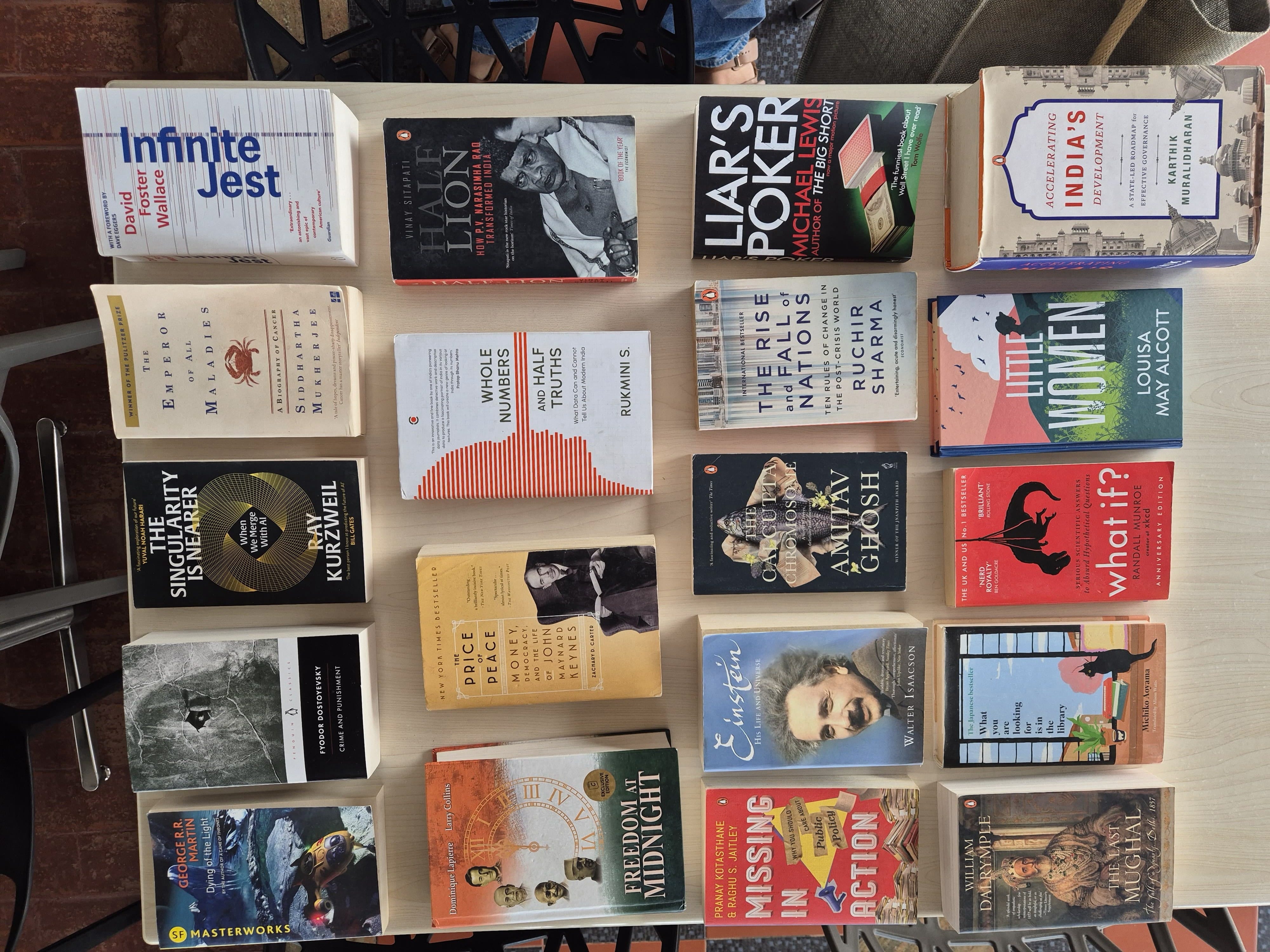
The Markets book club has been running for nearly a year. We have some avowed loyalists who come almost every weekend and nerd about their readings with us. But really, it’s become a great spot for many of us to talk to each other - even forge new friendships - without being distracted by any screen. It’s this in-person community that we’re really proud of building.
So, we’d love for you to join us! We host the book club every Saturday, 10:30-1 pm, in JP Nagar 4th Phase. Unfortunately, this location is fixed - we understand JP Nagar may be far for some. But this is the only place where we can host it smoothly. And we don’t host sessions online, either.
If you’d like to attend the book club, please keep the above in mind, and please reach out to: pranav.manie@zerodha.com!