
What We're Reading #17
The Strait reopens, land politics, state finances, the geopolitics of sport, the state of India's sugarcane workers, breast cancer prediction.

Hi folks, hope you’ve had a great week!
Our team at Markets is always reading, often much more than what might be considered healthy. So, we thought it would be nice to have an outlet to put out what we’re reading that isn’t part of our normal cycle of content.
So we’ve started “What We’re Reading”, where every weekend, our team outlines the interesting articles — even books — that put our brains in seventh gear (if that even exists).
We also host a book club every Saturday that we talk about at the end. If you’d like to read with us, please feel free to join!
We’d also love to know what has piqued your interest, too! Please feel free to let us know in the comments.
What Pranav is reading
Karthik Sankaran, The Strait of Hormuz to re-open. Now what? (link)
The latest global crisis, it appears, is over. Thank god. We’re really making a bit of a habit with these, huh?
Only, I’ve come across a lot of commentary (ok, I’ll drop the act, I meant a lot of tweets) about how this whole mess will take a long time to clean up. Personally, I’ve never restored war-torn regions, though, so I had no instinct for why.
Karthik Sankaran, a regular feature on What We’re Reading, has a detailed answer.
Step one, it appears, will just be to get all those ships moving. That itself isn’t easy. Ships that stay put in warm waters become home to barnacles and all sorts of other sealife, and you need to now get them sea-worthy. Frankly, put anything in water for that long and it becomes rather gross. I suppose ships are no exception.
Then, there’s the even more difficult job of getting the markets back in shape. As writing The Daily Brief has taught me, a lot of industrial processes only work when you can run them 24x7. Give them a rest, and there’s no guarantee you can start them back up. Oil turns out to be one of those things.
There’s also the simple matter that the entire world collectively soiled their bedsheets when the Strait of Hormuz was choked, and once business returns to normal, you shouldn’t expect them to behave as they did in the good old days of, like, February.
Humanity’s crowning achievement, this last week, has been to stop acting like an utter moron. Sadly, while being a moron can get you into trouble, not being one doesn’t get you out of it.
Pranay Kotasthane, Matsyanyaaya: India Has Leverage (link)
Folks, it is your patriotic duty to read Anticipating the Unintended. This is the single best blog out there for ideas on the problems we face as a country, and what we can do to solve them. Comes out once a week, and is always, without fail, illuminating. These are serious people, thinking seriously.
The piece I’m coming to you with is by the incredible Pranay Kotasthane, one of our favourite writers over at The Daily Brief. We also recorded a podcast with him, incidentally.
Pranay’s breaking through an idea that’s assumed to be true in how we think about the Trumpian United States: that because the United States is more powerful than us, we have no cards to play. We might not have the cards we wished we could play, and China definitely has a better hand than we do, but we have cards. Everyone does.
He then lists out places we can hit out at the United States that would genuinely draw political attention, and perhaps have serious deterrence value: including re-orienting our defence suppliers, or (in a worst case scenario) a ban on the export of generic drugs. A good frame for thinking about that relationship.
Do check out the other piece in this edition as well, though: on why Indian women don’t work, why it’s important that they do, and what we can do about it.
Kara Dimitruk & Ben Southwood, How smashing the NIMBYs created modern capitalism (link)
There’s an odd curse to living in India. All around you, you see things that can be obviously better. Only, there’s some MLA, or some powerful group, that benefits if they don’t happen, and they’ll beat the shit out of you if you want things any better. So, you take a leaf out of the scriptures and accept your fate in an act of karmic resignation, because who’s going to put their necks on the line?
As Kara and Ben show you, however, it turns out that Europe looked a lot like this, a couple of hundred years ago. And then, they fixed their act, buying them centuries of prosperity.
It began in England. From the late 17th century onwards, the island nation began finding ways of killing special interests and sclerotic laws, in order to unleash more productive forces from taking over.
Like India, its farmland used to be a mesh of tiny, broken plots. When it figured out how to collect and redevelop that land, however, it could improve that land at scale. It used to have horrible roads, just like our own dear nation. But then, it allowed landowners and merchants to pool capital and create turnpikes, which made transport vastly better. Rivers and canals, too, were improved in the same way.
These improvements unleashed the industrial revolution in England, even when the rest of Europe dealt with India-esque problems. Then, eventually, Europe followed in its footsteps, and improved its lot as well.
Perhaps there’s a leaf that India can borrow out of this book. We’re currently in a terrible equilibrium — built around a system where elites of every stripe can get in the way of everyone else, because it’s easier to leach away at the system than to actually do something worthwhile. But that isn’t set in stone. Other countries have managed the shift to less extractive arrangements. We can, too.
Trita Parsi, Trump ended his idiotic Iran war. Good. (link)
While we’re on this topic, here’s a sensible piece on the deal that got us there.
It sometimes feels like we’ve entered an era of meme-ocracy, where our political leaders live by the meme and die by it. The global memester-in-chief came to power by flinging idiocy and fluff at whoever came in his way. Now that he has egg on his face bigly, it’s delightful to see him being dunked on by the entire world.
Yes, this deal is an embarrassment for a country that, for most of my life, thought of itself as the world’s sole superpower. Doesn’t mean it shouldn’t have been struck.
There’s little doubt that Trump went and stepped into a giant pile of goo, and that the stink will take a while to clear. That he wants to fold, however, is a great thing. His MOU with Iran is a gift to the world. It wasn’t guaranteed that it would happen. If you want evidence, just look at Ukraine. The United States could, in another universe, dig its heels in and keep the war going for years. Trump would be spared a bunch of snarky memes, but we would all be poorer for it — quite literally.
Politicians may seem larger-than-life. Ultimately though, like us, they too are small pawns in a game much larger than we can comprehend. War is a terrible thing, even if you aren’t the one fighting — as India has learnt over these few interminably long months. It would be a little sad if Trump did not receive his fair share of lampooning for starting all this, but it would be a far greater travesty if the war didn’t have an end.
What Kashish is reading
Analysis of State Budgets by CareEdge group (link)
I’m half-Pahadi (on my mother’s side), and it genuinely pains me to see the Himachal Pradesh government cutting capital expenditure so sharply (~70%).
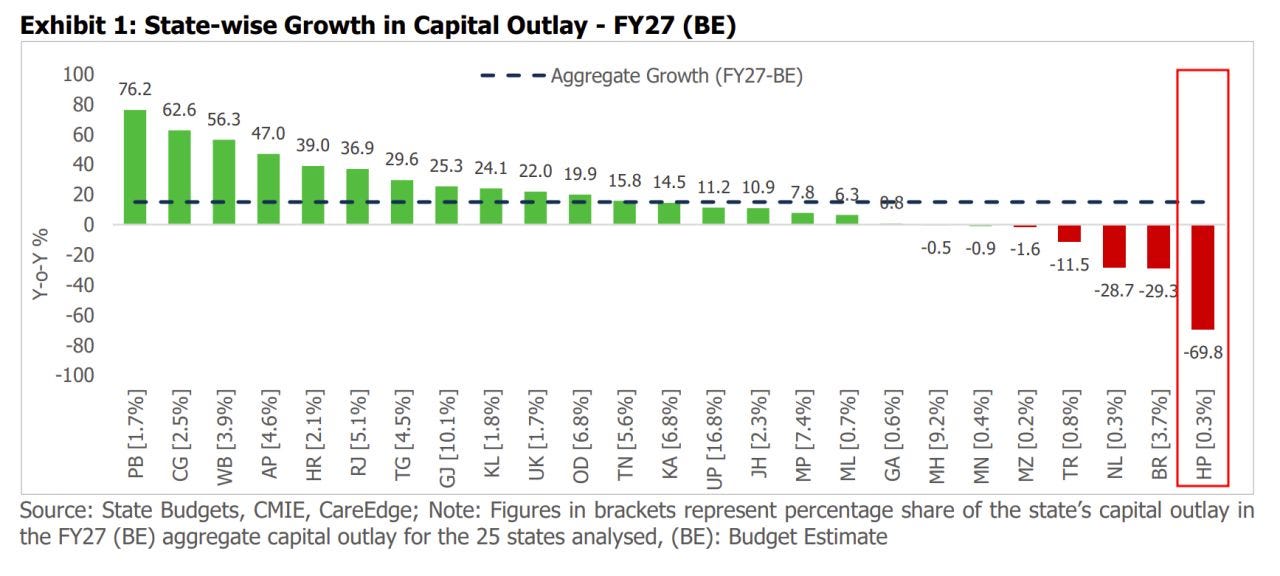
State politics attracts plenty of attention. State budgets, on the other hand, rarely do. If even a fraction of the energy spent on political commentary went into understanding how states earn, spend, and borrow money, local governance would probably be far more accountable.
Growing up, my mother would often tell me stories (still does) of villages receiving truckloads of money under one scheme or another. People built houses, maintained farmland, and raised cattle with the help of various subsidies and cash transfers. There is nothing inherently wrong with welfare, but over time you begin to wonder what happens when myopic consumption consistently takes priority over investment.
I am not a political commentator, nor do I understand Himachal’s finances well enough to prescribe solutions. But as someone who can read a balance sheet or two, the cracks are becoming difficult to ignore.
You have a system that keeps expanding freebies, cuts back on capital investment, and then eventually finds itself freezing salaries and pensions of government employees. It’s hard to think of a clearer example of fiscal stress.
What makes it more frustrating is that Himachal is not devoid of economic activity. The state has a significant pharmaceutical manufacturing base around Baddi, Solan, and other industrial clusters. It has tourism. It has hydropower. It has a reasonably educated workforce. Yet the state continues to struggle with the basics of fiscal management.
Himachal is politically insignificant in the national scheme of things. It’s a small state with few parliamentary seats. But that is precisely why it could be a fascinating case study. Small enough to experiment, large enough to matter. A place where thoughtful policymaking could have visible outcomes.
Whether there is enough political will for that is a different question altogether. And these days, that feels like a rather tall ask.
What Manie is Reading
Play The Game, “Saudi Arabia’s grip on world sport” (link)
If you’ve been tuning into The Daily Brief this past week, I wrote a story on the economics of the FIFA World Cup. And my unfortunate takeaway from writing that is that the biggest sporting event of the world is much less about the sport itself. In fact, it isn’t even all that about profit either.
It’s almost entirely about geopolitical power. And this is slowly becoming true about all sports beyond football.
This is not a surprise to those who have been following this for a long time. Sport as a whole has become part of the industrial policy of many nations — specifically oil-rich ones in the Middle East, who are desperately trying to diversify their economies. So that usually involves spending a ton of money on buying clubs, attracting international leagues like the NBA, the PGA Golf tour, the IPL — all of which have already had some presence in the region.
On that note, this report by Play The Game on Saudi Arabia’s ambitions to conquer world sport are illuminating. It’s a dive into the individuals, most of whom work in the state machinery, who drive Saudi’s aggressive bid to make a mark on global sport.
A key part of this strategy is Saudi Arabia’s Public Investment Fund (PIF), one of the world’s largest sovereign wealth funds. The PIF has scored partnerships with key associations in tennis, bought the revered English football club Newcastle United, and own the Saudi clubs that signed Karim Benzema and Cristiano Ronaldo.

Another lever of Saudi’s strategy is their futuristic city, NEOM. The city is meant to host major international sports events in the future, having already secured the rights to the 2029 Asian Winter Games, as well as sponsoring European football tournaments and partnering with the McLaren F1 team. But at this point, everyone probably knows that NEOM is also one of the most controversial infrastructure projects, with its poor record of labor practices, and a streak of expulsions of native communities to build the city.
There’s a lot more — on how Aramco, the world’s largest oil company, has made its own footprint, how the state airlines are also competing for sponsorships, and how all of it exists alongside Saudi’s poor human rights record and oppressive rules.
A lot of these projects are also money guzzlers. Well before the Strait of Hormuz crisis halted all oil flows out of the region, Saudi Arabia’s fiscal health was not looking too good. Now, they’re simply unable to make use of high oil prices because their supply was, so far, effectively halted.
As a self-proclaimed fan of sport and the competitive side of human nature it gives impetus to, all of this feels murky.
What Kulsum is reading
The Story of Zahra by Hanan al-Shaykh (link)
This has felt strangely personal. From the very first chapter, I found myself on an emotional rollercoaster, seeing parts of my own life in Zahra. Coming from a similar cultural background, I recognised so many of those feelings that girls quietly carry while growing up with traditions, expectations, and all the things that are never really spoken about.
What struck me most wasn’t anger, but how complicated everything is. There is resentment, sure, but there’s also love — the kind that doesn’t always know how to express itself. Parents protect in the ways they know best, shaped by the values and fears they grew up with. But sometimes I wonder, does that protection really protect us? Or does it leave us carrying things we don’t even realise? Does it make us push harder, rebel, or look for ourselves outside the boundaries we’ve been given?
Zahra’s story made me think about how girls are constantly trying to balance love, duty, guilt, frustration, and their own desires all at once. So much of that struggle isn’t because our families don’t love us. It’s often just generations of people trying their best with what they know.
What I take from these pages is that we inherit more than traditions. We inherit fears, expectations, and quiet acts of sacrifice. As I’ve grown older, I see so much of myself in my parents, and so much of them in me. Maybe that’s what shapes us, maybe it isn’t. I’m always learning, changing my opinions, and seeing things differently with time. I don’t think I’ve arrived at any answers. If anything, this book has just made me reflect more.
What Shahid is reading
Performance of breast cancer risk prediction algorithms across mammography systems (link)
Most medical AI stories are about diagnosis, helping doctors detect diseases faster or more accurately. This paper explores a different possibility: prediction.
Researchers evaluated four AI models on more than 112,000 mammograms from the UK screening programme to see whether they could identify women at higher risk of developing breast cancer in the years ahead. The women had initially received normal screening results, yet some were later diagnosed with cancer. The strongest models were able to detect subtle patterns associated with these future diagnoses, despite there being no visible signs of disease at the time of screening.
What makes this notable is that the AI wasn’t being asked to find existing cancer. Instead, it was being used to estimate future risk. That shifts the role of AI from supporting diagnosis to potentially helping identify who may need closer monitoring before any disease becomes detectable.
If these findings hold up in real-world settings, screening could become more personalised. Rather than treating everyone the same, healthcare systems could use risk-based approaches to determine who might benefit from more frequent screening or additional follow-up tests. The broader implication is that medical images may contain far more information about future health outcomes than we currently know how to extract.
What Srusti is reading
The New York Times & The Fuller Project, They Get Hysterectomies So They Can Keep Cutting Sugar Cane (link)
I came across this scrolling Instagram. It is an incredibly tough read, but it feels necessary.
The investigation follows sugar cane workers in Maharashtra — specifically Archana Ashok Chaure, who was married off at around 14 and pushed into the fields shortly after. Child marriages in this region are directly tied to the industry: sugar cutting operates on a two-person husband-and-wife system called koyta, which pays couples more than individuals. So contractors and families alike have an incentive to find brides before the harvest.
The most harrowing part is what the system does to women’s bodies. With no access to running water, toilets, or paid leave, periods become a problem women cannot afford. So thousands get hysterectomies — often in their twenties and thirties — borrowing money from their contractors to pay for surgeries they may not need, then returning the following season to work the debt off. The surgery meant to free them becomes another chain.
It is easy to assume that multinational corporations enforce labor standards down their supply chains. This piece shows how that assumption breaks down in practice: companies defer to the mills, mills defer to contractors, and the workers at the bottom are left with no protection. Coca-Cola’s own auditors flagged child labor and forced labor conditions in Maharashtra in 2019. The company declined to comment when the investigation was published.
The piece is from 2023. In late 2024, a health report from Beed found 843 women had undergone hysterectomies just before that year’s harvest season. PepsiCo blocked a shareholder resolution on this in early 2025. The quote that stayed with me: “Nobody chooses this life.”
Unread pieces from the bookmarks bar
Baldur Bjarnason, The old world of tech is dying and the new cannot be born (link)
M. Gessen, This Is the Formula That Defeated Orban. It Would Defeat Trump, Too. (link)
Joseph Solis-Mullen, The Taiwan Lobby moves to put a full court press on Trump (link)
Anthropic, Policy on the AI Exponential (link)
Drew Crawford, The Case for Brazil: The Greatest Asymmetric Bet on Earth (link)
Brian Christian, Evan M. Russek, and Thomas L. Griffiths, Resolving Feynman’s restaurant problem reveals optimal solutions and human strategies (link)
Damien Charlotin, The Lump of Law Fallacy (link)
Karina Bao, Morris Chang’s Memoir Chapter 1 (link)
Matt Sheehan, China is getting worried about AI & jobs (link)
Anton Leicht, The Moonshot (link)
The Regional Coordination of Industrial Policy (link)
The People’s Republic of Techno-Optimists (link)
We have a book club!
Here’s another reminder of something that we’re pretty bad at advertising: our book club.
So here’s an image of our fairly-impressive book collection to attract you. Yes, they’re not just for show, and we do read them, alongside some coffee/tea and sandwiches.
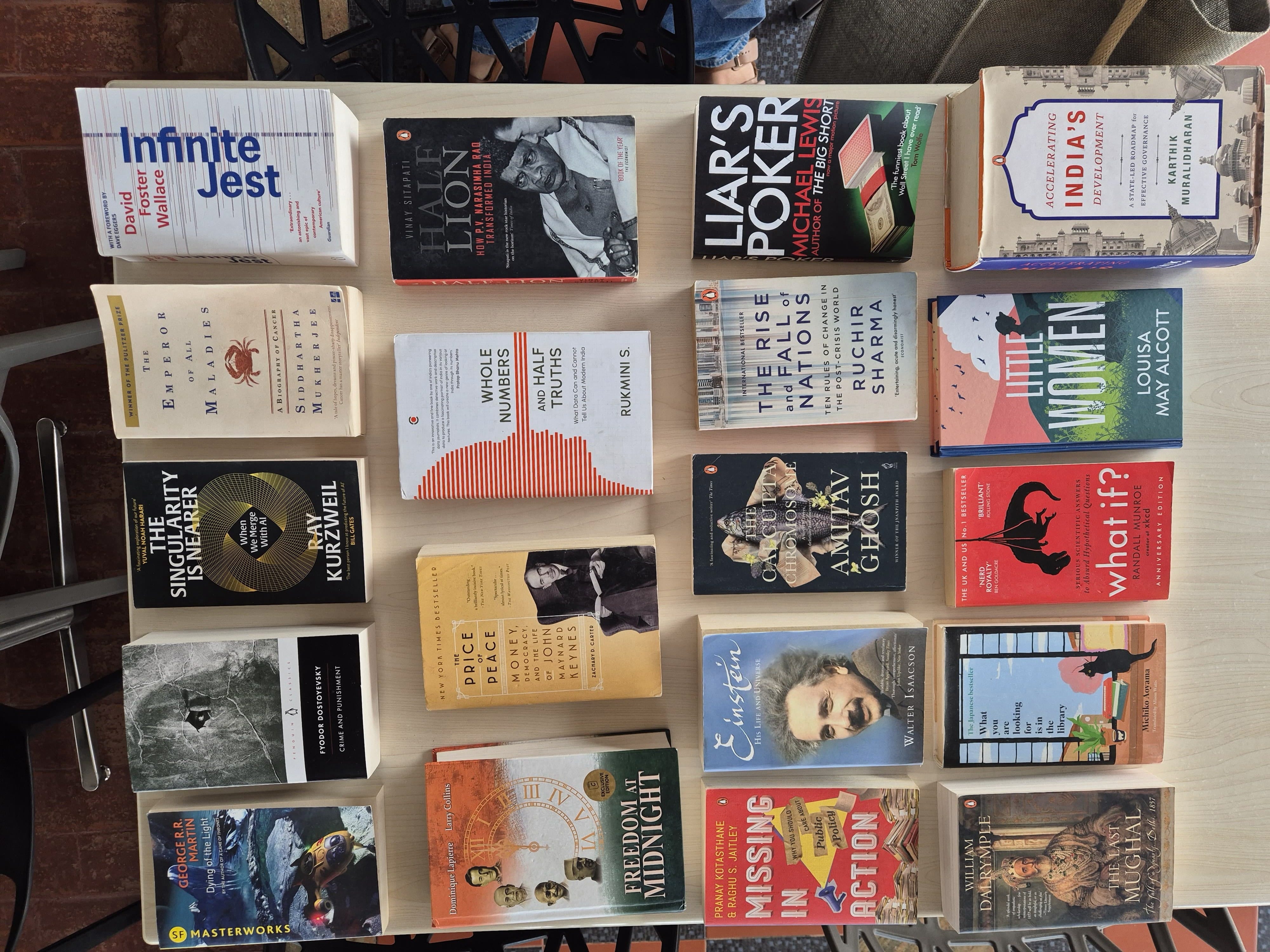
The Markets book club has been running for nearly a year. We have some avowed loyalists who come almost every weekend and nerd about their readings with us. But really, it’s become a great spot for many of us to talk to each other - even forge new friendships - without being distracted by any screen. It’s this in-person community that we’re really proud of building.
So, we’d love for you to join us! We host the book club every Saturday, 10:30-1 pm, in JP Nagar 4th Phase. Unfortunately, this location is fixed - we understand JP Nagar may be far for some. But this is the only place where we can host it smoothly. And we don’t host sessions online, either.
If you’d like to attend the book club, please keep the above in mind, and please reach out to: pranav.manie@zerodha.com!
Thank you for curating the list of articles! Really good content. Would it be possible to put out a list of what you guys are reading currently at your book club as well? Will help with discoverability of good/interesting books