
What We're Reading #16
Urban planning, India's demographic decline, Paul Graham, Peter Thiel, and the economist that predates Adam Smith.

Hi folks, hope you’ve had a great week!
Our team at Markets is always reading, often much more than what might be considered healthy. So, we thought it would be nice to have an outlet to put out what we’re reading that isn’t part of our normal cycle of content.
So we’ve started “What We’re Reading”, where every weekend, our team outlines the interesting articles — even books — that put our brains in seventh gear (if that even exists). This might be our largest list of recommendations so far!
We also host a book club every Saturday that we talk about at the end. If you’d like to read with us, please feel free to join!
We’d also love to know what has piqued your interest, too! Please feel free to let us know in the comments.
What Krishna is reading
Alain Bertaud on Order Without Design (link)
Ever since I came back from my holiday in Europe, the one thing I have gotten more upset and conscious about is how our roads are literally non-existent here. There are no footpaths to walk on. Forget about cycling tracks. Coming back home from office alive every day is in itself a big feat. I can go on about how stupid it is that we don’t even have the most basic facility right — something that could probably solve a lot of health issues in itself. But this trip also pushed me to learn about things I had never really paid attention to before, and that is city planning.
I came across the work of Alain Bertaud, who is an authority on this subject. The man hitchhiked from Marseille to Chandigarh in 1963, through Turkey, Iran, Afghanistan, and Pakistan, as a twenty-something architecture student, just to see Le Corbusier’s planned city in person (he designed Chandigarh). He went on to spend nearly two decades as the principal urban planner at the World Bank. He’s been visiting India for sixty years. He also wrote a book called Order Without Design: How Markets Shape Cities, which I haven’t read yet.
I did tune into an old podcast featuring him on Ideas of India. It’s three years old, but it’s not like our cities have improved any bit.
He makes a point that I keep thinking about. He says Indian planners have their priorities completely backwards. They spend enormous energy controlling what people do on their private land, how tall buildings can be, what they can be used for, while the public realm they are actually responsible for goes completely ignored. He says fifty percent of Indian urban street area is either unused or misused. That number is embarrassing, but it tracks with everything I have ever seen.
He also has a counter-intuitive point on density. The popular belief is that restricting building heights prevents cities from getting too dense. He says it’s the opposite. Slums are actually the densest parts of Indian cities, not apartment buildings, because poor people can’t afford to build upward, so they pack tightly at ground level. When you cap how tall buildings can go, you don’t reduce density. You just push it outward, creating sprawl, which then forces everyone onto private vehicles. All the congestion and pollution we blame on cities being “too crowded” is actually a consequence of density restrictions, not a reason for them.
And then there is this bit, about serendipity, which I truly believe in:
“My guess from observing cities for a long time is that even when you can work at home, at a certain point, you need to meet people randomly. If you work at home, you can spend some time in a coffee shop from time to time. That’s not a substitute for a big city. When you meet people in an office, you have also random meetings, people that come to visit somebody who works with you and say, ‘Oh, I work there.’ I think that here, that’s where you get ideas. Those random encounters are very important, and that’s something only a large city with a high density can provide.”
There are a bunch of more interesting bits that he shared, some of it I don’t fully understand yet. It is definitely worth tuning into.
What Bhuvan is reading / building
The Economist, India’s population will soon be falling — probably quite fast (link)
The recent article in The Economist on India’s falling fertility rate has, predictably, kicked off another round of debate about what this means for India, how bad the decline in births really is, and what the first-order and second-order effects might be.
I’ve been working on a side project to visualize India’s economic and social data, so I went looking for everything I could find on population, fertility, births, and the more granular breakups: where fertility is falling, where it is still high, how it varies across states, income groups, education levels, urban and rural India, and the various socio-economic factors that shape fertility decisions.
This is the first cut of the data I found.
It’s very easy to make apocalyptic predictions about falling fertility rates. You take the current trend, extend the line far enough, and eventually arrive at some barren, empty-earth scenario — something out of “I Am Legend”. But I’m skeptical of doom and gloom precisely because the case is so easy to make.
Surely this is not the first time in human history that fertility rates have fallen. And yet, here we are.
There is a lot of nuance in this debate. I don’t want to pretend I understand all of it yet. This is a topic I’m deeply fascinated by, and I’ll keep writing about it as I learn more.
But for now, here are some interesting data points on fertility in India.
What Pranav is reading
Scott Sumner, The great helmsman? (link)
Scott Sumner delivers a lesson that everyone — from me, to the good folks at Bloomberg, to the President of the United States — needed. When it comes to monetary policy, there’s only so much the person you put at the “helm” can change. The whole job is to try and navigate the economy well. Insisting that someone should be more partisan about rates is a bit like appointing a driver that will constantly swerve to the left, no matter where the road or traffic dictates you go. All that will do is get you into an accident.
There’s one option the Fed does have: of choosing what it targets (or, to stick to Sumner’s analogy, it can choose which road to drive on). Once you’re locked on to a target, though, you have little discretion in how to navigate your way there.
The problem with America’s inflation episodes wasn’t that the Fed didn’t perfectly nail the tactical steps it took to anchor it. It was something deeper; that the Fed had effectively signalled to the economy that it had abandoned the pursuit of stability; that it was comfortable letting nominal GDP growth run amok. It didn’t fail to navigate the road to 2% inflation; it set its Google Maps to InflationTown, and reached there in good time.
The tragedy is that the whole thing can backfire. Because the Fed is lackadaisical in 2021, it had to deal with higher natural interest rates in 2022. The pursuit of growth choked itself.
We recently learnt a related lesson in the domain of exchange rates. A couple of years ago, we tried to keep the Rupee pegged to the dollar for all intents and purposes. Only, once we stopped, it sprung back violently, crashing to almost a hundred.
A central bank’s job, it seems to me, doesn’t respect the human ego. The more you try to bend it to your will, the more it bends you back.
Anjali and Judah, Agents need Work Data (link)
Disclaimer before I start: I don’t understand data. I don’t understand how artificial intelligence models are made. I just have raw intuitions formed by being a heavy but technically illiterate AI user. It’s a testament to Anjali’s and Judah’s writing that some of this made sense to me anyway.
Here’s a basic premise: most work that people try to one-shot with AI is horrible. If you’re willing to work with it or hammer it into shape, however, its performance improves drastically. The differences you bring by prompting it into shape, however, can become data. That data can train the model to understand what users like you really want, so that it can do more complex things, while having you coax it a little less, the next time you need work done. That is, it becomes a better agent.
This is Work Data.
There was recently some outrage around how Indian workers were training their AI replacements. It looked dystopian; they were doing shitty, menial jobs with cameras strapped to their heads, all so that a robot could do the same task tomorrow. There’s a good chance, however, that early generation Claude-monkeys like me are doing the same thing — leaving a data imprint that trains our replacements. (Not that it’s necessarily a bad thing.)
This is why you’re seeing someone like Anthropic rolling out so many profession-specific models: because they need the work data all those professionals will generate.
This also means, however, that there may be limited scope for “products” built atop AI models. The work data they generate is simply too precious: more valuable, perhaps, than what they’re paying an AI company in exchange for burning tokens. That data simply has more value in the hands of a foundational model company than in the hands of some middleman.
My intuition can no longer project what the world will look like in the medium term. I’ve given up hope of doing so. If you want a sense of what the very next turn could look like, however, this is a nice piece to get your intuitions in order.
Ben Thompson, Agents over bubbles (link)
Here’s more on the same themes. Ben basically makes the case to you that AI is not a bubble.
That case may have seemed more compelling some time ago, when LLMs were dumb word-machines that frequently hallucinated, and were fundamentally unreliable without a human nannying them. But reasoning models, and then agents, have flipped the paradigm. The data centre buildouts may seem crazy, but that’s only because the number is unintuitive. Demand really is that big.
The fact is, even if agents aren’t always as good as a great employee, they’re better than a lazy employee — and if you’ve ever worked, you know how lazy most employees can be. Every organisation is a mix of people who pull massive amounts of weight, and those who slack off in their shadow. AI could simply replace the worst of the latter category, doing a better job than them.
In the previous world, that is, the world of five years ago, you often had to hire whoever you found for some roles, because they would at least take some work pressure off. That’s no longer the case. You really can imagine supercharged organisations, with a few competent people managing fleets of AI.
The economics of the coming age, in other words, will not behave like that of the internet era. You no longer need scores of people taking bite-sized subscriptions to your AI service. You can have small networks of people creating very large amounts of value, and paying the AI companies handsomely in turn.
That world might actually justify the mad data centre buildout.
Paul Graham, How to make wealth (link)
This one is over two decades old, but it remains remarkable.
On the surface, it is a piece arguing a simple premise: that if you wish to make a lot of wealth, you should run (or join) a start-up. Much more, however, it represents a philosophy: one that prizes entrepreneurship as a virtue.
He begins with a key idea: that money isn’t wealth. They’re related, sure, but wealth is actually all the stuff you want, and money is how you buy it. If you had no money, but did have a magical lamp with a wish-granting genie, you would have zero money and infinite wealth. If you were a certain trillionaire that ended up stranded on Mars with nobody to transact with, you would have functionally infinite money, and no wealth.
It follows that every time anyone does something of value, they “create” wealth. Imagine you paid Rs. 300 for some incredible butter paneer and naan. For you, this was a money outflow. On the other side, however, it was people creating wealth out of nowhere — the cook, the farmer, the mill, the cow herd, the guy who moves things around, the butter factory, and so on. A job is basically a place where you use your time to create wealth.
But in the average job, it’s hard to say how much wealth you, specifically, created. So you’re paid some random amount of money.
There are certain cases, however, where you can get compensated directly for creating wealth. One of those, he argues, is in working extremely hard in a small team of very driven people, to find new ways of doing things that larger, richer competitors can’t replicate. You essentially invent a more efficient way to create wealth, and reap its benefits. This is essentially what a start-up is.
Paul Graham has written some of the internet’s best essays, and this counts among them.
What is Kashish reading?
Gowri Bhat, More, but less (link)
This piece is by our teammate in Rainmatter, Gowri Bhat, and it starts with a simple observation.
She travels to Australia and finds that almost everything she eats tastes better.
Now, part of that is probably the novelty of travel. Food often tastes better when you’re in a new place, in a new environment, and generally having a good time. But Gowri uses that experience to ask a more interesting question: what if there is actually something different about the quality of food itself?
That question eventually leads her into a much bigger discussion about nutrition in India.
One line of thinking that has always resonated with me is that India is increasingly becoming a calorie-surplus country but remains a nutrition-deficient one. We have made enormous progress in ensuring that fewer people go hungry, but that doesn’t automatically mean people are eating diets that are nutritionally adequate.
Gowri does a good job unpacking this distinction.
The piece looks at how our food systems, incentives, and public distribution mechanisms have been designed primarily around calories and food security. That made perfect sense in a country where hunger was the immediate problem. But as the problem evolves, the solutions may also need to evolve.
The difficulty, of course, is political.
The benefits of improving nutrition are often long-term and gradual. The costs of changing a food distribution system, however, are immediate and visible. It’s much easier for policymakers to rally around preventing hunger than around improving nutritional outcomes that may take years to show up in public health statistics.
That’s what makes this piece interesting. It starts with something as mundane as why food abroad seems to taste better and ends up asking a much larger question about how India feeds itself, what we optimise for, and whether calories alone are still the right metric of success.
What Manie is reading
Ibrahim Owaiss, Ibn Khaldun: The Father of Economics (link)
Ibn Khaldun, Oxford TIDE Centre (link)
I’ve probably said this before, but I’ve read more economics while at Zerodha than I read in my actual undergraduate economics degree.
The folks at Oxford’s TIDE Centre are doing some interesting work in economic history and industrial policy. They have an entire page dedicated to one man who, it seems, has predated Adam Smith, Karl Marx, and David Ricardo — who together are often considered the modern foundation of classical economics. His name is Ibn Khaldun.
Ibn Khaldun was a 14th-century intellectual from the Arabian regions, who advised many rulers of his time. He’s considered to be among the most prolific historians of the Middle Ages. But what is lesser-known is that before anyone else, it was he who came up with some of the most important ideas in economics that we take for granted today.
Before Adam Smith (and then Karl Marx after him) famously said that “labor is the source of value”, it was Khaldun who said so. However, he didn’t really theorize it as a “labor theory of value”, nor did he think profits were unjustified. In fact, Khaldun had a powerful framework for viewing earnings. An excerpt from the first essay:
“Ibn Khaldun divided all earnings into two categories, ribh (gross earning) and kasb (earning a living). Ribh is earned when a man works for himself and sells his objects to others; here the value must include the cost of raw material and natural resources. Kasb is earned when a man works for himself.
Whether ribh or kasb, all earnings are value realized from human labor, that is, obtained through human effort. Even though the value of objects includes the cost of other inputs of raw material and natural resources, it is through labor and its efforts that value increases and wealth expands, according to Ibn Khaldun. With less human effort, a reversal to an opposite direction may occur.”
He also derived the laws of demand and supply, how the costs of production influence them, and how, ultimately, prices of goods work.
Khaldun used these basic concepts to explain the rise of cities, which he strongly believed were labor markets more than anything else. In fact, this is an idea that was eventually popularized by the work of someone my teammate Krishna recommended right at the top of this edition: Alain Bertaud. And these cities are the backbones of civilizations and kingdoms.
Khaldun had even stronger opinions about the rise and fall of civilizations. He charted out his own theory of when strong societies eventually become complacent and decline, and their fall gives way to the rise of new ones. That sounds a bit like, well, a description of capitalism as a process that necessarily entails the destruction of old technologies and the creation of new ones 🙂
I’m still reading more and more about Ibn Khaldun, and I’m fascinated by how much of the stuff we say today, he already had a firm grip on.
What is Mridula reading?
Peter Thiel, Zero to One [link]
Zero to One by Peter Thiel is about creating something completely new rather than copying what already exists. Thiel says most businesses go from 1 to n, meaning they repeat or improve existing ideas, but real innovation happens when someone goes from 0 to 1 by building something original.
He argues that startups should avoid crowded competition and instead find a unique idea, start with a small market, dominate it, and grow from there. The book’s core idea is that great companies are built on hidden truths or “secrets” that most people fail to see.
The main takeaway is that true value comes from originality, independent thinking, and creating something others have not imagined yet. I like the book because it presents value very differently from most business advice. Instead of saying competition is always good or that success comes from following trends, Thiel says the biggest success comes from thinking differently, discovering overlooked opportunities, and building something rare.
What Shahid is reading
State of India’s Digital Economy 2026 report by ICRIER (link)
Every time I open my phone to pay for something, I think the same thing: India figured this out. UPI works. Most of us use it so often that we barely think about what sits underneath it. Somewhere along the way, I started assuming that if India could build something like this, it was probably well-positioned for whatever came next. Being good at digital payments probably meant being good at the digital economy. And being good at the digital economy probably meant being well placed for AI.
Reading this ICRIER report made me realise I had been treating three different things as one: digital adoption, digital infrastructure, and AI capability. They’re connected, but they’re not the same thing. A lot of people using technology is one thing. Building the infrastructure underneath it is another. Building frontier AI is something else again.
One point from the report stayed with me. India has a large AI talent pool, but talent alone is not the same thing as AI leadership. Capital, compute capacity, and research ecosystems matter too. I started reading the report expecting to learn more about India’s digital economy. I finished it wondering whether we sometimes use the word “digital” to describe very different things.
We have a book club!
Here’s another reminder of something that we’re pretty bad at advertising: our book club.
So here’s an image of our fairly-impressive book collection to attract you. Yes, they’re not just for show, and we do read them, alongside some coffee/tea and sandwiches.
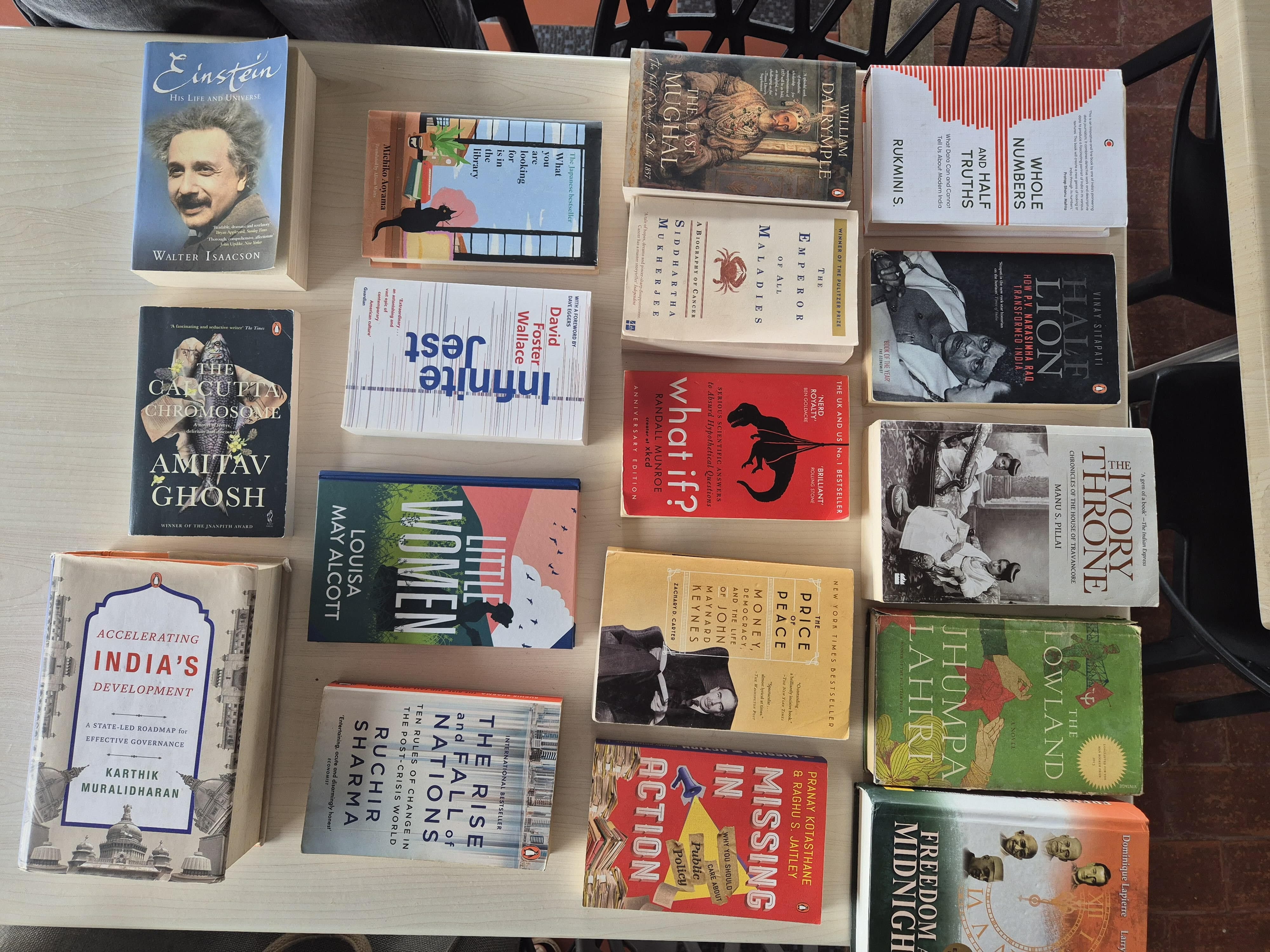
The Markets book club has been running for nearly a year. We have some avowed loyalists who come almost every weekend and nerd about their readings with us. But really, it’s become a great spot for many of us to talk to each other - even forge new friendships - without being distracted by any screen. It’s this in-person community that we’re really proud of building.
So, we’d love for you to join us! We host the book club every Saturday, 10:30-1 pm, in JP Nagar 4th Phase. Unfortunately, this location is fixed - we understand JP Nagar may be far for some. But this is the only place where we can host it smoothly. And we don’t host sessions online, either.
If you’d like to attend the book club, please keep the above in mind, and please reach out to: pranav.manie@zerodha.com!
LOVED how it went from city infra to fertility to digital infra.