
What We're Reading #15
A full package of reads this weekend!

Hi folks, hope you’ve had a great week!
Our team at Markets is always reading, often much more than what might be considered healthy. So, we thought it would be nice to have an outlet to put out what we’re reading that isn’t part of our normal cycle of content.
So we’ve started “What We’re Reading”, where every weekend, our team outlines the interesting articles — even books — that put our brains in seventh gear (if that even exists).
To make up for last week’s shortage, this edition has some hefty recommendations to make. They span the Iranian economy, a superb newsletter that spans the myriad aspects of global development, the SpaceX IPO, Jevons Paradox, and obviously AI. It's a whole goodie bag that should keep you occupied through the week :)
We also host a book club every Saturday that we talk about at the end. If you’d like to read with us, please feel free to join!
We’d also love to know what has piqued your interest, too! Please feel free to let us know in the comments.
What is Manie reading?
Yeganeh Torbati and Bozorgmehr Sharafedin, “How Iran Killed Its Economy” (link)
This is an incredible story on how the Iranian government killed a strong tech entrepreneurship wave that had taken off in the country. And it was all done in the name of sovereignty.
The centre of the story is Said Rahmani, a serial entrepreneur who took his learnings from the US and came back to Iran. One of his most successful ventures was launching a digital consumer electronics website — their version of Flipkart — which changed how Iranians shop for gadgets.
Iran’s tech wave was also unique. International sanctions made it difficult for them to access credit cards, which are primarily earmarked by the Visa or MasterCard protocols. They were forced to come up with creative, home-grown solutions to their problems, and they did.
However, to rain on this parade came the Iran Revolutionary Guard Corps (IRGC), led by their then-ruler Ayatollah Khamenei. Iran’s political economy is ruled by two types of organizations. One kind are large companies owned by the IRGC — effectively public-sector firms. The other kind is called bonyad, which is supposed to be a charitable trust that is exempt from taxes, but has been found to funnel funds to the IRGC instead of actually doing charity. Often, these bonyads are also partially owned by the state.
In effect, Iran’s private sector is quite small. And that’s by design.
Iran’s tech boom also coincided with a more optimistic time in the country. But by 2015, under Ayatollah Khamanei’s rule, the crackdowns began.
Said Rahmani’s fund, Sarava, was accused of “links to the West” — in tech, cross-border links are all too common, but also quite harmless. But just because, say, your advisor is American, or you have the stake of an American VC, you become the target of the state apparatus. State officials began asking for some form of protection money.
And unfortunately for Sarava, they also had a trailer scored to Queen’s “We Will Rock You” — and the Iranian state couldn’t stand any invasion of Western culture in their home.
There’s plenty more where that came from. IRGC officials raided and ransacked their offices, took a founder through intense interrogation, and more. And obviously, all of this sadly throttled what was essentially a home-grown movement that Iran could claim its own. Great story.
What is Pranav reading?
Let me break the format — I don’t have pieces to push at you. Instead, I’m here to tell you that you have to read David Oks. Here’s his Substack. Go, read! Shoo!
Ok, let me sell him a little more.
I have spent much of the last week reading David’s annoyingly thoughtful essays on a variety of rather disconnected topics, nursing that special kind of awe you have for people that are better than you at the very thing you do — when you no longer have the luxury of hiding behind the fiction that in another life, with different priorities, you could approach their level. To a fellow essay writer, he inspires abject resignation upon first contact.
But enough about me. Let me give you a glimpse of his ideas.
Just this week, he wrote an incredible essay on why India has failed to replicate China’s success. His was an idea that I’ve circled around before, pondering over many books and podcasts, without quite reaching there — that China tore its social fabric apart, and rebuilt it for a modern era, while India tried to make peace with its infinite social complexity. It was a brutal process. Tens of millions were crushed, while China grew disconnected to its cultural past. Despite the brutality, however, it created fertile ground for a new, industrial culture to take hold.
India’s journey has been more benign, in contrast. That is, in many ways, a good thing. But it has one singularly tragic outcome: too much of India is invested in keeping alive antiquated notions of a social order. Caste, gender, region, language — we fight over identities that should have died centuries ago, holding hostage the birth of something new. Our battle for modernity is an ugly, country-wide brawl, happening at once in every home and every street.
It’s hard to say how this ends. Perhaps we chance upon a synthesis; perhaps we shall eventually emerge into a society that is more efflorescent and more lively than anything top-down fiat will create. But for now, we lag well behind the world’s deputy superpower.
Oks clearly thinks a lot about these weird intersections between culture and economics.
In another stunning piece, Ochs writes about the unique DNA of Japanese firms, and how they differ from the classic, American-style, shareholder-centric, profit-maximising corporation. This was weirdly personal, in ways Oks may not have imagined. Zerodha, in some ways, is modelled on Japanese ideals, and reading Oks helped me understand my own workplace better.
Japanese firms, he writes, are simply built differently from the Western corporation. They run on strong bonds of loyalty, both between employees, and between a firm and its suppliers. Those cultural seeds allow a different structure — one where both information and authority flow laterally. Their incentives are such that a humble line worker could call for an entire production line to be halted because a small, local problem must be fixed. This is also why they’re capable of perfecting a wide array of business lines at once.
As a loyal salaryman myself (I’m being tongue-in-cheek, but only slightly so), this rings surprisingly true of our own aspirations, here in this little corner of JP Nagar, Bengaluru. Not perfectly, I’m sure. As Oks argues, you can’t separate an organisational culture from its wider milieu. But where I once thought we were simply odd, I can now say — hey, we aren’t weird, we’re just kinda Japanese.
Or try this piece on African funerals. Much of Africa, he writes, spends an inordinate amount of money on throwing massive, vibrant funerals that cost upwards of a year’s salary. This might sound weird and wasteful, until you remember the last wedding you went to, and then it all makes sense.
It all comes down to kinship. Their societies — perhaps more intensely than ours, but still quite like ours — revolve around the extended family. This is a durable way to live, especially when the world outside is given to chaos, and family is all you can trust. But they’re also rife with tall poppy syndrome, and heavily tax their most productive and dynamic members, expecting them to pull the weight of everyone else with them.
Modernity demands that you break out of the family, and learn to trust abstract, impersonal entities — like governments, markets or courts. Kinship ties routinely get in the way of that, as anyone navigating India will quickly recognise.
I’ll recommend one last piece, and perhaps the most unusual in this set: on why the weirdness of AI rhymes with the weirdness of human cultures.
Humans, he writes, are individually rather unremarkable creatures: we’re rather weak and unprotected, and while we’re smart, we aren’t that much smarter than other primates. The one thing we’re remarkably good at, however, is imitating each other with incredible fidelity. We all have a knack of finding others that seem to know what they’re doing, and then copy them. That single fact accounts for so many of our capabilities.
It also has a downside, however: rarely do we sift through the practices of others, evaluating what genuinely works, and discarding everything that doesn’t. Nor do we have the faculties for that, especially when the world is too complex for simple chains of causality. We take in entire stacks: that which is good and that which is utter bullshit, all at once. Sometimes the bullshit is eventually weeded away. Sometimes, it stays on, ossified under the generous umbrella of “tradition”.
AI models are rather like that. They go through something called “post-training”; once their core language faculties are set, we push them to train on small, curated samples of data. These models, having previously learnt broad correlations between words, now learn to mimic those specific samples. That gives them their mind-boggling range of capabilities. But like all the weirdness within culture, it teaches them an odd range of tics — fingerprints of all the data they were fed at the very end.
Substack, once you follow the right people, routinely throws up incredible writing. And yet, Oks’ blog features at the uppermost end of the distribution you’re likely to see here. Give it a read!
What Aakanksha is reading
The SpaceX IPO is not what you think it is (link)
I want to talk about the SpaceX IPO because something genuinely funny is happening in real time.
SpaceX filed its S-1 in May, applied to list on Nasdaq under the ticker SPCX, and is targeting a $1.75 trillion valuation, raising $75 billion, which would make it the largest IPO in history. The hype is enormous, everyone wants a piece. But this doesn’t mean they are rationally thinking about it, I say this because, Virgin Galactic, which trades under SPCE, one letter away from SPCX, has gone from roughly $2 to more than $7 in recent weeks, despite the company not doing particularly well by any measure. Retail investors trying to buy SpaceX have been accidentally buying Virgin Galactic and making money on it because enough other confused people did the same thing.
Anyway, the actual SpaceX IPO is also quite something.
In Q1 2026, SpaceX posted an operating loss of $1.9 billion. Starlink brought in $4.4 billion in operating income, and xAI lost $2.5 billion in the same quarter alone. You are not buying a rocket company. You are buying a rocket company that has absorbed a social media platform nobody wants to advertise on and an AI lab burning money at a pace that would make a government blush, and the prospectus is hoping you focus on the rockets.
What happened is a Russian doll-like series of mergers, where Twitter was folded into xAI, which was then acquired by SpaceX. So SPCX is Starlink plus Falcon 9 plus Grok, which has 117 million monthly active users and 1.9 million who actually pay for it, plus whatever X is now. Morningstar’s independent valuation landed at $780 billion, less than half the asking price. Goldman Sachs, who is getting paid to take this public, sees it differently. Funny how that works.
Normally 90 to 95 percent of any IPO goes to institutions and retail gets the crumbs. SpaceX has reserved up to 30% for retail, and Fidelity dropped its eligibility threshold from $500,000 down to $2,000. The largest IPO in history is now open to anyone with a brokerage account and two lakh rupees worth of conviction. They are being very generous, I wonder why.
SpaceX built a staggered lockup that lets insiders sell well before the standard 180 days. Musk won’t sell for a year, but other insiders can start as soon as the second trading day after the first quarterly earnings report, likely August
None of this means SpaceX is a bad company, the rockets are real, Starlink works, and there’s a version of this where xAI actually becomes something. But there’s a difference between a good company and a good investment at a given price
What I am now realizing is, some will buy SPCX, some will accidentally buy SPCE. I’m not sure which group has the worse deal.
What Shahid is reading
I use AI every day to write, research, and think through ideas. Like most people, I usually focus on what the technology gives me, rather than what it consumes. It is easy to forget the massive physical infrastructure humming behind a simple text prompt.
That blind spot is why a United Nations report on the energy costs of AI caught my attention.
I expected a standard breakdown of electricity grids, water usage, and carbon footprints. The report covered those. But a different economic concept stuck with me instead.
The Jevons Paradox.
The premise is counterintuitive. When a technology becomes more efficient, total consumption of the resource does not always fall. Often, it rises.
Look at LED bulbs. They use a fraction of the electricity of traditional incandescent bulbs. On paper, global energy use for lighting should have plummeted. Instead, cheaper lighting changed our behavior. We started lighting up spaces we used to leave dark. Offices stayed brighter, cities added decorative displays, and homes installed more fixtures. We did not just save energy. We expanded our definition of what needed light.
AI seems poised to follow a similar path.
The common assumption is that making AI models smaller, faster, and more efficient will automatically shrink their environmental footprint. I am no longer sure it is that straightforward.
AI is becoming incredibly cheap to run. As tech companies drive down the computing cost per prompt, they aren’t just saving energy. They are making it viable to embed AI into everything. If the cost of a single query drops to near zero, we will not simply use less power to do the same tasks. We will invent entirely new categories of products, automated workflows, and digital services that were previously too expensive to exist.
This creates two opposing forces. Efficiency reduces the resources needed per task. But lower costs exponentially explode the total number of tasks we run.
The report does not settle which force wins out. Instead, it leaves us with a deeper question about our relationship with technology. As we make intelligence cheaper and more efficient, should we really expect to consume less of it?
What is Kashish reading?
How the Electrical Grid Is Being Rebuilt for AI | Bloomberg Primer (link)
Whenever we talk about the energy transition, most of the discussion revolves around generation — solar, wind, batteries, nuclear, and so on.
But generation is only half the story. The electricity still needs to move from where it is produced to where it is consumed. And in many ways, the grid is the harder problem.
That’s what makes this video worth watching.
The Rainmatter team shared it internally, and what I liked about it is that it works both as a primer and as an exploration of new ideas. If you’ve never really understood how the grid works, this is a good place to start. And if you already have some familiarity with it, there are a few interesting solutions discussed.
The first is around transmission capacity. As electricity demand grows and renewables become a larger part of the mix, we’ll need to move far more power across the grid. The obvious answer is to build more transmission lines, but the video discusses another possibility: superconducting cables. The idea is that if electricity can be transmitted more efficiently, you may not need as many new lines as you otherwise would.
The second idea is synchronous compensators, which became particularly relevant after the Spain blackout in 2025. One of the challenges with renewable-heavy grids is that they can lack the inertia traditionally provided by large thermal power plants. Synchronous compensators help address that problem and improve grid stability. I won’t get into the technical details here, but the video does a good job explaining why they matter.
The third idea is mini-grids. Instead of relying entirely on one large, centralized grid, smaller local grids can serve specific regions and communities. This is something we already see in parts of India and increasingly across Africa, where extending a national grid everywhere is often impractical.
Overall, this is a light watch, but a surprisingly informative one. Most discussions on the energy transition focus on how we generate clean electricity. This video is a good reminder that moving that electricity reliably may be just as important.
We have a book club!
Here’s another reminder of something that we’re pretty bad at advertising: our book club.
So here’s an image of our fairly-impressive book collection to attract you. Yes, they’re not just for show, and we do read them, alongside some coffee/tea and sandwiches.
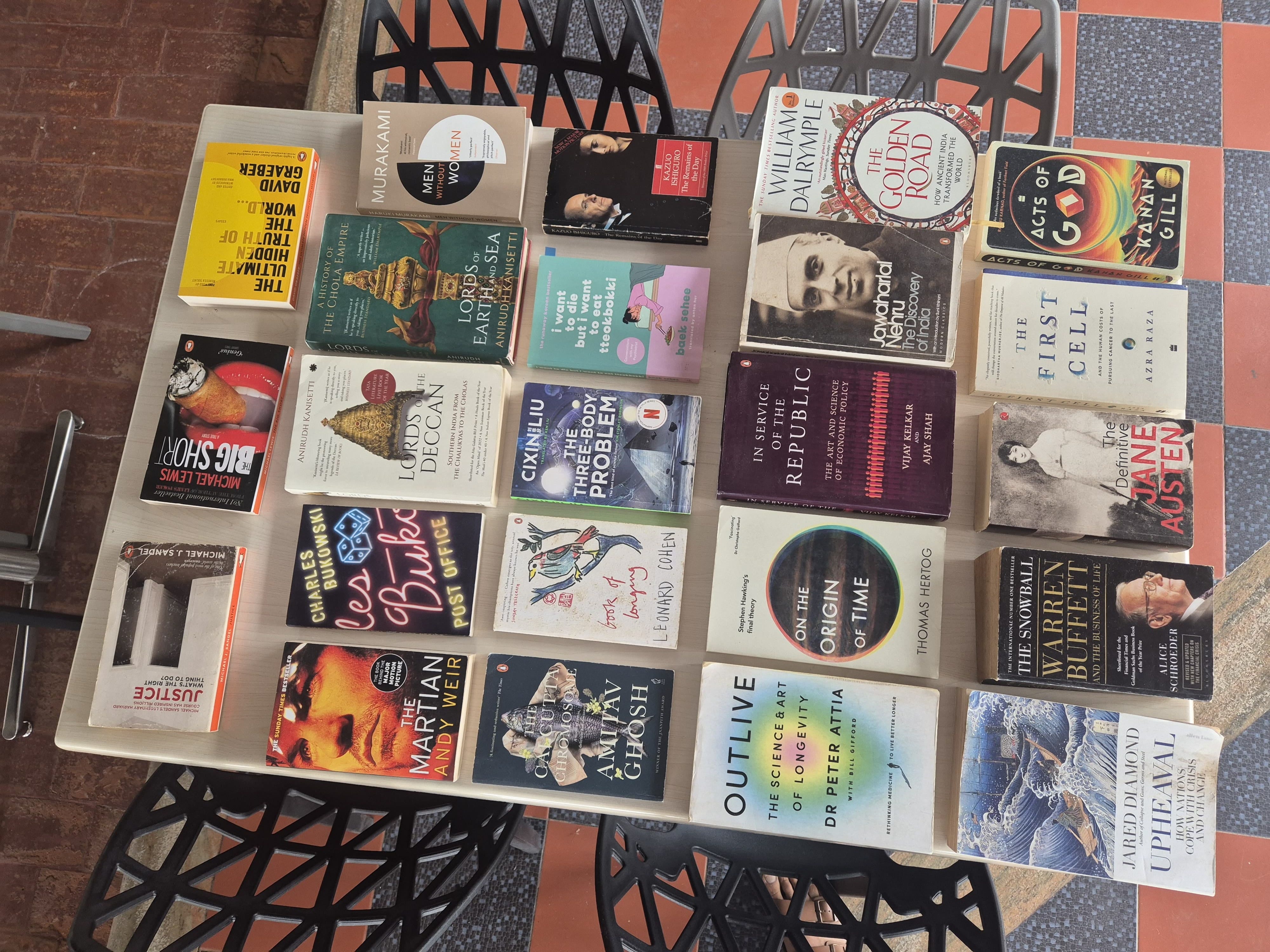
The Markets book club has been running for nearly a year. We have some avowed loyalists who come almost every weekend and nerd about their readings with us. But really, it’s become a great spot for many of us to talk to each other - even forge new friendships - without being distracted by any screen. It’s this in-person community that we’re really proud of building.
So, we’d love for you to join us! We host the book club every Saturday, 10:30-1 pm, in JP Nagar 4th Phase. Unfortunately, this location is fixed - we understand JP Nagar may be far for some. But this is the only place where we can host it smoothly. And we don’t host sessions online, either.
If you’d like to attend the book club, please keep the above in mind, and please reach out to: pranav.manie@zerodha.com!
Thanks for this post! And for all the cool links.