
What We're Reading #14
Compute constraints, Indian deeptech, and what makes a successful Indian PSU.

Hi folks, hope you’ve had a great week!
Our team at Markets is always reading, often much more than what might be considered healthy. So, we thought it would be nice to have an outlet to put out what we’re reading that isn’t part of our normal cycle of content.
So we’ve started “What We’re Reading”, where every weekend, our team outlines the interesting articles — even books — that put our brains in seventh gear (if that even exists).
This week is a little light on reading, primarily because our team isn't really at full capacity. But we definitely have some very interesting recommendations: from the constraints that could make AI engineering more efficient, to Indian deeptech, to the meticulous study of India’s foremost PSU in the coal industry.
We also host a book club every Saturday that we talk about at the end. If you’d like to read with us, please feel free to join!
We’d also love to know what has piqued your interest, too! Please feel free to let us know in the comments.
What is Kashish reading
The end of free compute is the beginning of better engineering (link)
This piece by The Ken makes a very interesting point about the economics of AI usage.
Over the past week, companies like Uber and Microsoft have reportedly started becoming less liberal with how employees use AI tokens, especially for tools like Claude Code. That doesn’t mean they are scaling back on AI. If anything, it points to something more basic: the era of free or heavily subsidised compute is probably ending.
For the last year or so, a lot of AI usage has felt almost unconstrained. You could ask an AI tool to write code, rewrite code, debug code, generate 5,000-word drafts, and then do it all over again without thinking too much about the cost behind it. But that was never going to last forever. Compute is expensive. And as AI companies move closer to IPOs or are forced to show a clearer path to profitability, those costs will eventually have to be passed on.
That sounds like bad news for people who have been using AI very liberally. But the piece makes a more interesting argument: constraints may actually make AI use better.
Good engineering has always emerged from constraints. Limited memory, limited compute, limited bandwidth, limited time — these constraints forced people to think clearly about what they were building and why. But with AI, for a brief period, it felt like the constraint had disappeared. You could generate endlessly, which also meant you could generate carelessly.
Once tokens become expensive, that changes. People will have to think harder before prompting. Engineers will have to be more deliberate about what they ask AI to do. Writers will have to think twice before asking for yet another long draft. The friction goes up, but so do the stakes.
And maybe that is not a bad thing.
A lot of AI slop exists because generation is too cheap. When the cost of producing something is near zero, the incentive to make it good also goes down. But if AI tokens become a constrained resource, people may start optimizing for them the way they optimize for any other scarce resource.
That’s what makes this piece interesting. The end of free compute may feel like a step back for AI adoption. But it could also be the beginning of more thoughtful AI use — fewer careless outputs, better prompts, better engineering, and hopefully, less slop.
Accelerating homegrown deep-tech to better utilise India’s resources (link)
Whenever we talk about deep tech, the conversation usually goes straight to software, AI, semiconductors, robotics, or something else that sounds obviously “tech”.
And that makes sense. A lot of the frontier in deep tech is digital, and the US and China are clearly moving very fast there. But deep tech doesn’t have to mean only software or AI. It can also mean using science, engineering, and first-principles thinking to solve very physical problems.
That is where I think India’s opportunity is particularly interesting.
This piece by Omnivore is about deep tech opportunities in India, but not in the generic “India has a large market” kind of way. It is about Indian entrepreneurs building deep-tech solutions for very India-specific problems — fertilizer imports, petrochemical dependence, climate finance, agricultural waste, and so on.
The good thing about working at Zerodha is that I don’t just get to read, write, and research about these things. Through my limited involvement with Rainmatter, I also get to see some of these ideas up close. This piece was shared with me by friends at Rainmatter, and it was a very good reminder that a lot of exciting innovation in India may not look like another SaaS dashboard or AI wrapper.
Without getting into too many details and doing injustice to the nuance of the piece, the broad idea is this: some of India’s most important deep-tech opportunities may lie in solving our own physical constraints. How do we reduce fertilizer import dependence? How do we reduce petrochemical dependence? How do we turn climate finance into something more practical and deployable? How do we use biomass more intelligently?
That last bit especially stood out to me. Two of the companies discussed in the piece seem to have biomass as a common theme, and that is something I’m personally very excited about. India has a lot of agricultural residue, waste, and underused biological material. If entrepreneurs can turn that into inputs for energy, chemicals, materials, or agriculture, the opportunity is not just climate-friendly — it is also deeply economic.
And the best part is that if these solutions work in India, they probably have relevance outside India too. Many emerging markets face similar problems around imports, energy security, climate resilience, and agricultural waste. So the domestic market becomes both a testing ground and a launchpad.
That’s what makes this piece worth reading. It broadens the way we think about deep tech. It is not just about building for the digital frontier. Sometimes, it is about solving very old, very physical problems with new science.
What Manie is reading
Rohit Chandra, Adaptive State Capitalism in the Indian Coal Industry (link)
When you work in a job where you have to research stories everyday, you can't help but feel how much you don't know about the history of things that have led up to whatever current moment we're in. And no object of analysis makes you feel that more strongly than the Indian economy.
Which is why this recommendation is very significant.
Rohit Chandra is a tenured professor at IIT Delhi. He specializes in the history of Indian energy - in particular, the nature of our dependence on coal. And his view of Indian energy also informs his view of the Indian economy. I recently started to read his PhD thesis at the renowned Harvard Kennedy School. The thesis is about how one PSU - Coal India - navigated the torrent of changes that the Indian economy has been through, especially since 1991.
This is a massive read that I only started this week, and I'm still left with a lot of pages. But not only is this thesis about coal, but it is also about how Indian PSUs really work. Prof Chandra tries to get us to pay attention to the elements of PSU success, and why they might often go beyond the cliches. Here's a passage from his introduction:
“Given that many SOEs operate in environments where they continue to have large market share, there is an implicit assumption that their financial success comes from lack of competition, their dominance of rent-thick sectors (eg. natural resources) and their closeness to the Indian administrative state. While these assessments have some truth, the political and operational constraints on the management of many of these SOEs were and remain just as organisationally burdensome as the liberties extended to them through sectoral dominance and industrial policy. This is true not just in India, but also more widely across the developing world.”
India, for instance, depended on state-owned enterprises (SOEs) to kickstart industrialization. China’s success in attracting foreign direct investment was also led by SOEs.
And yes, while it's true that PSUs (at least the largest ones) get a lot of financial leeway through government funding, the accountability attached to that funding never goes away. It's why, Prof Chandra notes, “many of the biggest financial scandals in developing countries have had been associated with large industrial SOEs.”
As to why Coal India has been a success, Prof Chandra notes some interesting features. For one, it was really able to maintain a significant level of operational independence from the government. Believe it or not, PSUs hate state interference almost as much as a private firm. Secondly, Coal India's success did depend on what Prof Chandra calls:
“bureaucratic entrepreneurialism: individuals or groups of managers at CIL innovating and taking large personal risks to overcome inertia within and outside the organisation.”
In many ways, these are some interesting indirect parallels to private firms. The actions of entrepreneurs, operational independence (from the state / external investors), and even some forms of competition (for private, it's market-based, for PSUs, it's inter-bureaucratic).
I'm really enjoying this paper so far. I think its best achievement is not purposing PSUs in opposition to private firms as people always do. There are industries where one suits more than the other, and Prof Chandra is careful to note that. What he does is foreground the importance of why we needed PSUs to start the feedback loop of investment in India after independence, why coal is one of those national strategic sectors that needs PSU leadership, and how they test themselves in the face of market competition.
This is a fantastic paper from an academic that you may want to continually follow for his excellent work on Indian energy and India's economic history.
We have a book club!
Here’s another reminder of something that we’re pretty bad at advertising: our book club.
So here’s an image of our fairly-impressive book collection to attract you. Yes, they’re not just for show, and we do read them, alongside some coffee/tea and sandwiches.
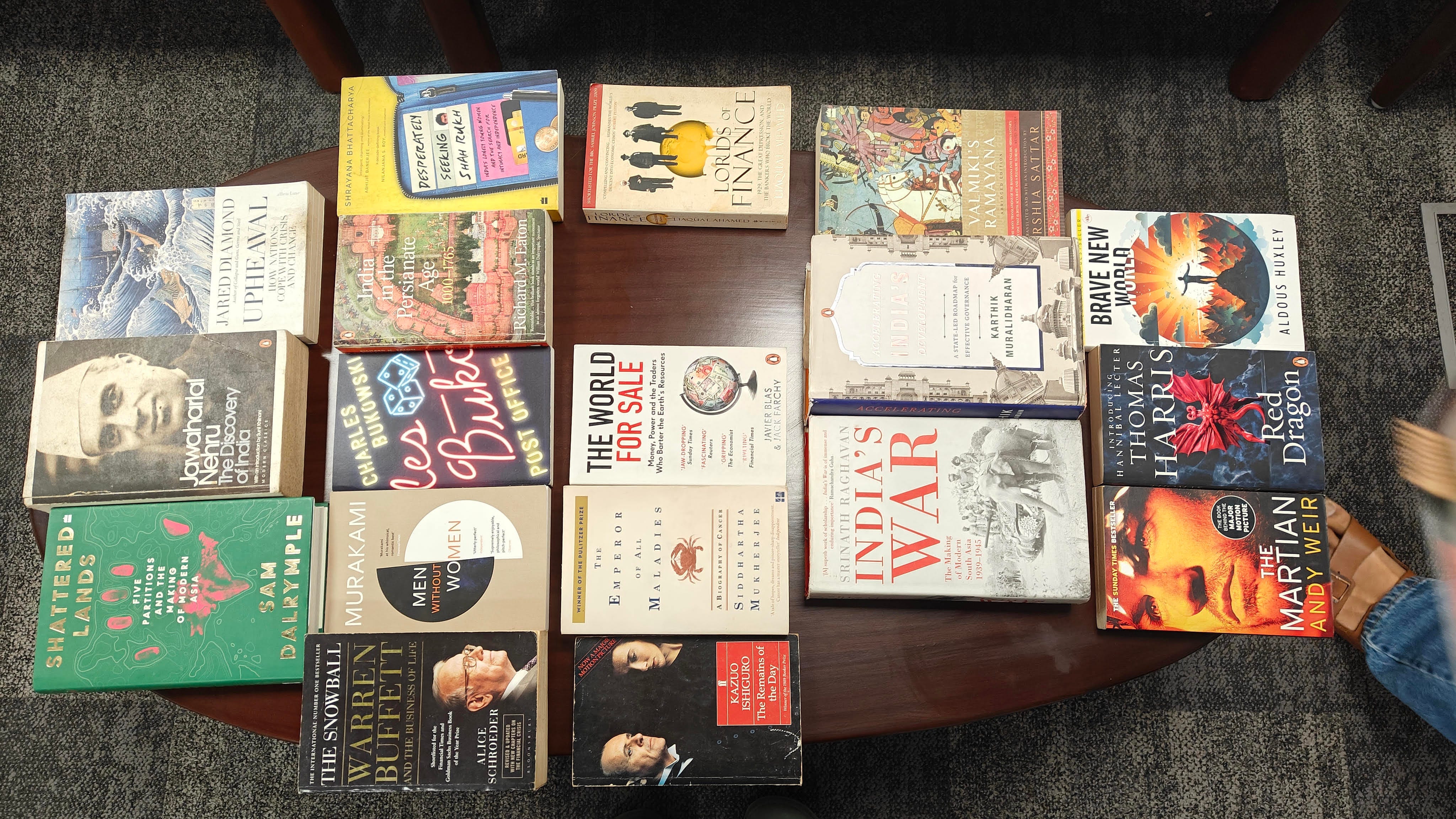
The Markets book club has been running for nearly a year. We have some avowed loyalists who come almost every weekend and nerd about their readings with us. But really, it’s become a great spot for many of us to talk to each other - even forge new friendships - without being distracted by any screen. It’s this in-person community that we’re really proud of building.
So, we’d love for you to join us! We host the book club every Saturday, 10:30-1 pm, in JP Nagar 4th Phase. Unfortunately, this location is fixed - we understand JP Nagar may be far for some. But this is the only place where we can host it smoothly. And we don’t host sessions online, either.
If you’d like to attend the book club, please keep the above in mind, and please reach out to: pranav.manie@zerodha.com!
I’d really like someone of you to write on how's lords of finance. I really liked it. But could only read in bits and pieces a few years back.
💗💫 wow