
What We're Reading #13
Economics of parenting, Chinese and Japanese overcapacity, US healthcare, and the ₹.

Hi folks, Pranav (Manie) here. Just wanted to drop a quick note today instead of our usual intro.
We started What We’re Reading because, well, our boss Bhuvan realized that we should have an outlet to yap. We often read about extremely interesting things that don’t always fall into the mandate of running The Daily Brief everyday.
Somehow, this extremely random experiment, which is 13 editions in, is seeing plenty of engagement every weekend without fail. So I wanted to thank you for that.
This edition couldn’t be more varied. Thankfully, this time around, it has no pieces related to AI, warfare, or AI-enabled warfare (if you’re new, you might want to take a look at past editions to see what I mean). I think eventually we all got tired of that.
Our picks this time mostly circle good old economics and finance, which are always fun to read. From Kashish’s rec to financial risk-taking for parents, to my namesake quoting an ode to the Indian rupee by ex-RBI governor DV Subbarao, to my own recs on East Asian overcapacity and the US trade deficit, this is a very colorful set.
We’d also love to know what has piqued your interest too lately! Please feel free to let us know in the comments.
Lastly, we also host a book club every Saturday that we talk about at the end. If you’d like to read with us, please feel free to join!
What is Kashish reading?
Investing When Fewer Expect to Parent: Fertility Expectations and Financial Risk-Taking (link)
This is a paper on how fertility expectations shape financial risk-taking.
The idea is intuitive enough. Your investment decisions today are not just a function of your income, age, or risk appetite. They are also shaped by what you think your future consumption will look like.
And few things change expected future consumption as meaningfully as planning for a child.
If you expect to have a child, you are also implicitly expecting a very different expense profile in the near future. More predictable expenses, more responsibilities, and probably a shorter effective time horizon for some parts of your money. In that world, it makes sense that your willingness to take financial risk goes down.
That’s what this paper tries to measure. Using representative data from three countries, the authors find that childless adults who do not expect to have children are meaningfully more likely to invest in stocks than those who do expect children. One version of the result puts the gap at around 15–40%.
This is not necessarily a shocking finding. If anything, it feels obvious once you hear it. But it is still an interesting link to see measured properly.
A lot of household finance is ultimately life-cycle finance. People don’t make portfolio decisions in a vacuum. They make them while thinking about rent, EMIs, school fees, job risk, ageing parents, children, or the possibility of children.
That’s what makes this paper worth reading. It is a simple reminder that “risk-taking” is not just a personality trait. Sometimes, it is just a reflection of what people think their life is about to demand from them.
What Manie is reading
Advait Arun, Varieties of Overcapacity (link)
Advait Arun is an analyst at the US-based think tank Center for Public Enterprise. On The Daily Brief, we covered an excellent paper he wrote on the nature of the AI bubble. If you haven’t read it yet, I highly urge you do before, well, the bubble bursts.
This recommendation is from his personal blog. It deals with a very loaded term that we hear all too often about in business news: overcapacity. It is a direct response (a celebratory one rather than one of attack) to another essay (which I’m yet to read): Capacity Returns by Jeremy Wallace.
Obviously, overcapacity (and the resulting price wars) is almost always mentioned in the context of China. But what Arun does here is get into the political economy of overcapacity. Here’s how he describes Wallace’s essay, which gets into the deceptively simple reason of why China likes having overcapacity, despite Xi Jinping’s own recent tirades on the tradeoffs it involves:
“Capacity Returns states upfront that excess capacity across the Chinese industrial system is a quality that broadly affords resilience, albeit at the cost of profit maximization. The reasons why are fairly obvious, and only more so in light of the U.S. war on Iran. The option value of possessing spare industrial capacity is immensely “in the money” during a shortage of primary goods that will inevitably throttle the construction of new industrial capacity.”
He gives the example of the polysilicon industry, which is a feeder industry to Chinese solar modules. In fact, the industry did try to cartelize and consolidate, but China didn’t like it at all. China is very selective about allowing mergers and acquisitions as a solution to this problem.
So, that leaves one response to price wars: innovation, particularly in processes rather than products. Which, as we know now, China is pretty capable of doing.
Arun also compares China with one other historical example of “overcapacity”: Japan. Their political economy was a lot more different, though. The Japanese economy was dominated by big corporations, and the Japanese government actively encouraged consolidation, and sometimes, even cartelization. Unlike China, Japan just did not tolerate price wars.
I really want to continue yapping about this essay. I love reading about competition, innovation and industrial policy more than anything. But I’ll stop here, and I think you should get into it.
Karthik Sankaran, American healthcare costs drive global imbalances (link)
Moving on from the Chinese oversupply debate, we now go to the mirror image of this problem: the American trade deficit.
The first edition of What We’re Reading had me recommending a different piece by the same person. But that’s how awesome I find Karthik Sankaran.
His ideas on globalization, trade, and geopolitics are extremely refreshing. He is perhaps the intellectual I’m closest to ideologically, and I will always shill his writing. Hopefully, one day, we’re able to invite him for a podcast on Markets!
This latest essay by him on Financial Times’ Alphaville blog is yet another banger. If you follow Karthik on Twitter, you might know that he regularly indulges himself in debates about global trade imbalances. How much does Chinese overcapacity contribute to trade imbalances? What is the role of the dollar’s dominance — and the global trade architecture administered by the US — in this context?
On that note, Karthik has an incredible new contribution to the debate. He believes that America’s healthcare costs are a key contributor to the US trade deficit, and therefore, the global trade imbalance. In his eloquently simple words:
“But it might help to be clearer. If persistent surplus countries are under-consuming, persistent deficit countries are likely to be over-consuming. And what the biggest deficit country in the world is consuming at a massive scale is healthcare.”
“At roughly 17 per cent of GDP, the US spends at least an “extra” 5 per cent of GDP on health care compared to some of its closest peers, but with worse outcomes in both coverage and results. Around 27mn Americans are uninsured, and average US maternal mortality rates across all groups are multiples of those seen in the UK or Germany.”
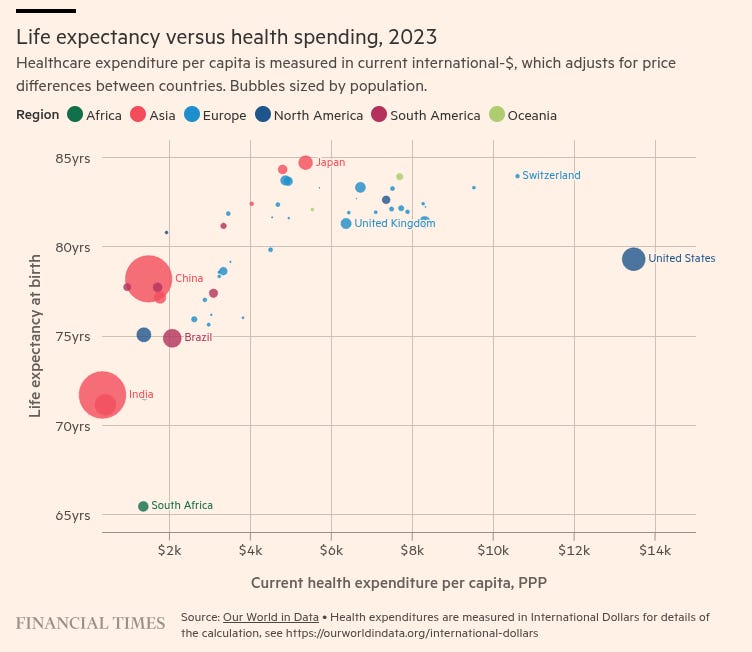
See, healthcare isn’t like manufacturing. It’s not a tradeable service. And the US spends way too much for the healthcare outcomes it does get. That increases the domestic wages and costs of that sector, which eventually spills onto other sectors. Eventually, this issue makes it expensive to produce other things, making your exports less competitive.
And American healthcare is just really inefficient:
“High insurance costs are a function of extremely high hospital and procedural costs. In a recent essay, Dr Zack Cooper, an associate professor at Yale’s School of Public Health and its Department of Economics, noted that hospitals earn $29,000 for a hip replacement covered by private insurance, and $16,000 for one covered by Medicare. Meanwhile the German system pays hospitals $9,400 for the same operation.”
Of course, this spills onto global trade. The unencumbered rise of non-tradeable sectors in the US hurts American manufacturing. But, Karthik argues, since US healthcare has a strong lobby, the finger will never get pointed there. Instead, countries like India, Bangladesh, even China — basically any nation slapped with US tariffs — are made the villains. Imports are held as the culprit, and not the domestic order of the US economy.
It’s a short, but killer essay, from one of the best in the business.
What is Pranav reading?
Duvvuri Subbarao, In defence of the rupee: Lessons from the 2013 crisis (link)
Doing a rather newsy show, I’m routinely stuck in a weird dissonance: here, events transpire that shall change the world forever; there, people carry on with their lives unaffected (directly), neither knowing what happened, nor caring much that they don’t. Once you know something that feels important, it fills you with fury when nobody else gives a damn.
Much more frequently, though, I find myself on the other side, floating in the dream-like bubble of my mind, oblivious to something deeply important that is moving the world.
I was a wee college third year back in 2013, testing out different versions of a “serious” adult personality, while falling in love with every second girl that smiled at me. Outside in the financial world, though, the mood was apocalyptic. I vaguely remember chatter, back then, of how the placements that year might be poor. I didn’t realise, however, that the rupee was battling a once-in-a-decade shock, one of the world’s “fragile five” economies that was trying desperately to survive. It would be another decade before I would finally learn of “taper tantrum” that, in its day, would have felt like the sky would soon fall in.
The champion of that battle, former RBI Governor Duvvuri Subbarao, just penned a piece on another terrible struggle the rupee is waging today, and what lessons 2013 can teach us.
I’ll leave it to you to read the piece, but his meta-point deserves a mention. The RBI governor in a currency crisis has a thankless job. They must juggle double-edged swords before a nervous, panicked crowd that screeches and screams at each wobble, seeing a laceration in any little scratch. That’s the sort of moment we’re living through today, with the USDINR lurching to the dreaded triple-digit mark.
This crisis will pass, like all the others. It may even become a spot of good news; a boost to Indian exporters who will nudge out more technically proficient rivals on the back of currency math alone.
Somewhere, there’s an oblivious 19-year old that is imagining their future children because a girl sent them three texts in a row, who will only chance upon our moment a decade later. When they do, perhaps they, too, will only see another artful juggling act, and marvel at how foolish we all were to be so terrified.
We have a book club!
Here’s another reminder of something that we’re pretty bad at advertising: our book club.
So here’s an image of our fairly-impressive book collection to attract you. Yes, they’re not just for show, and we do read them, alongside some coffee/tea and sandwiches.
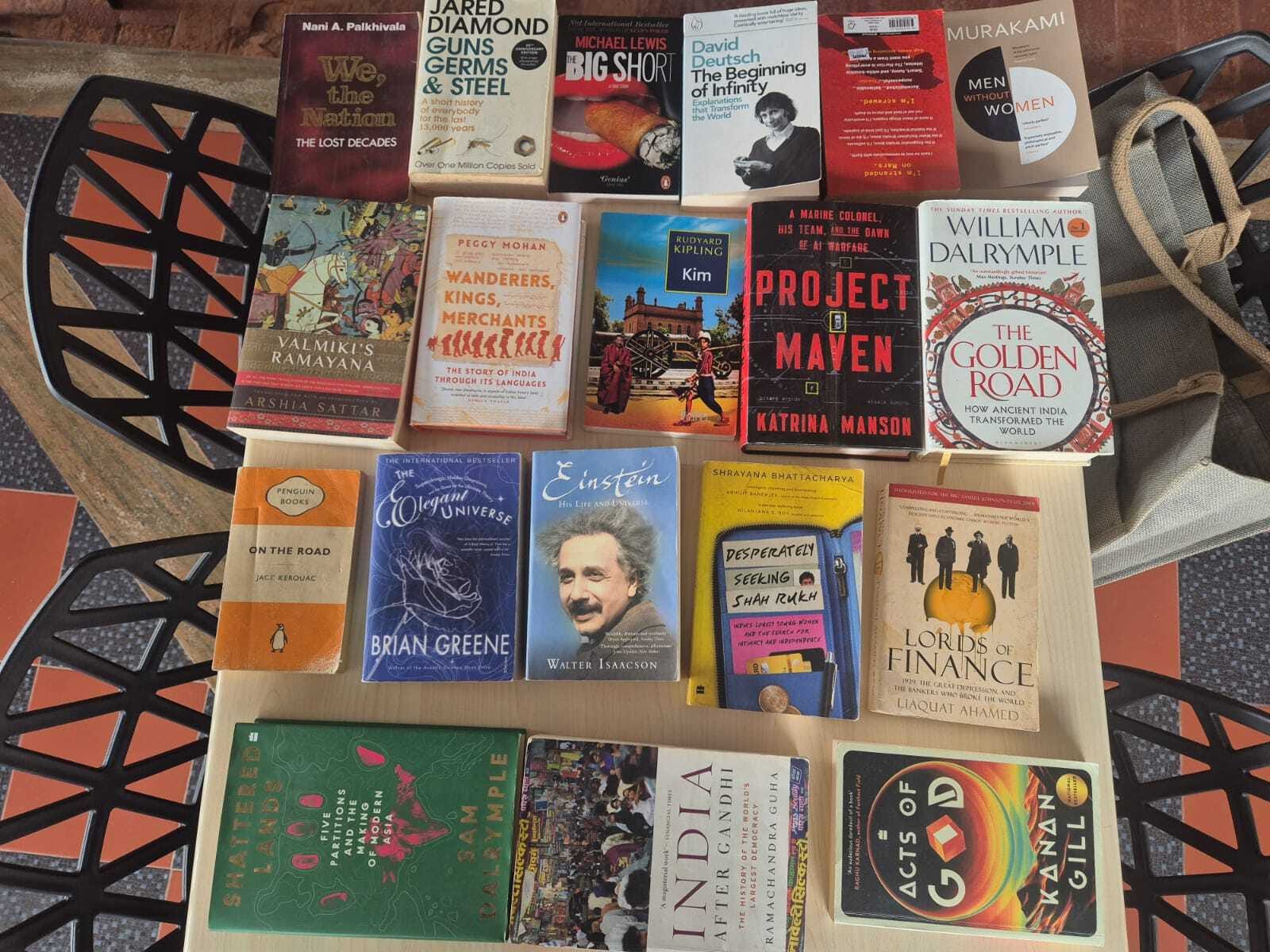
The Markets book club has been running for nearly a year. We have some avowed loyalists who come almost every weekend and nerd about their readings with us. But really, it’s become a great spot for many of us to talk to each other - even forge new friendships - without being distracted by any screen. It’s this in-person community that we’re really proud of building.
So, we’d love for you to join us! We host the book club every Saturday, 10:30-1 pm, in JP Nagar 4th Phase. Unfortunately, this location is fixed - we understand JP Nagar may be far for some. But this is the only place where we can host it smoothly. And we don’t host sessions online, either.
If you’d like to attend the book club, please keep the above in mind, and please reach out to: pranav.manie@zerodha.com!
Interesting
Here’s my post about the Capacity Returns essay. https://thechinalab.substack.com/p/returns-to-capacity?r=1e3&utm_medium=ios