
What We're Reading #12
Some very spicy reads this time, and one humongous podcast!

Hi folks, hope you’ve had a great week!
Our team at Markets is always reading, often much more than what might be considered healthy. So, we thought it would be nice to have an outlet to put out what we’re reading that isn’t part of our normal cycle of content.
So we’ve started “What We’re Reading”, where every weekend, our team outlines the interesting articles — even books — that put our brains in seventh gear (if that even exists).
We also host a book club every Saturday that we talk about at the end. If you’d like to read with us, please feel free to join!
We’d also love to know what has piqued your interest, too! Please feel free to let us know in the comments.
What Kashish is watching/reading
Intermission E02 - Bajaj Finance, The Ken (Link)
The Ken has started this series called Intermission, where they take one iconic Indian company and go very, very deep into its history. The first episode was on Asian Paints, and this one is on Bajaj Finance. The stated idea of the series is to dive into the histories of iconic Indian companies, and the Bajaj Finance episode traces how what began as a side arm of a scooter company eventually became one of India’s most important consumer credit machines.
I’m only halfway through this one, so I won’t pretend to offer grand lessons from it. But that’s also kind of the point. This isn’t the sort of thing you need to sit down with a notebook for. It’s a four-and-a-half-hour conversation that you can dip in and out of while eating, walking, travelling, or doing nothing in particular.
More often than not, these episodes are business lessons, economics lessons, and history lessons all at once. You get the decisions, the people, the context, the accidents, the timing, and the larger forces that shaped the company. That narrative quality makes the whole thing far more enjoyable than a conventional “company analysis” podcast.
And Bajaj Finance is a particularly good subject for this treatment. It sits at the intersection of so many things: India’s consumption story, the rise of NBFCs, consumer credit, distribution, risk, technology, and the changing aspirations of the Indian middle class.
Again, I’m not recommending this because I have some neat takeaway to offer. I’m recommending it because it’s just a really good, slow, detailed conversation to tune into if you’re interested in business, history, and finance. There are very few podcasts that do justice to Indian business houses at this level of depth. This one does.
Why Vijay Sales’ billionaire owners have no use for a family office—or even a wealth manager, The Ken (link)
This piece reminded me of a conversation I had back home.
My father is a CA, and one of his clients is a pharma business family in Ambala. They aren’t some giant billionaire family, but they’re definitely among the wealthier families in the city. At some point, they learnt that their CA’s son works at Zerodha and knows a bit about finance, so they wanted to speak to me about managing wealth.
When I spoke to them, I realised something that felt almost absurd to me at the time. Most of their wealth was in the business. Even the money they did pull out often found its way back into the business, either directly or in their personal capacity as loans to the company. The business was the wealth engine, and everything else seemed secondary.
As someone who is passionate about capital markets, my instinct was to find this strange. Why wouldn’t you diversify? Why wouldn’t you build a proper portfolio? Why wouldn’t you allocate to equities? I didn’t want to aggressively pitch them on the stock market because, clearly, they were smart people. They had built real wealth. But a part of me still wanted to nudge them towards what I thought was the more “proper” way of managing money.
Reading this Ken piece on Vijay Sales made that conversation click a little more.
Because, ultimately, all of this is just capital allocation. Whether you set up a family office, hire a wealth manager, buy stocks, or keep putting money back into your own business, you are answering the same basic question: where can this capital earn the best risk-adjusted return?
And for families that have spent decades building and running a business, the answer may very reasonably be: right here.
They understand their own business in a way no wealth manager will. They understand the risks, the cash flows, the suppliers, the customers, the seasonality, the small operational levers, the people, the geography, the politics, the credit cycles. If they can reinvest capital in something they understand deeply, and that business can compound at 25–30%, why should they be desperate to chase market returns elsewhere?
Of course, you can make a strong case for diversification. At some level of wealth, it probably makes sense to have money outside the business, if only to protect the family from one concentrated shock. But there’s also a slightly lazy way in which we assume that sophisticated wealth must look like a stock portfolio, a family office, or a neatly constructed asset allocation plan.
Sometimes, sophistication is knowing exactly where your edge is.
Warren Buffett once said that diversification is protection against ignorance. That line is often overused, but it fits here. A lot of these business families are not ignorant. They may not speak the language of modern wealth management, but they understand capital allocation in the language that matters most to them: their own business.
That’s what made this piece so interesting to me. It is not just a story about Vijay Sales or family offices. It is a reminder that the stock market is not the only place where compounding happens. For many business families, the best investment they will ever make is still the business they already know how to run.
What Manie is reading
Dani Rodrik, How I Became a Manufacturing Skeptic (link)
This piece is, without exaggeration, a contender for “the most provocative thing I’ve read all year”.
Dani Rodrik is one of the finest economists of our time, perhaps best known for popularizing the idea of “premature deindustrialization”. He brought into the mainstream many core ideas of industrial policy, and ensured that every developing country made manufacturing their undying focus if they were serious about achieving prosperity.
Which makes his latest article all the more bewildering.
In this article, Rodrik states his belief that many countries have tried – and failed – to pursue an industrial policy to bolster manufacturing. He highlights examples like Ethiopia and Mexico, which aggressively did so for various industries. But the successes of those policies were not broad-based. Unlike China or Vietnam, their manufacturing industries did not grow enough to spread the productivity benefits of making real things to a large population.
That model, which Rodrik has propagated for so long, is now, in his words, not viable anymore for poor and developing countries.
Conversely, Rodrik also believes that services might show a way out. This is where all the controversy lies. Industries like telecom, transportation, financial services, education aren’t massive workforce absorbers like manufacturing. They don’t make “real things” that people use. And all wealth comes from real things. In fact, without real things, the services layer doesn’t exist.
But Rodrik highlights success cases where that has happened. Indian IT, of course, is chief among them. Moreover, Rodrik’s argument for services-led growth ties somewhat with what another economist, Richard Baldwin, said about the globalization of services (which I highly recommend reading). If you remember, a very similar argument in favor of services was made by ex-RBI governor Raghuram Rajan himself.
Rodrik leaves the article on a somewhat open note on what a labor-intensive service-led growth model would look like, because there haven’t been a lot of those. But Rodrik is also someone who really likes embracing the unknown in economic policy. And he believes that there is still space for such a model.
Agree or disagree ( probably disagree), I highly believe you should read this, and in general, read any paper or book Dani Rodrik has written.
Adam Shuaib, A costume called conviction (link)
This is a pretty short essay by a venture capitalist on his industry. And it helped me remember why I like the idea of VC.
In investing, when you reach consensus on an idea, that idea has very likely already peaked. And in VC, that happens all too often. A major reason for that is the backgrounds of VCs today, which are largely the same — studied at a high-caliber institution, probably worked in a unicorn, so on and so forth. That’s what Shuaib’s first line takes a jab at:
“Most VCs today describe themselves as conviction investors. And they are, as long as the founder is working on AI, went to an Ivy League school, spent the prior decade leading teams at a unicorn, or exited their last business for.”
And when an idea has peaked, it’s unlikely that it’s going to be profitable for much longer. Which means that your fund isn’t going to return the kind of multiple you want it to.
But what does the opposite of consensus mean? What does it mean to hold an opinion that nobody else agrees with? That sort of idea will face a ton of backlash, and are likely to lose rather than not. But the best early investments also come from the same ideas.
In Shuaib’s words:
“Conviction is metabolically expensive; it costs political capital inside the fund, and the comfort of being able to say “we all agreed” when a deal goes to zero. The investor who champions a polarising founder is making a personal bet that their own judgment is worth more than the average judgment of the room. Most of the time that is a losing trade. The pressure to defer is rational and also exactly why large partnerships often struggle to produce category-defining returns.”
Shuaib gives the example of both Airbnb and Shopify, both generational companies, that emerged out of tons of conflict within the room of a VC fund. The investors that pitched them and led their rounds might have been wrong plenty of times in the past. But they were willing to be wrong in the pursuit of what Justin Timberlake from The Social Network called a “once-in-a-generation-holy-shit idea”.
And they got it.
What Aakanksha is reading
SEBI Order in the matter of Future Retail Limited (link)
The SEBI order on Future Retail is a 222-page anticlimax.
If you were around in the early 2010s and lived in any Indian city of reasonable size, you almost certainly shopped at a Big Bazaar. Kishore Biyani was the man who built that, and for a while he was the closest thing Indian retail had to a visionary, the guy who figured out how to sell everything to everyone under one roof before that was obvious.
Then came the Amazon deal, the Reliance deal, the arbitration in Singapore, the court battles in Delhi, the insolvency proceedings, the whole spectacular unraveling that felt, while it was happening, like it deserved a miniseries. Future Retail entered insolvency in 2022 and is currently being liquidated under the NCLT.
So when SEBI finally drops its order on the whole affair this week, you’d expect something proportionate to the drama. What you get instead is a 222-page document, four years of investigation, and a total penalty of ₹50 lakh, split between Kishore Biyani, his brother Rakesh, and the former CFO. To put that in perspective, ₹50 lakh is roughly what a mid-sized influencer makes in a brand deal.
SEBI found that Future Retail failed to adequately disclose certain related-party transactions, bypassing mandatory approvals from the audit committee and shareholders in some cases. But the regulator stopped short of invoking fraud provisions, citing inconclusive evidence regarding fund diversion or fraudulent conduct, and noted that no demonstrable investor loss or stock price manipulation could be established.
This is the part that I find genuinely interesting, not as an indictment of SEBI, but as a window into how corporate collapse actually works in practice. The story we told ourselves about Future Retail was a dramatic one, a founder who flew too close to the sun, a company that borrowed recklessly, a deal that blew up spectacularly in the middle of a pandemic. And all of that is true. But the SEBI order says, essentially, that the paperwork violations were real and the governance was sloppy, and also that there’s no clean evidence of someone deliberately defrauding investors in a way the law can pin down neatly.
Most large corporate failures look like this on closer inspection. Not a single villain pulling a lever, but a long accumulation of optimistic assumptions, related-party arrangements that weren’t quite disclosed properly, debt structures that only made sense if growth never stopped, and an audit committee that was perhaps not asking the hardest questions. Independent directors and compliance officers were not held liable due to a lack of evidence regarding consent, connivance, or negligence. Everyone was technically doing their job. The whole thing still fell apart.
The order will probably become a reference point in corporate law classrooms, which is a very quiet ending for one of the loudest business stories of the last decade.
We have a book club!
Here’s another reminder of something that we’re pretty bad at advertising: our book club.
So here’s an image of our fairly-impressive book collection to attract you. Yes, they’re not just for show, and we do read them, alongside some coffee/tea and sandwiches.
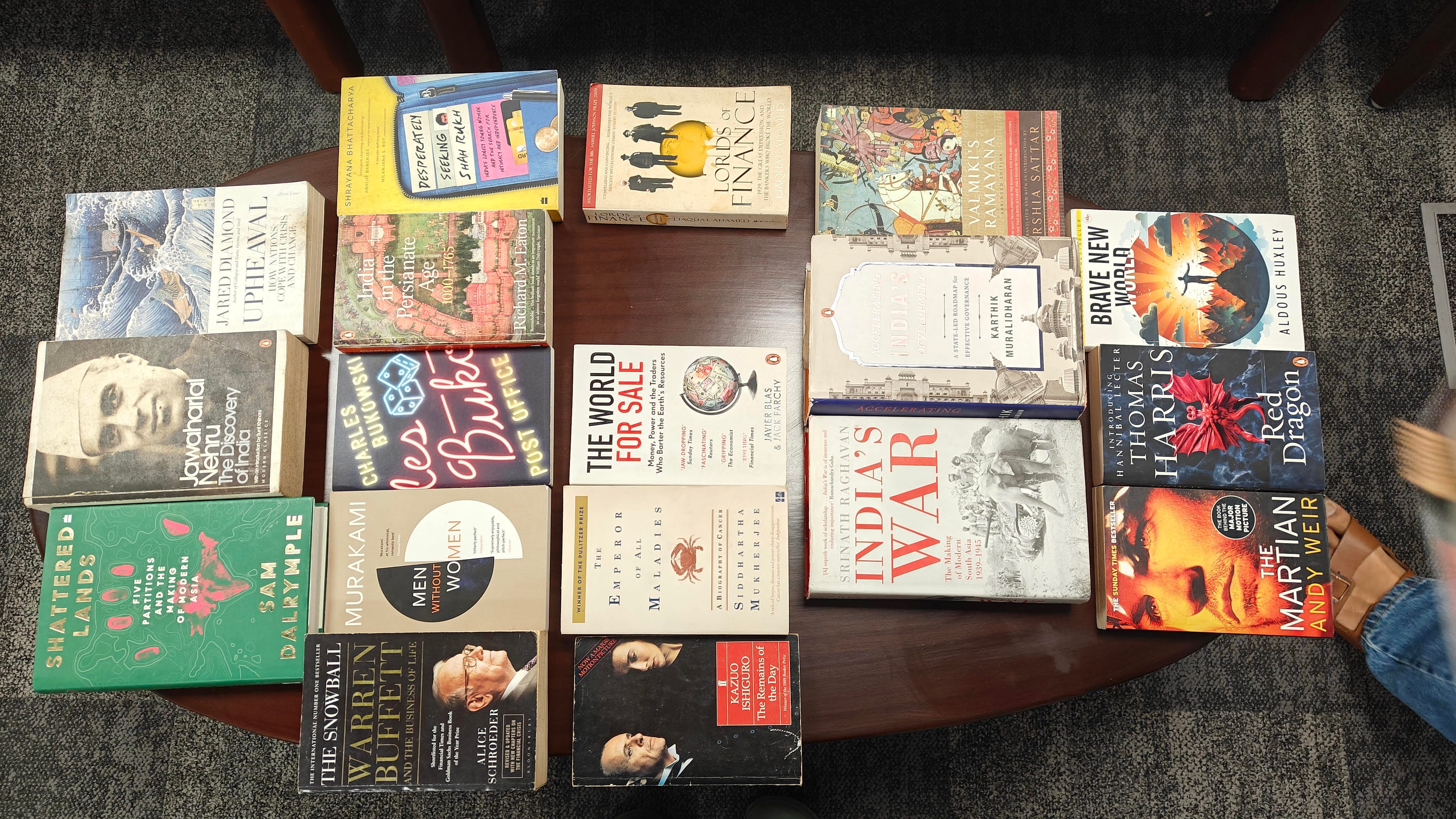
The Markets book club has been running for nearly a year. We have some avowed loyalists who come almost every weekend and nerd about their readings with us. But really, it’s become a great spot for many of us to talk to each other - even forge new friendships - without being distracted by any screen. It’s this in-person community that we’re really proud of building.
So, we’d love for you to join us! We host the book club every Saturday, 10:30-1 pm, at the Ditto office in JP Nagar. Unfortunately, this location is fixed - we understand JP Nagar may be far for some. But this is the only place where we can host it smoothly. And we don’t host sessions online, either.
If you’d like to attend the book club, please keep the above in mind, and please reach out to: pranav.manie@zerodha.com!
Interesting updates .