
What We're Reading #11
AI, renewables, a financial history of Indian bankruptcies, and AI again?

Hi folks, hope you’ve had a great week!
Our team at Markets is always reading, often much more than what might be considered healthy. So, we thought it would be nice to have an outlet to put out what we’re reading that isn’t part of our normal cycle of content.
So we’ve started “What We’re Reading”, where every weekend, our team outlines the interesting articles — even books — that put our brains in seventh gear (if that even exists).
We also host a book club every Saturday that we talk about at the end. If you’d like to read with us, please feel free to join!
We’d also love to know what has piqued your interest, too! Please feel free to let us know in the comments.
What Pranav is reading
Sean Stevenson, De-Dramatizing the Digital (link)
What if artificial intelligence made technology boring?
This is, frankly, one the most interesting futuristic AI-takes that I have seen. It’s contrarian; and for someone as AI-pilled as me, came as a shock. A shock which, I must add, very quickly turned into enthusiastic agreement.
The standard assumption with AI — one that I usually subscribe to — is that it only worsens our modern malady of too much screen time. I already find myself falling into AI wormholes far more addictive than anything Instagram or YouTube can throw at me (and that’s saying something, because I can basically watch Shorts for hours, motionless, like a heroin addict). To Sean, though, technology captures so much of our attention because it is unfinished. Our digital era is a mess of apps and tools and files that barely talk to each other, and that is, in part, what keeps us perennially online.
AI, in his telling, by mastering layer after layer of the digital world, will turn it into something reliable, and therefore unremarkable. Our world could look like the one in Star Wars — their thousands of years of development over us didn’t give them app algorithms that were even more addictive; it gave them butler-ish robo-friends that were, frankly, a little cowardly (was that just C3PO’s alignment training?).
You might not agree with him, but it’s a fascinating argument!
Venkatesh Rao, The Modernity Machine (I, II, III) and The Divergence Machine (I, II)
This is why I love the internet. If you’re new to Substack, take my advice: ignore all the new navel-gazing-AI-slop-popularity-contest nonsense, and look for essays like this. They will change you. My entire worldview is the distillate of half-a-dozen Substack newsletters. Not that any of them have helped me live better; I still exist in a confused fog, but at least my confusion is now more interesting.
Anyway, I came across this series in Stevenson’s post and it sent me down a fascinating five-post rabbit hole.
This series is, really, a framework that organises Venkatesh’s book club; a directed one which explores a specific way of seeing the world. It proposes “world machines”: the idea that the way the entire world operates, at least for periods of time, depends on the way that people think — and all the little culture factories that come up around it.
Venkatesh thinks we currently sit in a cultural gap between two world machines. Before us came the “Modernity Machine”. We had shed our mystical, vibes-based ways of seeing the world, replacing it with a quest for legibility — where we tried to systemise everything and build grand narratives around it all. It was sustained by the printing press, scientific ideals, and secular, legal institutions.
But the Modernity Machine is dying. It’s increasingly clear that our attempts at making sense of the world are fraying. In its place are all sorts of “monsters”: people cosplaying some ancient “past”, others drowning in endless rounds of critique, some tragically looking to re-create a world that is already gone. None of these shall last.
Perhaps, some day, we shall cross the abyss and step into the Divergence Machine. That will be a Bayesian world, perhaps — one where our ways of thinking are inherently probabilistic — and one which continuously spawns variety in what people believe. The way we shall live, in that era, is yet to be invented.
I know, I know, this probably sounds like a lot of very abstract, meta nonsense. I’m half sure I’ve flubbed the explanation too, But I’m interested.
Next, perhaps, I need to do my homework and actually read all the books he recommends. (And if you want to read them too, join us at our book club!)
What Kashish is reading
How a Tiny Latin American Country Fully Transitioned into Renewables: The Uruguay Story (link)
This piece is by Gowri Bhat, our colleague at Rainmatter, who looks after climate investments. But that’s not why I’m recommending it.
I’m recommending it because it’s a genuinely fascinating case study of how Uruguay got to a 99% renewable electricity mix, especially when they didn’t have even a single drop of oil or piece of coal produced domestically. That number alone was enough of a hook for me. But the story of how it got there is even more interesting.
I won’t spoil the whole thing, because you should read the piece in full. But here are a few things that should make you want to.
First, Uruguay didn’t get there primarily through solar, which is what you might instinctively assume when someone says “renewables.” It got there in large part through wind.
Second, the whole thing begins in the most unlikely way. An academic writes a paper arguing that Uruguay could rebuild its electricity system around domestic renewables. The president reads it. And then, almost overnight, the academic is put in charge of the country’s energy policy. His name was Ramón Méndez Galain, and he went from studying particle physics to helping redesign an entire national electricity system.
Third, the usual objection to renewables is intermittency. What happens when the wind doesn’t blow or the sun doesn’t shine? Uruguay’s answer wasn’t simply “batteries everywhere.” It solved the intermittency problem through a mix of hydro, biomass, grid design, contracts, and geography. That alone makes the piece worth reading, because it shows that energy transitions don’t all have to follow the same template.
But the most interesting bit, to me, is the politics.
Uruguay didn’t sell this transition primarily as a climate project. It sold it as an energy security project. The country had no fossil fuels of its own, was heavily dependent on imported oil, and was vulnerable to droughts that made its energy bill swing wildly. So renewables weren’t framed as some abstract climate virtue. They were framed as sovereignty, fiscal stability, and freedom from imported fuel. That framing seems to have made all the difference. It helped turn what could have been a partisan climate fight into a broad political consensus.
That’s the real lesson here. Sometimes, the best way to get climate policy done is to not lead with climate at all.
What Manie is reading
Maneesh Dangi, Why Firms Fail in India — Part 2: The Cycle Lens (link)
Maneesh Dangi is one of my favorite voices in Indian finance. For people familiar with him, he needs no introduction. He was Co-Chief Investment Officer at Aditya Birla’s Sunlife Mutual Fund, for which he has won multiple awards, and currently runs his own fund called Mosaic. He also does plenty of research as part of IIM Udaipur’s Center of Financial Research. This recommendation comes from his work there.
His research focuses on why firms in India fail. He wrote one blog on the same sometime last year, where he built a unique framework for evaluating bankruptcy risk, and looked at the history of how Indian bankruptcies took place in waves. The framework is not definitive, of course — it’s hard to predict things.
But what really got me hooked to the piece was his very first paragraph:
“If you had invested in the top 20 Indian business groups of the 1960s, more than half would have disappeared by now. Names that once dominated—Thapars, Scindias, Mafatlals—have faded into history. Corporate mortality is real, yet most investors obsess over how firms succeed rather than why they fail. But as someone in the credit business, I care about one thing, that is avoiding the left tail of the distribution—bankruptcies.”
Now, almost a year later, he’s published a sequel to the blog. Now, he looks outside the framework, and analyzes bankruptcies by looking at external shocks. Perhaps, the timing of this might have been somewhat earlier, as the Strait of Hormuz does provide one such shock.
Dangi looks at 4 such forces: demand shocks, supply shocks, policy shocks and finance shocks. He attributes multiple high-profile cases in Indian business history to each type. For instance, in the telecom industry, the government’s decision on AGR dues shook the existing players and even rendered Aircel and Tata Telecom unviable (while almost nearly killing Vodafone-Idea).
Then, he looks at what could multiply those shocks. Are you a highly-leveraged business? Does your promoter have a good reputation of doing the right thing when it matters?
And then, he combines both these analyses to reframe how each wave of bankruptcies in India was influenced by a shock and the amplifiers on top: from the twin balance sheet crisis of 2012-18, to the Asian Financial Crisis of 1999. And those waves may not resemble each other, but they do seem to rhyme.
“A shock hits firms unevenly and continuously. Defaults, in contrast, arrive in walls — 2015–18, 2018–20 — with long and calm stretches in between. If firm distress is the underlying water level, what holds it back until the dam bursts? The answer is lender behaviour. Understanding this mechanism is the single most practically useful idea in this note, because it tells you when the next wave is due — not whether, but when.”
Both pieces are an excellent condensation of India’s financial history that I think everyone should read.
What Bhuvan is reading
Brian Albrecht, You are not a horse (link)
There is a popular argument in the AI discourse that humans, in the age of artificial intelligence, will meet the same fate that horses and mules met with in the age of tractors and automobiles.
Horses once did useful work. They pulled carts, helped people travel, worked on farms, and supplied physical power. Then machines came along and did the same work better and cheaper. Horses could not learn a new skill. Once their main economic function disappeared, they had nowhere else to go.
AI critics argue that humans are headed the same way. With each passing model upgrade, they say, the scenario where humans become horses gets closer.
In a thoughtful and oddly cheerful essay, especially for anyone anxious about losing their job to AI, Brian Albrecht of Economic Forces pushes back against this idea. His point is not that AI is harmless, or that jobs will not be disrupted. His point is more precise: for humans to truly become horses, demand for human labor has to go to zero.
Not lower. Not badly disrupted. Zero.
That means if you take any product or service, there should be no human labor anywhere in the entire chain. Not in making it, not in shipping it, not in maintaining the machines, not in managing the systems, not in selling it, not in supporting it.
Take something as simple as a T-shirt. Suppose robots automate textile manufacturing. The people stitching T-shirts may lose their jobs. That is real. But for humans to become horses, automation cannot stop there. Robots would also need to grow the cotton, spin it, clean it, package it, transport it, warehouse it, sell it, and maintain all the systems around it. There has to be no human labor anywhere.
That is a much stronger claim than “AI can do this task.”
This is also where a lot of AI job discourse goes wrong. People confuse a job with a bundle of tasks.
Take a product manager. Yes, AI can write a product spec, generate ideas, summarize user feedback, create mockups, and draft launch notes. But that is not all there is to being a PM. The job also involves understanding the organization, its history, its culture, its politics, its constraints. It involves rapport with developers and designers. It involves knowing when to push, when to wait, whom to convince, and how to get something actually built.
A job is not just a checklist of tasks. A lot of the real work lives in context, judgment, trust, persuasion, and institutional memory.
Perhaps Albrecht’s most interesting point is about where spending goes after automation. Historically, when automation has made one sector cheaper, people have not simply bought infinite amounts of the newly cheap thing. Spending has moved elsewhere.
Manufacturing made goods cheaper. But people did not keep buying more and more goods forever. They started spending more on services: healthcare, education, restaurants, personal care, entertainment, and so on. Automation can destroy labor demand in one sector while preserving, or even increasing, labor demand in another.
This does not mean there is no risk. It does not mean people will not lose jobs. It does not mean the transition will be painless. And it certainly does not mean every worker will be fine.
But it does mean the simple argument — “AI can do tasks, therefore humans become horses” — is missing a lot.
The real question is not just whether AI can automate work. It can, and it will. The better question is: when AI makes some things cheaper, where does the saved money go? Does it all go into fully automated goods and services? Or does some of it move toward things where humans still matter — care, trust, judgment, taste, relationships, live performance, skilled trades, education, therapy, and so on?
That is why the article is worth reading. Not because it says everything will be fine. It doesn’t. But because it gives you better frames to think with. It shows the holes in the lazy AI-jobs argument. You may still come away worried, but at least you will be worried in a more precise way.
We have a book club!
Here’s another reminder of something that we’re pretty bad at advertising: our book club.
So here’s an image of our fairly-impressive book collection to attract you. Yes, they’re not just for show, and we do read them, alongside some coffee/tea and sandwiches.
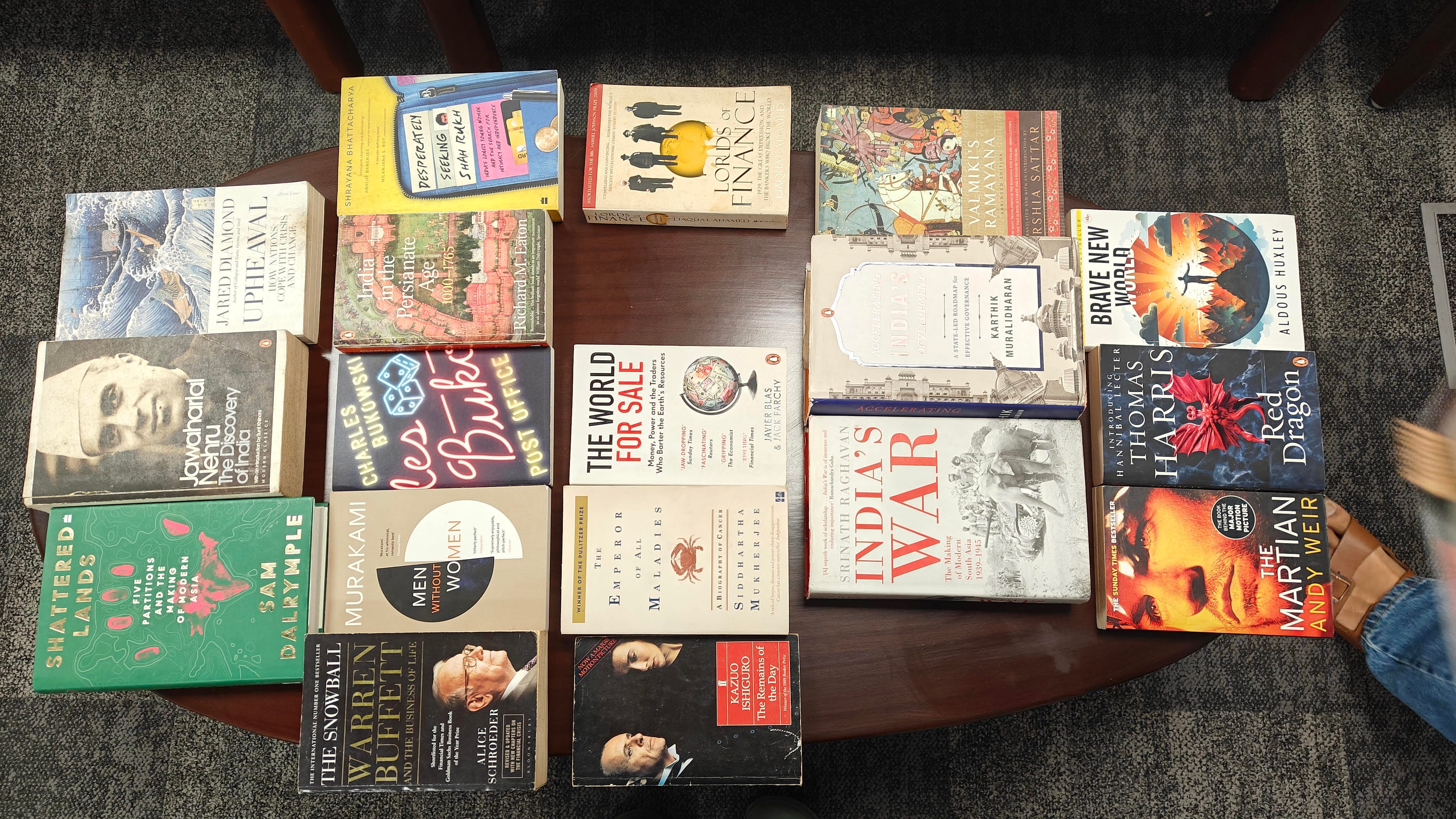
The Markets book club has been running for nearly a year. We have some avowed loyalists who come almost every weekend and nerd about their readings with us. But really, it’s become a great spot for many of us to talk to each other - even forge new friendships - without being distracted by any screen. It’s this in-person community that we’re really proud of building.
So, we’d love for you to join us! We host the book club every Saturday, 10:30-1 pm, at the Ditto office in JP Nagar. Unfortunately, this location is fixed - we understand JP Nagar may be far for some. But this is the only place where we can host it smoothly. And we don’t host sessions online, either.
If you’d like to attend the book club, please keep the above in mind, and please reach out to: pranav.manie@zerodha.com!