

Hi folks, I’m Pranav, and I love The Matrix.
So does our latest guest, Sidu Ponnappa.
In fact, when we shot this podcast live at our office, for a moment, it seemed like Sidu was seated the same way Morpheus was when he gave his infamous “red-pill” speech to a naive Neo about how AI has become sentient. You’ll see the moment on YouTube.

Sidu may not be fighting the agents like Morpheus does, but rather embraces them — in all fairness, the agents of today are not sentient like in the movie. But he shares many of the same traits. He’s unafraid of strong beliefs as much as he’s unafraid of changing them. He’s argumentative, contrarian, philosophical, and an extremely clear thinker who always seems to know what needs to be done, all at the same time.
Perhaps, the resemblance goes too uncanny. It wasn’t long ago that on Twitter, Sidu wrote a fantastic essay called “There is no product”. For fans of the movie, the inspiration behind the title shouldn’t be a surprise. But for those who don’t, I’d like you to just watch the “There is no spoon” scene.
A veteran in the Bangalore tech ecosystem, Sidu started at ThoughtWorks in the mid-2000s, in what he describes as the last era when a consultant was expected to learn a new industry and a new tech stack inside four weeks and nobody thought that was unreasonable. He co-founded a boutique IT services company called C42 Engineering with Aakash Dharmadhikari, which he sold to Gojek in 2015, Indonesia’s largest internet commerce company. Then, he led all of Gojek’s core engineering efforts, helping them turn into a giant in their native country.
Sidu and Aakash are now building realfast, an AI-native IT services firm that went from a hundred thousand dollars of revenue in a year to seven figures in the two months. By the way, this was after he threw out the thesis he had been building on for two and a half years.
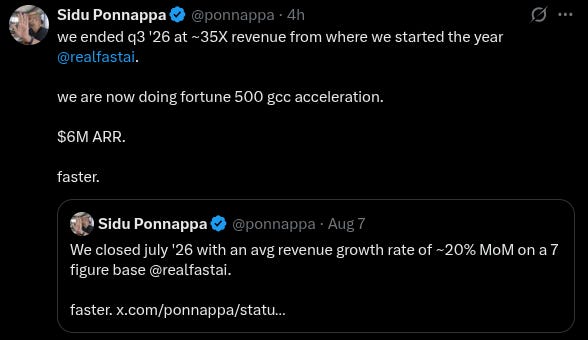
He also writes at his personal website and on X, in a register that is unusually willing to be wrong in public. Even at The Daily Brief, we used some of his commentary on a podcast with The Ken to help us base our understanding of what AI could be potentially doing to the IT services industry.
Sidu is perfectly placed to tell us how AI changes organizations. In manufacturing, for instance, you have the “Toyota Way”, which had certain key pillars that drove an efficient factory floor (just-in-time was among them). Japan’s management principles became so ubiquitously known that you were likely to find books on them in every other middle manager’s office 10 years ago. Similarly, you had the Ford assembly line before the Toyota Way.
What does AI do to such management principles? What are the key tenets that organizations across industries have to live by now, especially if they’re tech or software-adjacent?
The conversation starts with a question he likes to put to VCs: what is an agent? His answer turns out to be the spine of everything else. An agent, he says, is not a junior colleague you delegate to. It is an extension of your own subconscious, and it magnifies whatever is already in there, including the parts you cannot see.
From that one claim he gets to why systems built with agents rot into slop after about two weeks, why a competent person armed with an agent often produces worse work than before, why the enterprise AI pilots everyone is quietly writing off failed for reasons that have nothing to do with the models, and why the only business he can see worth building is an unfashionable one made of people (yes, he means good old IT services, the one sector that’s been in a downfall if the NIFTY is concerned).
He is also, by his own admission somewhere 20 minutes into the episode, possibly wrong about all of it. And of course, that makes arguing with him all the more interesting.
“I could be horrendously wrong about the stuff that I’m saying, but I believe it”.
His ability to say this while making every other highly-logical claim rooted purely in rational economic incentives is what made this conversation so fun for me and my boss Bhuvan, who host him.
Every 2 mins in this episode, Sidu rapid-fires one bomb after another. I am sharing some of them below, but be assured that they’re not enough.
On what an agent actually is
The popular definition of an agent is something that iteratively pursues a goal using tools. Sidu accepts that one, then says it is the less interesting of the two available, and the one that gets people into trouble. The trouble starts with the word itself: agent implies agency, agency implies a person, and once you are picturing a person you start handing it work the way you would hand work to a person.
His alternative is stranger and more useful. This is also the belief he says he has most completely reversed in the past year.
“When a human uses an agent to solve this problem, the human doesn’t use the agent as an externally anthropomorphised entity that is running by itself. You actually use it as an extension of your own subconscious. You have magnified your system one. I want to build a sub-module here that achieves sub-objective X. System two, system one delegation works this way — that I’ve thought of an objective and system one executes it for me. This is the actual mode in which real agent usage operates today. Everything else now is trivial use cases.”
On learning to use AI
A large industry has grown up in India around teaching people AI: certifications, cohorts, weekend bootcamps, ads everywhere. Sidu is at pains to say this is not the old scam — nobody is promising crypto riches or a guaranteed job, and the people selling these courses are being entirely honest about what they are selling.
His objection is that the format is obsolete rather than dishonest. He makes it very clear to us that he does not refer to scammy courses. Rather, it would be completely normal to assume that taking a course to learn a subject is the correct instinct for every subject.
Except this one. The best way to learn about AI is, well, by asking AI.
“There is this idea of learning AI by taking an AI course. Which actually, if you stop and think about it, is the old motion. Perfectly sensible: I wanna learn something, I will take a course. Perfectly sensible, but absolutely illogical if you’re using it to learn about AI, because AI knows about AI. The AI course you want is to use an AI and ask it: “How do I use you? Help me learn. Construct a pedagogy for me. Construct a curriculum to my taste. What is the first stage? No, I find this boring. Can we start with the second one? Rework the thing. Okay, great. Second one. Now teach me, how do I do this better?” It is to use this thing to teach you, because that’s what it is if you want it to be a teacher. And it’ll be better than any course anyone’s constructed, because you would use it completely personalised. But the challenge is that cognitive jump. It seems so simple, but it’s so hard. Yet most people will still go out there and pay lakhs of rupees for an AI course.”
On pivoting as the sane thing to do
Startup orthodoxy treats the pivot as a thing to be forgiven. Sidu, who’s lived most of his life as an entrepreneur, points out that we only had to normalise it because it was understood as a failure, and that the shame attached to it is now actively dangerous: it makes founders absorb a step change in the models six months late, reactively, after the evidence has piled up high enough to overcome their commitment to a thesis.
He takes a page from the early days of realfast itself. They had closed a hundred thousand dollars of revenue across an entire year. Then a model release turned a set of deals they had been refusing as off-thesis into exactly the deals they should have been taking.
“There were deals in the pipeline that we had been ignoring and saying no to because they were off thesis. We made the change, revisited the thesis, validated that these deals are no longer off thesis — in fact, arguably are now on thesis. And by January 20th, we had seven-figure revenue. We 10x’d in two months because we pivoted. And I think this is something that businesses, especially startups that don’t have debt, that don’t have a history they have to support, but are starting clean — it is so crucial now to ask, is this a step change that is relevant to my business? And if it is a step change and it is relevant — some of them are directly relevant — I need to pivot. I have to throw away everything that I was building towards and just pivot. And this is the sane thing to do. It is not the insane thing to do anymore.”
On building a business that gets better when the models do
One of Sidu’s essays argues that when the models improve, your addressable market should go up — that a well-built AI business should treat every frontier release as free expansion rather than a threat to be absorbed. We put it to him that this seems far easier to write than to build, given that releases now land every few weeks.
He agreed it was hard, and then reframed what kind of hard it is. The useful distinction, he says, is between a problem that is merely difficult to operate and one that is difficult economically — and he thinks the second kind is now the only sort worth picking.
“Which is why, at the end of the day, every time you build a startup, the startup exists to solve a hard problem. People usually make the mistake of thinking the hard problem is something which is difficult to solve for operational reasons. What you wanna pick is the hard problem that is operationally challenging, yes, but is foundationally an economically hard problem to solve. And this is that. Look, we have to accept that now, moving forward, your alpha as a business comes from your ability to extract alpha from the improvements in the underlying. It’s always been true. New regulations come in, figure out how to extract alpha. Political situation changes, extract new alpha. New special economic zone.
Businesses naturally do this. It’s just that they’ve never done it on a three-month horizon.”
On product firms and services firms
Indian IT has spent two decades being told, and half-believing, that services work is the lesser thing — that the real prize is owning a product. We asked whether AI has blurred that line. He said it hasn’t, and then went after the premise from the other direction. The claim is that the distinction was always partly a story companies tell about themselves, and that it dissolves the moment you look at how the operations are actually staffed.
“People don’t like to admit this, but all product companies are a business team and a services backend. You don’t like to think about it that way. But unless, bro, you are going out and closing that deal yourself, there’s somebody between you and the customer. That person understands the business better than you, because they’re the ones moving the things that matter in the business. So now look, all product companies are a business team with a services company bolted on. No one likes to admit this. It’s cooler to think of yourself the other way, but structurally, if you break down the operations over time, you will start to see that segregation form. And then you will start asking like, “Where do I staff my people? Which parts of the product are important?” And so very clearly, the only thing left is to do hourly billing. That last logical step, no one will take.”
On why enterprise AI has terrible UX
Most explanations for the failure of enterprise AI pilots blame procurement, or data, or the models. Sidu’s explanation is older and duller than any of those, and borrowed from consumer product: every additional decision you ask a user to make costs you conversion. An agent is a machine for generating decisions.
He distinguishes between the small minority who find that energising — the people who will not open Codex at 11pm because they know they will still be there at 3 — and everyone else, for whom the experience is simply dread.
This, he points out, is a very big reason as to why the average user hasn’t moved away from chatbots to more complex platforms like Claude Code.
“You introduce AI into a workflow, you’re increasing the rate of decisions that the human makes, which means that by definition, most kinds of AI being deployed have terrible UX. If I deploy a high-end agent for a normal user, the cognitive load imposed on them is tantamount to making them use a really shitty app. In fact, it’s probably 100x worse. You give a powerful agent or an AI system to a user, you have given them horrendous UX. The vast majority of people in the workforce, across industries, if given the same experience, are not energised. They have anxiety. It is the same anxiety that a user has when they log into a horrendous enterprise app. “Dude, I don’t wanna do this.” That’s the reaction.”
On acceleration as an organising principle
Underneath the AI question, Sidu says, is a much older split that has nothing to do with models. Some companies decided a long time ago that moving faster than everyone else was the whole point, accepted that this would cost them enormously in org structure and talent costs, and built around it anyway. Everyone else treats speed as a thing you apply where it helps.
That split, not technical sophistication, is what he thinks determines who can absorb AI now. The examples he reaches for are not AI companies at all.
One strategy is to become a tech company. You build the whole company around acceleration as a core value proposition. Always has been, pre-AI also. It’s what you call a tech company. Like, what is the difference between your regular large scaled-up taxi company and Uber? Or your brick-and-mortar large scaled-up retailer and Amazon? One has said that acceleration is core. It is part of our strategy forever. It is going to have an enormous cost in terms of managerial structure, org structure, talent, talent cost — but the alpha is worth it, because we will drive the business through this.
And there are companies that say, “No. Acceleration is not the key value proposition. We have other key strategies that we deploy. Acceleration is situational, it’s not universal, and we will not rebuild the business around this.”
”Now, you’re an oil and gas company. Is acceleration a core alpha? That has always been questionable. But the moment the acceleration stems from turning individual humans into super intelligences — forget about your physical operations being gated. You’re an oil and gas company, you are gating on physical operations first. So now, how much software can you build? It’s irrelevant. Maybe not irrelevant, there are operational accelerations. But at the end of the day, the drill bit will drill at — no software is going to speed up the drill bit. You have a fundamental physics. Fundamentally, you’re on atoms.”
On the middle disappearing
This is the part of the conversation that should worry anyone who runs, staffs or trains an Indian services business. The economy of good-enough work rests on a quiet agreement: for most problems, average talent producing average results is acceptable, and the education system is tuned to supply exactly that in volume.
Agents, he argues, break the agreement — not by replacing the average worker, but by making their output bimodal. The thirty-dollar hour was the price of predictable adequacy. Predictable adequacy is what has gone.
“You had a certain expectation when you go and hire a median developer out of India, outsourced at the median price point, which is roughly $30 an hour. $30 an hour will require a certain amount of management and will produce an adequate outcome. What has happened now because of agents is that the $30-an-hour good-enough band has suddenly dropped down here. There is no $30-an-hour band anymore. There is no middle. There are only people who perform exceptionally well and people who perform exceptionally badly with an agent. There are no people who produce okay, okay results with an agent. Think about it. Have you seen anyone produce adequate results with an agent? Either they’re producing slop or they’re producing bangers.”
On what Indian IT has to do
If the good-enough middle has gone, the question that follows is what happens to the companies built on selling it. Sidu is careful not to treat this as a story about incompetence — he has said repeatedly through the conversation that the Indian IT majors made perfectly rational choices, and that Infosys’s Mysore campus represents an enormous amount of serious thought about how to manufacture talent at scale.
The problem is that none of that can be retuned at the edges. He walks through what an actual retooling would require, and the list is a description of breaking the company on purpose.
“And now all of that is gonna get disrupted, and you cannot really deliver value to the customer until you disrupt it. It’s not like you can say, “Hey, in this management hierarchy, on these comp bands, with this performance review, I will make this team AI-native.” You have to 4x comp bands. You have to drop review cycles to one quarter. You have to move this out into a new management structure. That new management structure has to directly report to the board, not even the CEO necessarily — or if it’s a certain type of CEO, yes, maybe. Then you have to now figure out how to scale this out while cannibalising this in a way that doesn’t spook investors. And Indian investors are easily spooked.”
On what India should be competing for
Sidu lies on the pessimistic side of things when it comes to India’s sovereign AI ambitions. He wanted to sharpen that: he is not pessimistic about the ambition, he is pessimistic about the target. The US and China are not peers to be caught; at fifteen, twenty, thirty trillion dollars of GDP they are a category with two members, and their advantages are as much political and cultural as economic.
Which leaves, in his reading, a position that is both available and worth having — and that nobody in India is explicitly playing for.
“What is meaningful for us is to build a strategy to crush France, Germany and Japan, to make sure that we are number three. Clean. No one else can come and touch us on number three. We are not doing that, no? We are either coming up with these weird, infeasible plans to mimic China or the US, or just giving up, like “oh, there’s no point”. I mean, what is number three? Why does France have Mistral? If France has Mistral, we should be able to do something. Why are we not financing Sarvam properly here? Why aren’t there more Sarvams? The gaps are obvious, because what we are trying to do is either compete with the US or China, or give up. That’s not the game. The game is we have to be number three.”
A list of Sidu’s writings / apperances / inspirations:
The future doesn’t need you: 8 pieces of advice to myself as a new graduate
The Mundhe Banni podcast (this is in Kannada)
The Puliyabaazi podcast (co-hosted by Pranay Kotasthane, a past Subtext guest) (this is in Hindi)
The Matrix
Neuromancer by William Gibson
Listen to the full conversation on YouTube, Spotify or Apple Podcasts.
The transcript below was generated with AI assistance and may contain errors.
Pranav Manie: Hi, folks. Welcome to another episode of Subtext. I am Pranav, your host, and my co-host, my boss, Bhuvan. Today our guest is Sidu Ponnappa, whose tweets in Indian tech are some of the most insightful even — or rather especially — when you might disagree with what he says. Sidu is a serial entrepreneur, with his first major venture being an IT consulting firm called C42. He sold it to Gojek, the largest internet company in Indonesia, and then led Gojek’s engineering for years. Now he’s started up again with realfast, a startup that promises AI-enabled IT services at superhuman speed. He’s been here before, except the paradigm now has completely changed. Sidu, welcome to Subtext.
Sidu Ponnappa: Thank you so much for having me.
Bhuvan: Big fan of your tweets, especially the “there is no spoon” tweet.
Pranav Manie: To start out with, Sidu, icebreaker: how much do you love The Matrix? So Sidu has a very famous essay on Twitter called There Is No Product. It is based off a line from The Matrix, “there is no spoon”. If you’ve seen the movie, it’s where a spoon gets bent, literally, in front of Keanu Reeves.
Sidu Ponnappa: I mean, it’s got martial arts and deep Hindu philosophy mixed. How do you resist that combination, right?
Pranav Manie: You didn’t mention any agents in there, which is quite true.
Sidu Ponnappa: True, true, true. The reason I love it so much is there’s so many parts of it which are so conveniently referenceable for so many real-life things, right?
Bhuvan: It’s a movie that spawned many memes.
Pranav Manie: He’s seated right now like he’s Morpheus in that chair.
Sidu Ponnappa: No, my wife is also amused because I actually find it comfortable to walk with my hands behind like this, and sometimes I’m reminded it’ll actually go up into that pose and my wife will be like, “Hey.”
Pranav Manie: So, first things first. I wanna start out with — and obviously we’ll make a lot of reference to your tweets — one tweet of yours that I saw was really funny, where you said something on the lines of, you know, so many VC dollars get exchanged in the name of vague AI terms, like agent, harness, XYZ. Which is where I also asked a bunch of my teammates, and we all like to think we use AI, but we asked ourselves the question that you had also posed in the tweet: what’s an AI agent? How do you define an agent? How is an agent different from a workflow? When do you decide an AI agent is something that you can sell to anybody?
Sidu Ponnappa: I think there are two modes in which this actually exists, and the answer is different depending on which. I think the more traditional, popular one is an agent that has agency, hence agent. I think the crude definition is very simple: it can iteratively pursue a goal using tools. This is very straightforward.
I think the more interesting one is the other definition. Everyone looks only at the first because agents are anthropomorphised. You wanna reason about this, so you think of it as another person. And I think that is dangerously flawed for the current crop of models, because what I have realised with each step forward — from 3 to 3.5 to 4.0 to, you know, Sonnet, Opus, now to Astra — there is agency, but that agency seems to have serious limitations. And those serious limitations operate in very subtle ways.
For example, I was just talking to a friend this morning, and I was pointing out that if you remember when 4.0 dropped, making your own website became hot —
Pranav Manie: Yeah.
Sidu Ponnappa: — because it was so easy. And it’s great. You can hammer out a website in no time. But the moment you say that I now want to build a website with a very clear intent, I have these three core brand pillars, this is my design language, this is my communication strategy, these are my key talking points — suddenly, you can no longer build that website with AI. Now you will find yourself constantly in the loop fixing drift from the anchors you have set.
There’s a senior of mine from ThoughtWorks who moved to Google. When I was talking to him, he once told me this. He said, “When you’re designing any system, as the architect, you can hammer down three pegs, no more.”
Pranav Manie: You pick pillars.
Sidu Ponnappa: Yeah. These are largely invariant, or the barrier to changing them is very high, and then you rotate the architecture around them. The subtle distinction I’m making today is that with agents, you can’t hammer down those three pillars and expect the agent to adhere to them.
Which means that non-trivial systems — whether it is a communication system or a software system or a sales system or a recruitment system, whatever, because we now run everything on top of this — you cannot hammer down architectural pillars and have an agent follow them unguided. There is a human in the loop always, and that human in the loop is the one who’s protecting the architectural pillars, the integrity of the system.
And this leads to an interesting question. Ultimately, we still do not have an agent with agency. At the end of the day today, practically, inductively, without that human in the loop, the system turns to slop.
Again, this is one of those reductionist terms where people think of slop as bad copy, but bad copy is just the most trivial example. The more insidious, important example is: you’re designing and building a system. You’ve nailed down your architectural pillars. You’re working with an agent, so you’re making dozens, hundreds of decisions a day revolving around those pillars. You miss one. Something slips in that breaks the integrity of the system. You don’t notice. And this is gonna happen at a certain error rate even if you’re incredibly disciplined, highly attentive — some of those decisions will slip through. This compounds the next day and it compounds the day after.
And unfortunately, the best term for this that I’ve seen comes from engineering, though now it is a universal problem. We call it technical debt. But it is not technical anymore, it is just debt. It is the compounding violation of the integrity of the system in a way that undermines the ability of that system to achieve its objectives.
And what I realised is, if you really look at how humans use agents now to mitigate this — because this is where the game is now — the game is not, can I one-shot something? The game is not even now, can I sustainably build a system for two weeks? The threshold has reached two weeks. Beyond that, it turns to slop, and it turns to slop at an architectural level.
When a human uses an agent to solve this problem, the human doesn’t use the agent as an externally anthropomorphised entity that is running by itself. You actually use it as an extension of your own subconscious. You have magnified your system one. I want to build a sub-module here that achieves sub-objective X. System two, system one delegation works this way — that I’ve thought of an objective and system one executes it for me. This is the actual mode in which real agent usage operates today. Everything else now is trivial use cases.
Bhuvan: A lot of people make this argument saying that, one, of course, you need to have a human in the loop, but with each model upgrade, there seems to be a point in the distance where the human in the loop will become a liability. How do you reason around that? Because right now, the image I had in my mind when you were talking about this variation in models is trying to put a leash around a wild beast, and the human in the loop is trying to hold down the beast today. Is there a flip side to that, where that becomes counterproductive considering how fast these things are?
Sidu Ponnappa: I think with the current — I don’t know if it is an architectural aspect of today’s generation of models —
Bhuvan: Right.
Sidu Ponnappa: — and the way the agents are built, but I don’t see that going away for the current crop. Hypothetically, in the near future, do we see it going away? Yes. And when that happens, the economic basis of everything changes. Arguably one of the inflection points of the singularity. There’s no point looking beyond that, because what will happen beyond that is by definition unpredictable.
But before that, I think the more useful way to approach the problem is to ask: what are the invariants? If you say that at some point humans will no longer be required in the loop, and we put that as the boundary, because beyond that there’s no point looking at it unless you’re a frontier lab — the question to ask is what are the invariants before it? Because we know everything will change.
The one invariant is a human will be required. It’s what we’ve built realfast around. And we are always searching for invariants. Obviously, I think the longest invariant is a human will be required until they are not, and then everything changes. But within that you find situational invariants. They’re always moving, but they are not going to evaporate in two weeks or in three months. Right now, the operating horizon for these strategies, I believe, is around three months, give or take. So you want invariants that allow you to build a strategy that is longer than three months, otherwise you have a problem.
And the second invariant is what I was just talking about, which is that when you want to build any non-trivial system, there are architectural pegs you nail down. Today, the models do not respect those. And if you look at how we operate, you will see that we have those two invariants at the core of our business. But any business that is sitting on top of using AI has to operate on identifying invariants that they are playing into, not asking the question what will change, because the answer is most of it.
Bhuvan: Just to set the baseline, so that it becomes a starting point for us to take the discussion further — where do you lie on the spectrum of “I have full-on AI psychosis, I am AI-pilled”, to “I think this is a tool, I am the God-level programmer and this is still beneath me, so it’s a junior intern that I am corralling”? On the spectrum of different types of feelings about AI, where do you lie?
Sidu Ponnappa: I think that entire scale that is so popular is wrong. Connecting it back to my previous argument — if it is an extension of your subconscious, then that entire maturity model, that scale, it doesn’t work that way. The question is: how deluded are you by your own subconscious? The more deluded you are by your own subconscious, the more you are going to be bamboozled by your agent, because the agent is an extension of your subconscious.
Bhuvan: You versus you.
Sidu Ponnappa: It’s you versus you, fundamentally. It is reflecting back to you. Your obvious biases, at least you can see. But what is reflecting back to you is your subconscious biases, that it magnifies through the interaction as it tries to please you.
And if you are not constantly, aggressively accepting that you have AI psychosis because of this, and you’re not constantly running defence against it, the quality of your output will be bad. But more fundamentally, especially if you are in a fragile mental state, you are prone to full-blown psychological breakdown.
So you have this spectrum driven by self-awareness and mental integrity, starting from “my work degrades” to “I will internally implode”. And I do not even say this lightly. I’m talking about full-blown schizophrenic breakdown, hallucinations. It does happen. So I don’t think it’s a question of like, this is an intern I’m corralling. This is a question of: how self-aware am I, and how aggressively am I chasing down the artifacts of my lack of self-awareness as it surfaces through this interaction, and corralling that to ensure that, A, I’m not losing my mental integrity. You are extremely vulnerable when you use an agent. This is not a joke. You have to treat it as an info hazard of the highest order.
Bhuvan: It’s a weird kind of high.
Sidu Ponnappa: Yeah, absolutely. And take that all the way out to saying: now that this is so, what is it then when we all try to do good work, we all pursue our craft? This is how I think of it, and I think it’s widely framed. It doesn’t matter what it is we pursue — doing something like this is a craft. And you folks are improving at your craft. It is apparent, and therefore the output of it becomes better.
The ability to pursue the improvement of your craft while you are now not using an agent as an externality — but you’re accepting that what you are is a superhuman cyborg. You have already started crossing the threshold into transhumanism. You are more than human when you use an agent.
I used to joke about this before AI also. People just dismiss these things, but six million intraocular lenses have been implanted every year for decades now. That is —
Bhuvan: That is —
Sidu Ponnappa: Cyborgs have been around for decades. It is superhuman for someone at that age with that medical condition to have those physical capabilities. It has happened already, decades ago.
What is happening now with agents is super intelligence. And what matters over here is that super intelligence is two-sided, just like our own subconscious is two-sided. What is your ability to navigate this in pursuit of your craft when you yourself now are super intelligent? It’s not that that is super intelligent and you are something separate. When you work with it, you are super intelligent. How do you use that super intelligence in pursuit of your craft is now the whole game.
Bhuvan: So one question I try to ask people who are really close to this is — we started at, let’s say, GPT, November ‘22, if I remember correctly. “Oh, this is a dumb thing. It can’t do one plus one.” Then we went through the whole process of, it can’t count the number of R’s in strawberry.
Sidu Ponnappa: Yes.
Bhuvan: Then as soon as Claude Code came, suddenly you could see the shift in vibes. Then it just took off after Opus 4.5, or whenever you wanna mark that point. In all of these things, a lot of people went through a typical template of, let’s say, hope: “Oh, this is dumb. Eh, not so dumb, not so dumb, not so dumb. Dude, this is good. I’m toast.” How did your own journey — rather, how did you go about making sense of navigating this technological shift? Because it’s that Stalin quote, like, “Weeks happen in” —
Sidu Ponnappa: Lenin.
Bhuvan: But yes. Sorry. Did you find it hard to build a mental model where you said the last thing which you said — which is, having a craft as a North Star probably will help you anchor your tendencies towards psychosis, or basically just sycophancy, or whatever, outright break? How did that process happen?
Sidu Ponnappa: I think a lot of that discussion assumes the “I am toast” at the end as the problem you’re solving. So, yeah. I have been pursuing transhumanism since I was in ninth standard. I read — there is this famous Asimov, I think they made a movie out of it, which is not that great — The Bicentennial Man.
Bhuvan: Certainly, yeah.
Sidu Ponnappa: It’s a very famous Asimov short story, and it is the story of a robot bound by the three laws of robotics seeking to be human and looking for the most fundamental invariant of humanism, which is dying. And I read that story and I’m like, “Well, obviously, all of us are on the opposite trajectory.”
I obviously, deep down, instinctively crave immortality. It’s a different thing that you should have the wisdom to let that craving go, and I think we have one of the most ancient traditions in the understanding of the flaw in that desire — but the desire is there. And ever since then, I’m like, “Well, I’m walking the other road.”
And then as I got older, I realised that it’s not just me. The entire human race is walking that road — through better hygiene, better medication, intraocular lenses, computers. We are all in pursuit of godhood. We are hardwired to play God. To seek that. It’s not just to play it, but to seek that state. Whether we can play it or not, I think is an open question, but the craving is there. For me, it has just been an amazing ride.
Pranav Manie: I think Westworld, the TV show, had the tagline for every season: “Play God, pay the price.” And you clearly see a lot of that in what you speak.
Sidu Ponnappa: I don’t take that perspective very seriously, and I know it’s odd for me to say it. You know, the uncles say that is a Western concept, and they mean something without understanding what it means. And what they’re saying is a Western concept is usually a British one — it’s a contradiction to a Western concept they believe. They’re like, “That’s a Western concept. My Western concept has been here for 100 years, therefore so.”
But I think the core premise holds. Play God, pay the price is a Western concept. You pay the price of being alive. We understand this at a deep cultural level, that you are paying the price the moment you’re born. None of this changes that for us.
In some ways, I like to joke that the deep multivariate Indian cultural history is actually the best suited to navigate the singularity. They will break because they don’t know how to bend. They’re not water. They’re the rock. We are water. The singularity will shatter all rocks.
And so even that framing of Westworld is rock thinking. Play God, pay the price is rock thinking. Water thinking is: you were born paying the price. You’re just riding on the balance. Existence has a price, and it is baked deep into everything. We understand this even though we have now 100, 200 years of uncle thinking borrowed from the West, masquerading as Indian thinking. The reality is, in our bones, we understand this. We understand the Tandava.
Pranav Manie: I wanna circle back to you talking about the architecture. You have a very solid essay called When The Models Improve, Your TAM Should Go Up — your addressable market should go up. But again, we look at model developments that happen at this point, I don’t know, every three weeks, every month —
Sidu Ponnappa: Overnight.
Pranav Manie: Overnight, sometimes. How hard is it to build an architecture and an operating system that sustains the principle behind that essay — that with every model improvement, you should only see your potential business increase? Because from where we sit, it seems like it’s much harder. Easier said than done.
Sidu Ponnappa: It is. It is. Which is why, at the end of the day, every time you build a startup, the startup exists to solve a hard problem. People usually make the mistake of thinking the hard problem is something which is difficult to solve for operational reasons. What you wanna pick is the hard problem that is operationally challenging, yes, but is foundationally an economically hard problem to solve. And this is that.
Look, we have to accept that now, moving forward, your alpha as a business comes from your ability to extract alpha from the improvements in the underlying. It’s always been true. New regulations come in, figure out how to extract alpha. Political situation changes, extract new alpha. New special economic zone.
Bhuvan: But these things operated on a much slower timeframe. They’re fleeting also.
Sidu Ponnappa: Yeah, they’re fleeting. I mean, these are fleeting too, to be fair. But my point is the dynamic has always existed. Businesses naturally do this. It’s just that they’ve never done it on a three-month horizon.
Now, if you wanna build a business in the foothills of the singularity, one of the core premises of any business started in this era is that we are now capturing the alpha that grows every three months.
For example, for a startup to pivot — we’ve tried to normalise it in the startup ecosystem for well over a decade now that it’s okay to pivot. But we don’t look to the question of why did we have to normalise it? We had to normalise it because it is a bad thing.
Bhuvan: It’s still very dirty, yeah. It is perceived as a failure.
Sidu Ponnappa: Hence, we have to normalise it. And there is a normalisation up to a degree. Even until 2022, a startup that pivoted every quarter was sketch.
What we realised through the first two years of our journey — that was there subconsciously — we were also inheriting dangerously obsolete premises from the previous cycle of startups, like build to a thesis. You try to identify a thesis and you build into it, and you don’t think about that thesis too much in terms of invariants. Remember what I mentioned earlier. Now, given the circumstances, you focus on invariants.
So you end up making this mistake of lagging the consequences of a step change in the models and the ecosystem by six months. Because the step change lands. You are locked in a thesis, pivoting is a bad thing. Now evidence has to build up to an overwhelming level that whatever your strategy was before that step change, either the strategy is now obsolete in entirety or significant pillars of it have become obsolete. You don’t intentionally lean into that change. You do it organically and reactively as the consequences of the step change land.
For example, we went from 3.5 to 4.0. Step change, and the step change was subtle. We spent four months solving diffs. If I need AI in my loop and I’m working on text, being able to rapidly integrate the output from the model into a running system, validate the system, feedback and loop, is core — and therefore solving for diffs was critical. And we spent four months on it, only to have 4.0 drop and invalidate it. In the process, it invalidated the core of the premise that we had before that. We just never paid attention. And then it took us four to five months to retire that strategy and replace it.
Then this happened again. And it was only around Opus 4.5. So it happened again with Sonnet 4. It happened especially with Sonnet 4 and Claude Code, which is the first true agent. Before that, agent was just a buzzword you sell to people who don’t know better. There was no real agent.
Bhuvan: Sell a course with it.
Sidu Ponnappa: No, you can sell a lot of enterprise software with it.
Pranav Manie: Today only you tweeted something about very, very large enterprise platforms of 2024 promising you agentic platforms.
Sidu Ponnappa: It’s just hilarious. But we only really internalised the learning that we were looking at this wrong with 4.5, towards October, November ‘25. And that was the first time we said, “Look, isn’t it obvious that every time there is a step change, you have to revisit your strategy?”
Hopefully, you’ve been wise enough that the strategy is not invalidated in entirety, but you have to be open to that. You have to identify the pieces of the strategy that have been invalidated, the implications on your operations and your motion because of that, and then turn hard. And you have to do this now intentionally with every step-function change.
And that change — we had closed a hundred K of revenue that entire year. This process started baking among us in the team around late October, early November. There were deals in the pipeline that we had been ignoring and saying no to because they were off thesis. We made the change, revisited the thesis, validated that these deals are no longer off thesis — in fact, arguably are now on thesis. And by January 20th, we had seven-figure revenue. We 10x’d in two months because we pivoted.
And I think this is something that businesses, especially startups that don’t have debt, that don’t have a history they have to support, but are starting clean — it is so crucial now to ask, is this a step change that is relevant to my business? And if it is a step change and it is relevant — some of them are directly relevant — I need to pivot. I have to throw away everything that I was building towards and just pivot. And this is the sane thing to do. It is not the insane thing to do anymore.
Pranav Manie: You mentioned that you were ignoring deals that you probably should have made earlier —
Sidu Ponnappa: No, no, no. If we had made them earlier, we would have failed. The step function is what turned them from unviable to viable deals.
In this particular instance, it was a thirty-five, forty-year-old system built in Delphi handling regulated financial and operational trust — the corporate secretarial. So, ESOPs, all of that. You can’t mess around. I mean, you folks understand this better than anyone.
Pranav Manie: Speed is a liability.
Sidu Ponnappa: Yeah, speed is a liability. Regulations matter. You can’t make mistakes. And they were into a .NET rewrite of that system for fifteen years. So now it is two stages of legacy. Since neither have been retired, both are in flight. So there are parts of the system that are evolving in the Delphi stack. There are parts of the system evolving in the .NET stack. And there was a hard deadline: this system needs this integration with this bourse to go live in demo in under three months, approximately.
If we had attempted this on 4.0, we would have crashed and burned. In fact, it only really started to become possible with Sonnet 4 and Claude Code, and the Opus 4.5 jump really unlocked this. If we had attempted it with Sonnet 4 and Claude Code, it would have been risky. Before that, it was impossible. And this is just three months.
Bhuvan: And now suddenly this is squarely centre. This is now big business.
Sidu Ponnappa: It’s gone from impossible to big business. In six months total cycle. Three months for early viability, three months for serious viability.
Pranav Manie: These timelines are a little hard for me to wrap my head around. How dependent is building that kind of architecture on frontier LLMs? Because I think somewhere in one of your blogs, you’ve mentioned that you should build a system where if you have access to a model that’s 20% less effective, you should still be able to get your work done. So how important is that access?
Sidu Ponnappa: Again, two axes. And it was interesting — I was talking to somebody very senior operating at substantial scale, again fintech, regulated, massive name. Everyone watching this podcast who makes a transaction is probably using them one-third of the time. And they were still focused on using Claude Code or Codex, the frontier, for the human in the loop. And they operate at scale. So reviewing PRs and fixing issues on the PRs had been shifted to lower-cost open-source models.
Logical, operationally and financially. But for me, the takeaway was actually connecting back to my earlier thesis, which is that if you’re augmenting yourself, you want the best. You wanna be 20% dumber than the next guy? Doesn’t make sense. But if you’re running routine operations, yeah, of course, the question is now, is it good enough? But for me, for you, it will only be the best that we can afford. Nothing else cuts it, because being 20% dumber than the next guy is —
Bhuvan: Doesn’t make sense.
Sidu Ponnappa: It’s a problem.
Bhuvan: Do you think large firms are inherently disadvantaged to make good on this step change that you talk about? Because they obviously will have their own organisational debt, so to speak.
Sidu Ponnappa: The reason realfast exists is I believe that paying down that debt is going to be a multi-year journey, and there are two kinds of strategies to this.
One strategy is to become a tech company. You build the whole company around acceleration as a core value proposition. Always has been, pre-AI also. It’s what you call a tech company. Like, what is the difference between your regular large scaled-up taxi company and Uber? Or your brick-and-mortar large scaled-up retailer and Amazon? One has said that acceleration is core. It is part of our strategy forever. It is going to have an enormous cost in terms of managerial structure, org structure, talent, talent cost — but the alpha is worth it, because we will drive the business through this.
And there are companies that say, “No. Acceleration is not the key value proposition. We have other key strategies that we deploy. Acceleration is situational, it’s not universal, and we will not rebuild the business around this.”
Now, both of these companies have legacy and debt, and they are going to have challenges. But these companies will naturally lean into this problem because they have been leaning into this problem for as long as they’ve existed. These companies need partners. That’s why we come.
Bhuvan: I wanna pick up on something you said previously — and maybe you answered it, maybe my framing itself is wrong, but nonetheless I still wanna ask you. So with each passing model upgrade, what used to be something similar to the diff example you gave is now internalised model behaviour, which means either one tool or one business just vanished. And a lot of the — there’s hype, like Figma being dead, or lawyers being dead, doctors being dead, the famous Hinton example, et cetera.
Sidu Ponnappa: Yeah.
Bhuvan: Everybody now having the ability to vibe-code Amazon, Google in their bedroom. All of these examples are legion. But even if you remove the hyperbole, it does seem like if you are building, let’s say, thin things, for the lack of a better term, you are basically just buying time.
Sidu Ponnappa: I mean, this is where it is exactly because of this pattern that I switched to this model of asking, what are the few invariants? Because if you’re not building around an invariant, this happens.
Bhuvan: So how do you think about invariants? And let’s say, for example, if you were to tell someone, “Dude, it’s not gonna work out for you”, how would you frame it for them?
Sidu Ponnappa: I think it’s very difficult to frame it to anybody. Especially to founders. Because founders, you tend to be obsessive. I mean, I fall into — I could be horrendously wrong about the stuff that I’m saying, but I believe it. And I’m operating on it, and I’m committing years of my life and investor capital, my capital, to this. It’s just founder psychology.
But: I’m not a software company, I’m a manpower company. I will be building the best damn organisation of humans in the loop, as the definition of best damn humans in the loop evolves. That’s my invariant. We don’t need the humans in the loop anymore? We’ve all jumped off a cliff. How does it matter anymore? But I am not a software company, I’m a manpower company.
Do you have the cojones to go out there and stop building a SaaS? Because building a manpower company is the kiss of death in the venture-funded ecosystem.
Bhuvan: Oh, yeah. It’s also terribly unsexy to boot.
Sidu Ponnappa: Yeah, of course. But it turns out that the only Lindy thing over here is people. So I am building a people-centric company. I’m not building a body shop. I’m not doing any of those things, because those are the naive reductions of saying I’m a manpower business. But my company will exist, last and succeed because of the people. Everything else is second order to that, because the humans in the loop matter.
And this is the thesis. And my advice to people is that, yeah, I don’t have a lot of advice other than do what I’m doing, because I don’t see a lot of choices. I don’t see any other invariants, so I will build around the invariant. If you ask me my advice, I will say, do what I’m doing. This is not 2022, where we could have a conversation about 50 options. I see one invariant.
I mean, there are a couple of other invariants which are inaccessible. The other invariant is this is gonna take a lot of capital. So if you’re gonna go attack the problem at the frontier lab level, it’s capital intensive. There is another invariant, that your ability to hoover up large volumes of capital is a key strategy. But I don’t have that ability, and therefore I will play to the invariant that I can play to. It is a strength — I’ve been people-centric for a long time. I understand how to build large teams.
In America, the high-quality human in the loop is going to be completely sucked out, like the oxygen is being sucked out there by the frontier labs and the top-tier big tech. So America will not have supply of this available to the wider market.
Bhuvan: So you’re saying all this talent is going to the labs, which means there’ll be large businesses who want good —
Sidu Ponnappa: You can’t. Who’s going to go compete with OpenAI for good-quality talent? Or Meta or Google? China has the other large pool. They’re not gonna serve the world. Where’s the other large pool that can serve the world? It’s us. There’s no one else.
Bhuvan: You think we have a good pool?
Sidu Ponnappa: Of course we have a great pool, especially thanks to President Trump now. Otherwise the best were leaving. Now, very bluntly, a core strategy for realfast is now figuring out how to tap into and monetise the erstwhile LeetCode-to-FAANG pipeline, because that’s now dead in the water.
Problem is, those folks have a particular canon and a narrative that is baked in over the decade of ZIRP, which turned that sexy. And therefore the reality today is that we are going back to enormous value in 2000s consulting. 2000s, which doesn’t exist today anymore. ‘90s and 2000s-era software consulting doesn’t — Kailash is an amazing example of that pattern, which you don’t see anymore. I don’t even know how to think about it. A top-notch, serious hacker who will engage with gnarly business problems and then use the hacker mindset to solve them doesn’t exist in the mainstream anymore. It did. It was the norm, in fact, in the ‘90s. And that is coming back — but of course we have to call it an FDE now. What choice do we have?
But yeah, that’s the whole game. And unfortunately, the LeetCode-to-FAANG talent pool neither appreciates the game nor has the skills for it. But they have the raw material for it. The intellectual horsepower is there, but the cultural conditioning is to look at that as sexy. And the kind of attitude and game you have to play as a consultant requires you to not merely be a narrow hacker. You have to be able to social engineer. I’m sorry, what do we call it in corpo? We call it stakeholder alignment. Hackers call it social engineering. If you can’t social engineer, you have lost alpha, and that is the missing piece. The talent is there.
Pranav Manie: In this entire answer, we mentioned this idea of services businesses being considered unsexy for a while. Do you think the line between product and service — because, you know, on one hand you had the perception of these Infosys-type companies, that besides the other problems that exist, you’re also doing — or even for that matter, an EY or a Bain or a Palantir-type company — you’re doing something that you don’t really have ownership over. And you are serving some other client, and there was that perception around service-based companies. And a lot of people obviously wanted to build something that they could own, that they could proudly call their own. Do you think that line has blurred with AI, and especially with what you’re doing?
Sidu Ponnappa: No, that line has not blurred. Your ability to own something for a long duration in consulting — it’s difficult. It happens when you build a durable partnership. And historically you will usually see, and that’s what happened to us, when you build a durable partnership with a much larger partner, your much larger partner acquires you, because the meaning of that durable partnership is you’re core to the alpha now. But it is unusual for that durable partnership to build out today. Historically, by the way, it was very common.
Pranav Manie: Indian IT services are much more —
Sidu Ponnappa: Yeah, exactly. So one part is the durable partnership. But — I mean, see, people don’t like to admit this, but all product companies are a business team and a services backend. You don’t like to think about it that way. But unless, bro, you are going out and closing that deal yourself, there’s somebody between you and the customer. That person understands the business better than you, because they’re the ones moving the things that matter in the business.
So now look, all product companies are a business team with a services company bolted on. No one likes to admit this. It’s cooler to think of yourself the other way, but structurally, if you break down the operations over time, you will start to see that segregation form. And then you will start asking like, “Where do I staff my people? Which parts of the product are important?”
And so very clearly, the only thing left is to do hourly billing. That last logical step, no one will take. That is a logical step, by the way — to have internal billing and to balance your allocation of talent to important initiatives in the company by applying a cost structure that forces that rationalisation. At scale, it’s the rational way to do it. But the reality is that all companies are business with services bolted on. Question is, what psychological games do you want to play to make yourself feel good about it?
But the other part of it is, in consulting, people don’t talk about the opposite. When I was at ThoughtWorks, where I started my career, which is in that era a leftover of that ‘90s-style hacker culture in the enterprise, I went from vertical to vertical. I went from retail to insurance to tech, building one of the earliest cloud companies — migrating the foremost pre-cloud hosting company on. A very diverse set of problems. The tech stack was different each time. I’ve gone from Java to .NET to Ruby on Rails in the space of, I think, eighteen months, on production systems, some of them at substantial scale.
And people just expected you, like, “Hey, you’ve never seen this business before. You don’t understand this industry. We reasonably expect you in four weeks to be speaking the domain, understanding the vocabulary, and have onboarded onto an all-new tech stack.” Usually, if these are enterprise customers, that tech stack has a history and has debt, so you’re not coming in cold on greenfield. And all of this was a reasonable expectation from a consultant in 2005.
I think there are very few people in the industry today who can do this. It’s a challenge, and it’s extremely interesting. If you wanna ask where you get your kicks from — ownership is one. But just onboarding onto a wild new ride every six to eight months is another. And honestly, I think most people can’t.
Bhuvan: Going back to the Jevons paradox, which you reference in multiple places — that opportunity set unlocks because there are large, especially in financial services where we know, in US banking, there are like three old people who are literally holding the entire US banking system together. The moment they’re dead, it’s exposed. And there is now a scope for tackling those gnarly problems. I mean, calling them gnarly problems, especially in finance, would be the understatement of the decade. Now, do these tools unlock that ability to go after those businesses and tell large businesses, be it the JP Morgans or BofA, that “dude, that ancient piece of tech stack now is in play”? That opens up?
Sidu Ponnappa: It does. It very much does. I think the execution motion to achieve it remains unsolved. I don’t think anyone’s actually really even begun to crack it.
And the reason for this is another invariant, which is that we know that increasing cognitive load on a user decreases their conversion rate on that workflow. This is — consumer companies live and die on this. You introduce AI into a workflow, you’re increasing the rate of decisions that the human makes, which means that by definition, most kinds of AI being deployed have terrible UX.
Bhuvan: It’s a glorified chatbot bolted on.
Sidu Ponnappa: No, no, no. I mean, if I deploy a high-end agent for a normal user, the cognitive load imposed on them is tantamount to making them use a really shitty app. In fact, it’s probably 100x worse. You give a powerful agent or an AI system to a user, you have given them horrendous UX. Very much so. And this is to a normal user.
There is a tiny percentage of the workforce — for reasons that I cannot fully fathom yet, they are scattered across functions, it does not mean programmers — who lean into this. You increase their cognitive load, they get energised. It’s the exact opposite. These are the people who now say, “Oh, I don’t want to start using Codex at 11pm because I’ll be up until 3.”
Pranav Manie: Sounds familiar.
Sidu Ponnappa: But the vast majority of people in the workforce, across industries, if given the same experience, are not energised. They have anxiety. It is the same anxiety that a user has when they log into a horrendous enterprise app. “Dude, I don’t wanna do this.” That’s the reaction. And so this problem that you’re talking about, unlocking Jevons paradox here, is now gating on the fact that most people have anxiety when engaging with AI.
Bhuvan: So it’s a sales game now?
Sidu Ponnappa: Sales doesn’t solve this. You can’t solve this with sales. It’s a UX problem.
Pranav Manie: Is this also why — because you keep hearing people saying, “Oh, you’re still stuck at ChatGPT or Claude. You’re still stuck to a chatbot.” But is that because ChatGPT is often considered a great consumer app?
Sidu Ponnappa: You’ve actually perfectly nailed the threshold. What I have observed is that people will be comfortable all the way up to using it in chat mode, for summarisation and mild generation. The moment you cross over into an augment for the mind — you are not just doing this, but you’re saying, “Make me smarter. Now I have to figure out how to use you to make myself smarter” — you cross that threshold, boom. Engagement just collapses, anxiety spikes.
Now, until you can figure out how to solve that problem, you can do whatever you want with sales, your users will churn. You can absolutely close the first cycle of sales for this. There is enough top-down push at a board level, at a C-suite level, to adopt AI that you can. But your retention will be atrocious.
Bhuvan: But considering the fact that people at the top are more likely to not know the power of these things —
Sidu Ponnappa: Yes.
Bhuvan: — and the people at the bottom are riddled with anxiety, saying that, “Dude, if I do this, it’s gonna break my system and my head is on this thing.”
Sidu Ponnappa: Yes. They carry risk.
Bhuvan: And in between, here you are saying that, “Dude, that’s an opportunity for me.” What does that mental model look like, to say that this is an opportunity worth going after?
Sidu Ponnappa: See, the thing is that that becomes a big problem if I’m a very big company. Today, I’m not. Today, for me, the problem is finding the niches, the instances, the exceptions where I can meaningfully solve.
It also means scale. For example, I cannot today attack a really giant company. For us, we are currently operating in the fifty million to five hundred million revenue scale, broadly, because at this scale I reasonably have access to the board. I reasonably am working on projects that are important to the board. In fact, I will not pick up projects that are not important to the board.
Why? Because I have to own that change management problem. Because if I solve that change management problem, that’s the hard problem. If I crack that, I have a trillion-dollar company, not a billion-dollar company.
Pranav Manie: So I think in one of our past Subtext episodes, which we hosted with Arpit Tandon, who works at CGI India, he said something that sounds very similar to what you’re saying — that in reasonably large enterprises you’re seeing decisions that earlier used to be with someone called a CIO. And these are obviously central decisions. But now because of AI, you’re seeing a lot of these budget shifts down to operational managers who own a metric, who obsess over a single number.
Sidu Ponnappa: Actually, that is a myth. I come from a consumer background also. Consumer: every manager in the chain owns a metric. In B2B, except for very narrow functions, nobody owns a metric. And where usually a metric is owned, it’s a coarse metric, like a deadline. Financial month close, year close. Yes, hard metric, clean, crisp, but there’s no breakdown.
If you step out of support and, to a certain extent, inside sales use cases, you will not find the kind of rigorous top-down, layer-by-layer metrics roll-up on top of which consumer companies live and die. If you don’t have that in a consumer company, you’re dead in two months. But your typical enterprise, nobody knows what their metrics are.
Pranav Manie: I want to ask you a question about knowledge. Because I think all companies are bases of knowledge. We see it every day we work, every time we hire somebody new. And you obviously talk a lot about how you don’t look at a company with a centralised software layer, but a centralised knowledge base. But a lot of companies have had this thing where the CIO would make a decision for the entire company. They would procure a Salesforce or an SAP or whatever. But those all-in-one solutions won’t necessarily serve some niche function. So how do you — I mean, I think the easiest analogy that I look at is like the way, say, a federal country like India runs. You have central decisions, then you have state fiscal decisions.
Sidu Ponnappa: No, I think there is a slightly different dynamic playing out now compared to, say, buying an SAP or a Salesforce or a ServiceNow or whatever.
What we are seeing right now is one of two things is happening. Either the CIO or the CIO’s office has run a — what in consumer we would call a 1% rollout. Some function or some number of headcount have some AI tooling rolled out to them. The decision at the leadership level and board level is we are going to do this. We will measure impact. Based on measuring the impact, the CFO has said that I will then unlock budgets to do a twenty percent, fifty percent, one hundred percent rollout. They may not use this language, but the strategy is this. That’s how they dip their feet in the water.
Now, this stream is stuck in having done a one percent to five percent rollout and being unable to quantify the impact to the CFO’s satisfaction. This is the current, this-quarter situation.
Bhuvan: So I’m assuming this leads to all those discussions saying that ninety-nine percent of all AI pilots are bad.
Sidu Ponnappa: Yes. Yes, because the problem is that, again, in consumer, you quantify impact continuously — you will die otherwise. You don’t know where to invest. In the enterprise, impact quantification has operated on multi-year cycles.
So think about it like this. I believe that our sales team could have more alpha. I’m an enterprise, I’m a CRO. I believe my sales team could have more alpha. The problem is that we are not running our operations well enough. We are not capturing insights from conversations with the customers as they happen. And I believe that if I bring in a software solution for this, I will be able to structure those operations better and gain better insights, and there will be alpha. Maybe I can accelerate my deal velocity or I can increase my ticket, whatever. I have a point of view on what metrics I can impact. I will go buy Salesforce. There will be a three-month workshop with me to design this solution, the problem that I have. There will be an implementation partner who will then implement it for me, and then my team will start using it, and then I will mine the alpha.
Baked into this is the assumption — and if you notice, there’s no iteration here. None of this is iterative. It means that I’ve baked in an assumption that engagement will be a problem. It’s just assumed. It shocked me that in B2B SaaS, it’s just —
Bhuvan: They call it shelfware.
Sidu Ponnappa: It was a term that I learned when I switched into realfast. Call it shelfware. Unused or underutilised licences. Do you know what an underutilised app is in consumer? It’s a lost customer. It’s a dead business. You start with engagement. If you don’t solve for engagement from day zero, you are screwed.
So now, what is interesting with AI is that the external world is now showing examples of acceleration. This is very obvious. The expectations have changed, often subconsciously, at board and C-level. The other thing that is really messing things up, dynamics-wise, with what we discussed earlier, is individual acceleration is obvious. If you have used it, or even if you have a friend who used it.
Let’s say that you fall into that category, that you are non-technical, you’re a senior leader in the enterprise, but you go out to network with your peers. You’re out in a nice hotel for monthly drinks with five other friends who are in similar positions of authority in other big companies. One of them has got an AI built. This has already happened. So your benchmark has changed.
Now what you’re asking as the CFO to the CIO is not, give me a two-year roadmap with a vague large impact. It is, show me how this 1% rollout has changed anything. This was never a reasonable expectation before. But that expectation has just drastically shifted.
So now one of two things is happening. Either you are stuck in a partial rollout, unable to prove the impact. Or your leadership has decided that AI matters, 100% rollout has been executed, now you have massive burn and you can’t show impact. But in either case today, what the technical organisation or the CIO’s organisation in the enterprise is facing is answering the question: how do I justify the money for this by showcasing impact in a meaningful way on a short time horizon?
Bhuvan: Token leaderboards.
Sidu Ponnappa: And that evolution process will run everywhere, but enterprises are stuck on this because they cannot execute this. This is where people like us come in. A big tech company will naturally go through that evolution. A leaderboard will pop up, token maxing will happen, quality control will land. It will then start to break down. Best practices will percolate. Then you bring data into the loop. It will connect into performance reviews.
But in the enterprise, that simple thing — listen, if you’re talking about measurable impact on a short cycle, you’re talking about performance review.
Bhuvan: You’re gonna hack the reward.
Sidu Ponnappa: Not just that. That is the mechanism. Yes, of course. The hacking of the reward is the whole point of career ladders. What is a career ladder? I’m telling you, here’s a formula to hack this. This is how you get more money. There’s nothing wrong with that. That’s the right thing.
Pranav Manie: You put that Buzz Lightyear meme — skewed incentives, skewed incentives everywhere.
Sidu Ponnappa: But now the moment you say that I need to see your impact, and I need to see the impact of adoption of AI, people do not fully have internalised yet in the enterprise that the next performance review has to change. Be that guy. Quarterly checkpoints, half-yearly cycle, yearly comp cycle. It means that your next quarterly checkpoint has to materially change for the team in which you’ve done the rollout.
Now, which software company is engaging with you saying, “By the way, while we are doing all of this, can we talk about how you do perf?” We do, because these are all connected now.
Bhuvan: Which naturally leads to the question about productivity itself. For example, the typical language that people in the AI world use is, oh, is it showing up in the aggregate GDP statistics or unemployment rates — which has its own set of problems. Because you use the term acceleration, like this accelerates your ability to do the work of, let’s say, two people, three people now. Is it becoming obvious to you that this is an accelerant? If yes, why? If no, why? You gave the reason no, saying that this is a dumb rollout where there is no objective saying what AI has to do for you. You just roll it out and expect things will magically change, which is a terrible idea. But when used thoughtfully, are you seeing examples where this is enhancing productivity reasonably?
Sidu Ponnappa: So I think the most important thing in my frame for this is, productivity is irrelevant. I mean, this is operations research. There’s a reason why manufacturing operates the way it operates, and why Toyota took everyone to the cleaners. It’s this very obvious realisation that local maxima lead to global minima. Obvious in hindsight.
If I have a factory and I increase the production capacity of one machine — the naive assumption earlier was, if I increase production capacity of one workstation in the assembly line, the throughput increases. What was the actuality, and later on validated through mathematical models? Doing this often actually reduces throughput. It increases friction, increases inventory, lowers your unit economics, and actually lowers the number of final products that you are shipping.
Where companies deploy AI understanding this, you go from decision to production ship in nine months. It’s what OpenAI has done. Or if you look at the depth and maturity of Claude Code as a product today — I’m not getting into the debate of harness design. There are a bunch of harness design choices that others have made differently. Codex has different ones. Others have different ones. I’m not getting into the merits of the product. I’m saying the depth of the product. The amount of depth that it has gained in the last one year is humanly impossible. You can’t ship that much product in a year. It just doesn’t happen.
Or if you do — to be fair, for example, Apple and Google will ship an Android version every year. But those are systems that take years to set up. To get to that consistent annual cadence — you just don’t go from cold start to delivering this depth of product at this pace. It’s humanly impossible.
So is the acceleration happening? It is very evident, but you can only see it in the output of the frontier labs, and to a lesser extent in pockets within the top-tier big tech. For everyone else, there’s nothing.
Bhuvan: But why is that? Are these people clueless? They don’t know what’s happening, they don’t know how to use these things, they need an AI course?
Sidu Ponnappa: No, no, no. It is never about people being clueless. These are people running multi-billion-dollar corporations. Calling them clueless is, at best, engineer’s bias…
Sidu Ponnappa: It’s naivete. The problem is that, you know, I mentioned this earlier: are you as a business built from get-go around acceleration as a core source of alpha?
Bhuvan: Which means you’ll not only move faster, but you’ll do it better than everybody else.
Sidu Ponnappa: Everybody else, and you’re going to use moving faster to do it better. This is what Google is. I mean, of course, we crack jokes about Google being slow and all that. But the point is that if you look at the scale of what they do, they’re insanely fast. No one else can match what they do.
So Google in pockets, but obviously Anthropic, obviously OpenAI are accelerating. They are shipping high-quality product at unprecedented rate. How many people? It’s not like anyone’s fooling around here.
But on this side, the problem is that if your entire organisation is not built from ground zero — you’re running a 30-year-old company generating 5 billion in revenue. That company has evolved into its economic environment over decades to produce excellent fit and excellent fitness. You cannot change that without drastically crippling the fitness. It is the innovator’s dilemma.
So now what do you do? Which is why I’m like, yeah, what other choice do you have? You have to bolt on. Because if you try to change yourself now, you risk that revenue in very serious ways. And I am that bolt-on. Bolt me on.
Pranav Manie: This is Joseph Schumpeter all the way. Creative destruction.
Bhuvan: Listen, I wanted to ask you — AI to me feels like that Wile E. Coyote moment. You’re off the cliff, you’re running in the air. You have no idea that the ground has given way.
Pranav Manie: And then you look left and right, and then you fall.
Bhuvan: You didn’t use this term in the sense that I use it, but on that Mudde Bani podcast which I referenced earlier, you were saying to know your limits, you need to break all the rules. Take whatever you’ve assumed is a good rule for you, break it and see what happens. Works? Adopt the new one. If it doesn’t, go back to the old one.
Are we in that world where even the large-scale organisations, which have sort of curdled into the shapes they’ve adopted over decades — do you think the world that’s about to come? And I use this in the most clichéd sense possible: the mental models to build organisations and sustain organisations and run large organisations — do you think the time has come to change? Or do you think this is another moment where we use all this hyperbolic language, and we’ve been through previous technological shifts?
Sidu Ponnappa: I think the timeline is questionable. But the last 30 years has been an increasing dominance of companies that use acceleration as a core strategic pillar.
Pranav Manie: This is across industries?
Sidu Ponnappa: Across industries. More and more companies that we would call big tech are entering the Fortune 500. That number is just steadily going up. That trend is very clear.
What has been questionable is whether acceleration as alpha is valid if you’re running an oil and gas company. Is universal acceleration actually a core pillar? Again, I want to be very clear: I’m not saying that in these enterprises acceleration doesn’t matter, but it is very clear that it matters situationally. It is not a universal “hey, our company has this as a core premise”.
Now, you’re an oil and gas company. Is acceleration a core alpha? That has always been questionable. But the moment the acceleration stems from turning individual humans into super intelligences — forget about your physical operations being gated. You’re an oil and gas company, you are gating on physical operations first. So now, how much software can you build? It’s irrelevant. Maybe not irrelevant, there are operational accelerations. But at the end of the day, the drill bit will drill at — no software is going to speed up the drill bit. You have a fundamental physics. Fundamentally, you’re on atoms.
But today, what AI does is it turns your leadership into super intelligences. Done right. Now it doesn’t matter whether you are atoms or not. Your core decision-making as a business is being accelerated because your leaders are accelerated. Not just operationally, though that is a part of it — how do we get them the data in time? Those problems have always been there. Better dashboards, better data pipelines, more real-time data, better decision support, data science teams. All of this has been there. But we’ve never been able to take the leader as an individual and say, “Now you are superhuman” — which is possible now. I believe we have crossed that threshold. Now we are on that trajectory where acceleration as a core pillar, across the board, for every company, is now non-negotiable.
Pranav Manie: This is also very similar to — because you’ve mentioned Toyota on here. A lot of what you said reminded me of, you know, Xiaomi was once like, “We’re not selling phones anymore.” And then they were like, “Let’s pivot to EVs.” And they had to end up finding out, “Hey, what are the ways in which we can do it that take some process from phones?”
When the Toyota Way was a huge thing, when they introduced Kaizen and all of these management techniques — my parents’ bookshelves were often filled with books about Six Sigma and Lean and all of these things, which were considered back then adequate principles in manufacturing, although people have obviously applied it to services. And that was a core pillar. Not the same as acceleration, but it was a core pillar. Similarly for Ford, which would be a good example, the core pillar was the assembly line. It was Taylorism. It was you finding out, maxing out productivity from every worker on your assembly line and churning out cars as much as possible.
So how do you think about these shifts, and that too across industries? Because like you said, an oil and gas company or a brokerage or an insurance company will just not move at the same speed, because speed is a risk for them. So how do you think about these principles, these core pillars, especially when they conflict with each other sometimes?
Sidu Ponnappa: This is a dilemma that we are grappling with right now. I’ll give you the dilemma in a nutshell. The deepest market for us to attack is BFSI, or the equivalent of that term in the regulated financial industry. Insurance, banking, et cetera. Our alpha is speed. And our alpha comes from being able to accelerate our customer in a way that gives the customer a competitive advantage against their competitors.
Speed in and of itself is not the point. Productivity is not the point. Taking your competition to the cleaners using AI is the point.
Now: deep market, deep revenue pool, but for good reason, extremely deeply regulated.
Bhuvan: Literally trillions at stake.
Sidu Ponnappa: Trillions at stake. What is the better path for us to pursue? Do we try to accelerate those who have gates on acceleration for very good reason, at a deep regulatory level that you do not want to bypass? We are not here to run an end run around it. Those regulations are there for very sane reasons — which means that our ability to accelerate is now structurally limited. Or pick shallower pools of revenue, relatively, where I can actually accelerate and I am not regulated, and prove that my customer beats their competition by using AI.
Because this is the inflection point for us as a business. Today, this doesn’t exist, by the way. There is no enterprise company I have seen — and I’ll ask the question to you folks as well. You’re on Twitter as much as I am. You see your timelines, we have overlap. You read the news. Name one enterprise which is now taking their competition to the cleaners because they have adopted AI.
What is the largest, most successful, widespread, deepest revenue adoption of AI? It is in support. It’s in inside sales. And AI girlfriends — AI girlfriends has actually tanked, ironically. Think about it. It took off and then it crashed, which is an entirely different conversation.
Pranav Manie: Also technically structurally limited. You had China do that rule where they’re like, “You can’t have AI girlfriends anymore,” or something.
Sidu Ponnappa: But just looking at the enterprise — where has the adoption and revenue been strongest? Enterprises have bought inside sales. I’m sure you guys get plus-one calls now from Eleven Labs selling you real estate. I do. It’s not even funny. So that’s taken off. And massive adoption in support. There are now multiple companies spending multiple millions of dollars on either in-house or vendor-based support stacks.
Has our support experience become amazing? No. We’ve just got another shitty support experience to alternate with the call centre, because the approach has been cost-cutting. Can I do the same support cheaper? AI today has not made support better. AI today has not made your sales experience, your buying experience as a customer when you get a call, better. It’s made it worse.
The question is: how do we use AI to make a company, an enterprise, so much better that customers love them, that they start destroying their competition for all the right reasons? This is going to start happening. You can visibly see it happening. OpenAI and Anthropic are doing it. This is not a hypothetical.
Bhuvan: Their shadow increases with each model.
Sidu Ponnappa: No, no, not just that. The specific products that they ship are delightful. People love using that stuff. You can see Meta, Google et al. also making those moves in pockets. Until the enterprise starts to crack this, we’ve not actually seen the inflection of revenue. When one company does it, then the rest believe it’s possible. That is when demand unlocks.
Bhuvan: So is it fair to say this is not a diffusion problem, but more or less a mindset change problem also?
Sidu Ponnappa: It is a belief problem. Anthropic, OpenAI, organisationally from board to every grassroots employee, believe that acceleration and customer delight and beating the other person on top of AI is possible. The enterprise requires an example.
How does enterprise sales happen? There’s a reason why enterprise sales happens on logo and case study. Because the way enterprises make decisions and procure is based on proof. Now, in every niche and every vertical, there will be one enterprise that breaks rules, is the exception, and delivers alpha using AI. It is coming. It has not happened yet. And it’s possible, because OpenAI et cetera are doing it. So we are not discussing is it possible. We are now saying that someone has to be the leader in setting the example and breaking the mould. When they do that, they will start beating their competition in their geo, industry, vertical, whatever. And they will not beat their competition in small ways. They will beat them in horrendously obvious ways.
Bhuvan: Violent assault.
Sidu Ponnappa: Violent assault on at least one axis. My support is now exceptionally better. My sales motion is now exceptionally better. You respond to an RFP in two weeks, I respond in two days. Crushing, overwhelming superiority. When that happens is when the inflection takes off. That is when you’re going to see enterprise demand for AI actually genuinely kick off.
Today, what is happening is top-down demand for AI in the enterprise. But the belief in the impact of AI does not exist in the bones, top to bottom.
Bhuvan: You said that, let’s say for example, you are helping companies that you work with accelerate, to beat their competition black and blue.
Sidu Ponnappa: That is what we want to be. That is not where we are today, and that is not something the market wants today, because they do not believe it’s possible. That’s my whole point.
Bhuvan: Does it mean you’ll also have to go through that process of changing your mindset? And the reason I ask is, I don’t come from the software sales world. I’ve never sold a piece of software. So to my understanding, it’s not like software used to sell outcomes. You used to sell licences, is my clichéd understanding. What you’re saying, when you said “I’ll help you beat your competition” — you’re not selling a licence. You’re selling an entirely different way of doing business, which —
Sidu Ponnappa: Selling a religion.
Pranav Manie: Just to add — one of the craziest things I’ve seen from you is that one of your salespeople, biz dev persons, single-handedly built a working CRM in, like, 18 minutes. Demo, in 18 minutes, for a prospective client. And I was just wondering, what was the sales conversation like?
Sidu Ponnappa: That wasn’t from scratch. The thing over there was, that was something where if it was on Salesforce as a CRM platform — what does the customer usually expect? Theory. Come in, I will talk to you. You will go back. You will send me a document with a proposal that outlines. This guy just built the features for the customer on the call.
Pranav Manie: Which is so different from the stories you get to hear from general IT services, because you have a sales team that talks to a client, they overpromise, and then the delivery team is like —
Sidu Ponnappa: No, the reason that dynamic exists is, again, as always, you will find that economic incentive sits at the core of so much of this. These incentives are operating on the basis that software projects almost always fail. The customer doesn’t like to own the risk. The risk is pushed to me as vendor, and I don’t really have levers to control it other than staffing. And therefore I prefer to now lock the customer down into a large contract, because I do not have the option to win multiple focused contracts on top of my performance. Because the risk in my performance is actually so much sitting with the customer. Customer doesn’t want to own it, has contractually pushed it back to me. Which means that my life is always a shit show.
This is the natural dynamic of pre-AI services at scale. Customer is usually price-sensitive also. So now how do I operate? I say the only way this thing boils down to sanity is I have to somehow make this work at a two-to-five-year contract. If I can’t close a two-to-five-year contract, I will be in the red on everything I do. If I do two-month, three-month engagements, I will be in the red.
This is not boutique dynamics, by the way. Boutiques are very different. Boutiques do actually lean into the two months, because you can perform and things are in your control, largely. But for a typical scaled-up vendor, you want a large contract locked up there, with the value proposition landing over the course of that contract, being measured at the end. And usually not a hard number like you do in consumer. You want a sign-off from the CRO that the CRM has been adopted. You’re not looking at how many times does a field salesperson log in, and where do they have friction on what workflows, and how does that workflow convert into a converted deal. You don’t do that. It was never economically viable. It is now — and therefore the talent you require to run that motion is totally different.
Bhuvan: If I’m understanding right, you are saying that we can directly prove it. So it shows up in your bottom line.
Sidu Ponnappa: Yes. We can deliver that. But the problem today is that the enterprise doesn’t believe this, and so now you have to sell into the niches in the enterprise where you can deliver that impact.
Bhuvan: So that’s where you are before you sell your religion?
Sidu Ponnappa: Yes. The religion will come in time. First I need faith, then I will sell the religion. Today I don’t have faith, so I have to sell into the clear problem. Like I said: “Hey, I have this project. I have a March deadline. We’re in December. At my current trajectory, I am going to complete this nine months late. Can you get this done in the next two months?” This is crisp. This is clear. There is a direct impact to the top line, and therefore I will pick it. But if you tell me that “hey, I want a cool chatbot that is gonna engage my employees and help them understand leave policy”, I won’t touch it.
Bhuvan: Not worth the money also.
Sidu Ponnappa: It’s not that it’s not worth the money. I cannot impact your top line or your bottom line. The measure of value of that doesn’t percolate upwards through the hierarchy. Your employees may now have a fantastic experience in understanding company policy and filing leaves. But is your CFO now saying, “Oh my God, this vendor is critical”? No, they’re not. It’s pointless for me. I need to be the vendor who the CFO believes is mission-critical. Otherwise I will not drive the growth momentum that I need.
Pranav Manie: So, Sidu, we’ll move into the last few questions. Obviously we’ve discussed AI and the economy in general, but I wanna talk about India. We all wanna talk about India. But before we get to India, one of the questions that everyone’s constantly grappled with — and this is obviously not necessarily just an industrial question, but also a legal question in many ways — what is the future of intellectual property as a form of asset? And I have a feeling you have a philosophical take on this as well. Because you look at it in music, you look at film, you look at all these things, and intellectual property was always the fundamental thing underlying all of it. And it’s true for IT services as well. What happens when you put AI in the mix, and how do you see it modifying intellectual property?
Sidu Ponnappa: I think this is one of those very hard — I mean, it remains very vague as to what is going to happen. But what is very clear is that, one: intellectual property has been taken and used without being paid for. This is clear. However, now that that is done, the consequence of that is that the value of intellectual property has collapsed, except at the high end.
My favourite example: Delhi Belly. I don’t know if you folks have watched the movie.
Pranav Manie: Love it. Great movie.
Sidu Ponnappa: That art director who says, “Make the banana smile seven percent more.” That work now has no economic value, because now I will go to the AI and say, “Make it smile 7% more.” The skilled craftsperson who had to interpret what 7% more meant, and then to reconstruct the banana to not look stupid with a wider smile — the value of that craft, which earlier could logically have been converted into IP and monetised, is gone.
So there’s an entire category of IP creation that used to be valuable earlier but is not valuable, because anybody can do it. This is true for software. You could very well have built a substantial business building websites once upon a time. That is now automated. Finally, after multiple assaults on that bastion by no-code, low-code, some-code — finally, AI has solved it.
This is clear, that large chunks of IP have become valueless, and this pattern will continue. How this is going to impact, in the longer term, defending IP and monetising IP, I think is very hard to say.
Pranav Manie: Because, for example, you have manufacturing. In manufacturing, you obviously have intellectual property on certain processes. In fact, sometimes you don’t have intellectual property — your entire defence is tacit knowledge, which is knowledge you don’t codify, but you know because it’s something you’ve learnt by doing it. Which is how the entire term “learning by doing” also came. So I was just wondering what happens to these various forms of industrial knowledge now that you have AI in the mix. And obviously each of those knowledge forms has different effects in different industries.
Sidu Ponnappa: I think there is, especially in knowledge work disproportionately — because your factory runs on a computer, inside a computer. You’re using software. It’s much more easy to instrument. I think a lot of tacit knowledge is now no longer tacit knowledge. In manufacturing, yes, but there your problem is observability. Building observability for the physical world is still non-trivial. But building observability in a digital world is trivial.
Which means that — for example, let’s talk about concrete metrics. What is the onboarding time of a consultant onto a project for me? What is gating this is tacit knowledge, no? The more tacit knowledge I have shifted into the repo, into the context, along with workflow, can now be shifted.
How do we do workflow today in a modern project? You build chains of small tools, which then control the workflow and execute work for you. Which was just never possible before. If you sat around and built that many scripts doing traditional product building, you would be there until the cows come home. But today my entire life cycle is just filled with these little scripts that accelerate all this donkey work for me, and that’s workflow.
Which means that a consultant who’s coming cold onto this project — well, 80% of my tacit knowledge is sitting right there. Instead of onboarding in weeks, they’re onboarding in days now, and I believe we can bring that down to hours. You just show up. The way the team moves, every team has its own patterns of execution, which is what you’re calling tacit knowledge. Those patterns are available. Your agent is nudging you saying, “Hey, in our project, the convention is to use commit messages in this way and not that way.” Or actually just skip it — the agent knows, it is doing the commit for me. So now all my commit messages have instantly switched from what it was on my previous team to how this team does it, without me having to worry about it.
And commit messages — people in the game know how much commit messages, commit frequency, comment structure, comment quality, creating tickets, creating requirements documents, the conventions around those. All of these are tacit knowledge, where every time someone was added to a team it slowed the team down, and that person would make mistakes, and then it’s a multi-week process of them coming on board. All of this now sits in my harness, sits in my repo, sits in my systems of record. It’s not a cognitive burden for that person anymore.
Pranav Manie: Twofold question. One is, what does this do to the culture of a company? And secondly, if tacit knowledge is not as important as it used to be anymore, how do you teach skills? Because we’ve obviously talked about AI possibly rendering junior hiring — I mean, more than junior hiring, we are seeing middle management layers, something you’ve talked about. Because a lot of these coordination roles, stakeholder management roles, are now gone. And that was obviously also dependent on the delivery manager knowing “this is how I should resolve a ticket” and whatnot. How do you teach those new sets of skills to a completely new workforce that doesn’t yet know how to do it?
Sidu Ponnappa: I think this is an open question. I’m now spending some non-trivial percentage of my time trying to figure out what does it mean to teach a human who is augmented with an agent. This is not an easy question to answer, because all of the teaching patterns, philosophies, principles and operating models that I’ve built over a decade and a half of onboarding people into a company — because I’ve owned that problem forever, that “hey, you’re a fresh guy, I’m onboarding you into the business” — all of those things are out.
I have so many problems, because how do I do wax on, wax off? If your agent is — it’s like saying I’ll go to the gym and the robot will lift the weights for me. How do I solve that problem? But at the same time, if I do wax on, wax off, there’s a whole bunch of discipline on this side with the agent for which I have no mental models before.
I was just talking about it today, that there is this idea of learning AI by taking an AI course. Which actually, if you stop and think about it, is the old motion. Perfectly sensible: I wanna learn something, I will take a course. Perfectly sensible, but absolutely illogical if you’re using it to learn about AI, because AI knows about AI.
The AI course you want is to use an AI and ask it: “How do I use you? Help me learn. Construct a pedagogy for me. Construct a curriculum to my taste. What is the first stage? No, I find this boring. Can we start with the second one? Rework the thing. Okay, great. Second one. Now teach me, how do I do this better?” It is to use this thing to teach you, because that’s what it is if you want it to be a teacher. And it’ll be better than any course anyone’s constructed, because you would use it completely personalised. But the challenge is that cognitive jump. It seems so simple, but it’s so hard. Yet most people will still go out there and pay lakhs of rupees for an AI course.
Bhuvan: I feel sad when I see those ads and when I hear anecdotes. It’s really sad.
Sidu Ponnappa: And just to be clear, this is not the old scammy motion. This is not that old motion of selling a bullshit course promising crypto money or promising a job. It is a very honest thing. You’re still honestly saying, “I will help you with an AI course.” There’s nothing scammy about it.
Bhuvan: There’s a level of seriousness to this. Like, there are certifications, this, that.
Sidu Ponnappa: And that is because that’s historically how we’ve solved the problem. What I’m trying to say is, it’s very easy to slip into — and I don’t want the audience to take away that an AI course is a scam motion, because that is the conclusion people would draw by me talking about crypto. Historically, this kind of a course has gone down that road. But it is not because it’s scammy. It’s because it’s obsolete. It’s the wrong mental model. You don’t learn about AI from a course. You learn about AI by asking the AI to teach you about AI.
Pranav Manie: That’s literally how I taught myself whatever I know about AI. What do you think about the role of the government of India in this case? Because obviously India’s approach to education has always been, you know, build a lot of engineering colleges, build a lot of secondary education institutions.
Sidu Ponnappa: I think this is going to be an incredible challenge for us, because what has happened now is, when you arm a human with super intelligence — you see, most of the economy is based on a very simple premise that we don’t talk about: for this problem, for this team, for this workflow, for this output, I am okay with average talent and average results.
Bhuvan: 100%.
Sidu Ponnappa: This is the backbone of the industry. So there has been this huge pool of talent that you just want to be good enough. And good enough is what sits at the average. These two things meet. Your education system will evolve to produce volumes of people who satisfy good enough. Of course, there will be a distribution of people who are above average and well above, but your curve is going to be sitting there on good enough.
The weird thing with agents now is that when you give someone who’s good enough an agent, they do not have the mental discipline — exceptions, but by and large they do not have the mental discipline — to sustain using an agent without giving up on passing judgment. I started working with it. Now I have to make 20 decisions in a day that otherwise I would’ve made over two or three weeks. Is this good? Is this requirement document correct? Are the acceptance criteria there? Are all the tests written? Is the log file clean? Are we logging the right things? These are the decisions you make. I’m picking a software workflow, but it’s true of any workflow. Now this person has to make three weeks, four weeks of decisions in a day. Decision fatigue sets in early, then you start giving up. Slop slips in, whole thing goes to shit. And the problem with systems is, when you let slop in, slop compounds and turns into debt.
So now what’s happened is, earlier you had this perspective as a manager generally in the industry: for extremely important problems, exceptional talent. For routine problems, good enough talent. And obviously nobody wants bad talent, so we have a definition of bad and we’ll keep churning it. Now what’s happened is there is no good enough anymore. Arming these people with an agent turns them into bad talent.
In services parlance, the way I frame it is: you had a certain expectation when you go and hire a median developer out of India, outsourced at the median price point, which is roughly $30 an hour. This is the median price point. We also know that if you go to freelancing websites, you can get talent for $5 an hour. You know the difference between the two. $30 an hour will require a certain amount of management and will produce an adequate outcome. But $5 an hour requires micromanagement and will almost certainly fail even with your micromanagement. And you’re doing it only because you have no choice, you can only pay this much.
What has happened now because of agents is that the $30-an-hour good-enough band has suddenly dropped down here. There is no $30-an-hour band anymore. There is no middle. There are only people who perform exceptionally well and people who perform exceptionally badly with an agent. There are no people who produce okay, okay results with an agent.
Bhuvan: So there’s no middle.
Sidu Ponnappa: There’s no middle. Think about it. Have you seen anyone produce adequate results with an agent? Either they’re producing slop or they’re producing bangers.
Bhuvan: It’s extremes.
Sidu Ponnappa: Now the problem is that our country is not geared for this. The shift is sudden.
Bhuvan: It’s the same thing which you said — some companies are not geared to accelerate.
Sidu Ponnappa: We are serving good enough, and rightly so, because that is the sane strategy. You’re not going to try to produce a million IIT-grade graduates a year. It’s just structurally not possible. But agents have suddenly taken this middle and it’s gone to the bottom.
Pranav Manie: I think the thing is, he’s not even saying that we made mistakes. He was saying we were following a strategy that made sense.
Sidu Ponnappa: Welcome to the foothills of the singularity. Perfectly sensible choices, suddenly invalidated. This is what it means, foothills of the singularity.
Pranav Manie: At no point have you mentioned irrational decisions being made, because that’s usually when the conversation turns to Indian industry and IT services — irrational choices are often at the centre of discussion.
Sidu Ponnappa: I have played this game long enough and made enough mistakes to know that for perfectly rational reasons, with all good incentives, extreme integrity, you can produce weird, dysfunctional behemoths. It is the nature of these things. You try to do the right thing, and there is a certain ecosystem, a certain context. So I don’t pass judgment. I don’t hate the player. The game is the game. I have made this mistake as much as anyone, which is why you don’t see me saying “that is stupid”. My point is that everything happened in its time for the right reason. The problem is, when you deal with acceleration, that time ends quickly and suddenly.
Pranav Manie: What do you think about — this is broader, I suppose — because I know you’ve been a bit pessimistic about India’s sovereign AI efforts. And obviously, with what you’re saying, acceleration needs to be now part of the plan.
Sidu Ponnappa: If I had to sharpen my position, I would say that I’m not pessimistic about India’s sovereign AI position. I am pessimistic that it is meaningful to try to compete with the number one and the number two, because they are a unique ecosystem.
Again: how many 15-trillion-plus economies are there? Two. How many 10-trillion-plus economies? Two. How many eight-trillion-plus? Two. They are both utterly unique. US and China. Now you come down to 5 trillion ballpark. Suddenly there are three or four. There’s us, France, Germany, Japan. You come up with three, four names easily in the four-to-five-trillion range.
It is crazy to try to build a strategy that China or the US is following. First, because 19 trillion, 30 trillion economy, 20 trillion, broadly. Second, completely unique sociocultural dynamics. China is what it is because of the party. America is what it is because of extreme free speech, individual rights. I mean, there are other factors, I’m just picking the most stark standout. We don’t have that kind of freedom of rights and independence in India that the Americans do. Nobody does. They’re extremes.
So first, those are operating at scales which we don’t have. We’re a four, five trillion economy. What is meaningful for us is to build a strategy to crush France, Germany and Japan, to make sure that we are number three. Clean.
Bhuvan: Hmm.
Sidu Ponnappa: No one else can come and touch us on number three. We are not doing that, no? We are either coming up with these weird, infeasible plans to mimic China or the US, or just giving up, like “oh, there’s no point”. I mean, what is number three? Why does France have Mistral? If France has Mistral, we should be able to do something. Why are we not financing Sarvam properly here? Why aren’t there more Sarvams? The gaps are obvious, because what we are trying to do is either compete with the US or China, or give up. That’s not the game. The game is we have to be number three. We have to be clean, square number three.
Bhuvan: One of the really important things that stood out to me in your writing was this flow of inward talent, which we have historically sucked at. We have been net exporters of bodies in all senses of the term, and our bodies never made it back. I think one of the reasons for China’s success is because it was a national policy to send people, get them studied in the best universities, bring them aboard, and do it. You think it’s too late for us?
Sidu Ponnappa: Can you give someone who has gone and studied in a 30-trillion economy comparable opportunities in a 20-trillion economy? Yes. Can you give that to someone in a four, 4.5-trillion economy? No.
Bhuvan: Which begs the question, what games do we have left to play?
Sidu Ponnappa: I told you. Number three.
Bhuvan: Number three, that’s fine. But what does it look like in terms of — do we build models? Do we build services to serve the people who use models?
Pranav Manie: Just to add one thing. Because the Indian economy is the Indian economy, when you try and scale up in a certain industry — this was true for manufacturing, this was true for textiles — there was a policy that you’d follow of going inward. Which is the import substitution policy of the ‘60s and ‘70s, where you would be like, “You know what, we really wanna build our own thing. We don’t want foreign imports.” And the only way to do that is you put tariffs and whatever else. Does that strategy work in AI services, or for that matter even AI hardware? Because — I could be wrong on this — but from where I sit, technology has always been a global thing.
Sidu Ponnappa: I mean, now the problem is regulation. They did block access to Fable for us. Now you take that away and suddenly I’m operating at a lower tier. As long as countries can do that, we are very much at risk.
I’m not suggesting that we can go out and build a strong competitor tomorrow. But we do have to build that muscle, because that muscle builds over decades. And it’s a compounding thing, which means the sooner we start, the better it is. The least we can do is make sure that companies like Sarvam are adequately financed. What we are seeing now is a nascent starter-motor ecosystem in India. We can’t afford to miss the bus on this.
We need to make sure that we are setting up the research equivalents. IISc is the only thing that I hear of, no? Where do we do research? Whereas 60% of notable research papers in the world are already coming out of China. There, Sharmaji ka beta becomes a PhD, and everyone follows. Here, Sharmaji ka beta doesn’t become a PhD and make frontier mathematics breakthroughs. That doesn’t happen, and that’s a problem.
Bhuvan: He leaves the country.
Sidu Ponnappa: Leaves the country, because those breakthroughs are appreciated somewhere else. India very much has a Sharmaji ka beta problem. We have to solve that. And if we don’t fix all of this, we will miss the bus, because this is now a compounding race.
We are all behind. Japan’s behind, we are behind, France, Germany, all of us are behind at this tier. We’re all, in that sense, starting from ground zero. They’ve also lost all their best talent for other reasons. The best talent there also leaves and goes. So in that sense, it’s all table stakes.
Pranav Manie: And one can also argue that at least with a Germany or a Japan, they’ve built so much tacit knowledge over time — but now you see all these news items of Germany’s car industry just completely in a bloodbath.
Sidu Ponnappa: When it comes to AI, they don’t have tacit knowledge either.
Bhuvan: They are the atoms guys. The other really important point which stood out to me in your writing is: we start now, the talent that will help us get to number three are still in middle school or college. But if you look at the kind of policies we are doing, there’s no rhyme, there’s no coherence. It’s XYZ policy, XYZ mission. They’re not talking to each other. They’re not even well designed.
Pranav Manie: One example is — if you’re designing an EV policy, ideally you shouldn’t just be thinking about EV manufacturing, you should be thinking about the grid also. I think we had Zohra Khan on here on Subtext, where she makes EV infrastructure for companies like Ather and so on. And we understood that the coordination problem for EVs in that sense is huge, and India has a bit of history of not having these policies talk to each other. But what is the AI equivalent of that, which gives you hope? Or not.
Sidu Ponnappa: I think this is one of those places where India’s balance in terms of its democratic structure is now starting to fail us. We have not gone complete top-down control like China, obviously. We are a country with rights. You have freedom of thought.
Bhuvan: It’s a federal republic.
Sidu Ponnappa: Limited freedom of expression, but you have it. America went into extreme individualism.
The problem is that the kind of disruption that you have to drive to boot an entire ecosystem can either be driven through extreme top-down control that force-boots it, which China is so good at. Or it is going to come from extreme, rugged, rebellious individualism, which says, “Forget the policy thing. Forget what the government wants. I am going to go do this thing and I will make this change” — which America does.
We are kind of in this weird place where rugged individualism is a bad thing. And we obviously do not have the technocratic top-down control that China — I mean, China’s all technocrats. This was pointed out to me once: look at the origin story of politicians. Where do they come from? China, they’re all engineers.
Pranav Manie: Xi Jinping has a PhD in agricultural economics, was it? He has a very interesting PhD. They’re all technocrats.
Sidu Ponnappa: In the West, they’re all lawyers.
Bhuvan: That was a theme of the recent —
Sidu Ponnappa: Breakneck. Yeah. Lawyers are not gonna innovate. Western innovation doesn’t come from lawyers, it comes from rugged individualism. Chinese innovation comes from the top, because they’re all technocrats. Where is Indian innovation coming from? Because you get blocked on both. You don’t have the technocrats at the top, and you don’t have rugged individualism at the bottom.
Pranav Manie: One question I wanted to ask you, because this is obviously true for the US and China — India has, at least there was a phase when it used to work, but academia-industry linkages in India have historically been somewhat weak.
Sidu Ponnappa: I’m sorry — academia has been somewhat weak. What linkage? What use is academia to me?
Pranav Manie: So apparently in the 1980s or ‘90s, some of the few tech transfers that used to happen — there was a deal between IISc and Wipro for some tech transfer. Today you see some examples. For example, Ather is technically born out of IIT Madras. I believe so is Sarvam. But historically, the incubation units — and we had Rakesh Basant on Subtext who told me this — the incubation units of, say, an IIT Madras and an IIM Ahmedabad are technically not part of the college. They are technically opened as separate special purpose vehicles in some sense. There is very, very limited cross-ownership, and the rule is some old rule about colleges not being involved in commercial ventures. So how do you think about those kinds of linkages that don’t exist very powerfully in India?
Sidu Ponnappa: I think, see, where there is a certain type of personality involved, we make it happen. All of the policy-level friction can be overcome. Again, this is my argument about the US. Any amount of policy-level friction is overcome by rugged individualism. I was literally about to say IIT Madras when you preempted me on that. It was an obvious exception. But you step outside of these tiny zones — what do we do in academia?
Bhuvan: These are all very small examples.
Sidu Ponnappa: There is no academia here. There are teachers. There’s no research. Those teachers are not researchers. They are not in the arena, the academic arena. Of course it’s weak. What use is it? If I have a partnership with someone — do I see us partnering with someone at IIT? Yeah, of course. But that’s the exception. IISc, yeah, sure. Exception. Who else? And even within those, it’s not like systematically there are large swaths of researchers there, all of them with massive output.
Pranav Manie: We’ve been talking about companies, we’ve been talking about colleges, institutions, research labs. But we’re in Bangalore. Bangalore has IISc, Bangalore has all the Infosyses and Wipros of the world. Because obviously on Twitter you’re often in the argument that if IT services goes down — and obviously that’s a big if — one of the cities that’s gonna be impacted the most is Bangalore. How do you look at all of what you’ve said from the point of view of cities as a whole? Because India’s economic growth comes from five, six cities. The expectation is that you have other tier-one cities, or tier-two — the Noidas and Gurgaons and Indores of the world. But to this day, it’s still Delhi, Mumbai, Hyderabad, Chennai, Bengaluru, maybe to a degree Calcutta. So how do you think of all of this from the point of view of cities, and how we live life in cities?
Sidu Ponnappa: I honestly do not know, because it is so early right now. It is unclear to me which verticals are going to see economic change. For example, I think it’s reasonable to say that all the atoms businesses are gonna see increasing operational efficiency over time. How fast, to what degree, I don’t know. But that trajectory should be there.
But what is the impact on knowledge work, which is the backbone of Bangalore? All the startups in the world are not going to add more than like 2% or 3% of the headcount that is sitting in IT services, which is the middle backbone of Bangalore’s economy. What happens if that improvement in operational efficiency guts that industry? We’re a one-trick pony. We’re not Bombay with six industries, where one goes down, the other goes up, and that goes down, something else goes up. That cycle is not there.
It’s very, very hard for me to say. The only clear thing is clear, steady improvement in operational efficiency for traditional businesses. That is clear. That trickling down into better roads, better electricity —
Pranav Manie: I didn’t necessarily ask you from an urban planning perspective, because cities are often first labour markets, and then they’re everything else. So I asked you from the point of view of — because this is after all a city where, I mean, I’m not from Bangalore, but I came here. So how do you think about those kinds of things? And obviously you believe that Bangalore has its own culture. And that doesn’t necessarily have to stem from technology, but technology is a part of it.
Sidu Ponnappa: We’re the fastest-moving city in the country. What more do you want? All of this is stepping around because someone’s gonna be like, “I’m not a techie.” Sorry, bro. This city is the acceleration city. In as much as anything can be, this is it. Technology is at the heart of it. Technology is at the heart of our culture. That is over. That’s not a discussion anymore. In 1999, we could have had a conversation about it. Not in 2026.
Bhuvan: On that entire question of IT services, where do you stand?
Sidu Ponnappa: There’s a small window where we have to retool ourselves, we have to reimagine ourselves. But innovator’s dilemma — it’s brutal. I’ve run teams at a tiny fraction of the scale that an IT services company runs. Just restructuring incentives across those layers of management, and then dealing with the insane fallout. Because you’ve got a fully vertically integrated supply chain of talent. Infosys Mysore campus. There’s a lot of thought that has gone into this.
And now all of that is gonna get disrupted, and you cannot really deliver value to the customer until you disrupt it. It’s not like you can say, “Hey, in this management hierarchy, on these comp bands, with this performance review, I will make this team AI-native.” You have to 4x comp bands. You have to drop review cycles to one quarter. You have to move this out into a new management structure. That new management structure has to directly report to the board, not even the CEO necessarily — or if it’s a certain type of CEO, yes, maybe. Then you have to now figure out how to scale this out while cannibalising this in a way that doesn’t spook investors. And Indian investors are easily spooked.
Bhuvan: They’re jittery.
Sidu Ponnappa: They’re jittery. It’s a brutal, brutal problem. I don’t know how we will navigate it. The relationships are there. The revenue is strong. The trust is there, because impact has been delivered by IT services to Fortune 500 and Fortune 5,000 enterprises for decades now. But this shift — I don’t know. It is no joke.
Pranav Manie: In the Mudde Bani podcast, there was a bit where you talked about the importance of having to change your mind on something, and we’ve seen you tweet about it a lot. Like, today’s truth is gonna be tomorrow’s lie — or not lie, but non-truth. In the last six months, last eight months, what are things that you used to believe in that you’ve now completely done a 180-degree flip on? Or even for that matter, a 105, 120-degree flip.
Sidu Ponnappa: For two and a half years, our mission was building a platform to accelerate and supercharge the median export of India. What I alluded to earlier — the median export is sitting at around roughly thirty dollars an hour. We do like hundreds of billions of this as export. It was to figure out how to take that and just supercharge it.
Hundred-and-eighty-degree U-turn, because I told you the polarisation. There is nothing we can do at that price point. You either are offering an emergent, lovable solution where it’s like, these kinds of problems, pay me twenty dollars, trivial prototypes, done. Small systems without any serious reliability requirements or compliance requirements, done. Or you go to the opposite extreme. You’re like, now this talent I’m fighting for with Amazon, with the who’s who in the country, and only these people now can be armed with agents to supercharge.
So there is that complete — we are no longer focusing on scaling the thirty-dollar band. It’s just off the table. As it must. This is now a game for the ninety-ninth percentile talent. Nothing else. Very clear.
Pranav Manie: What about from a personal standpoint? From a personal belief standpoint. Not necessarily in the last year or so, because at this point we are all changing minds in quarterly cycles or less.
Sidu Ponnappa: The subtle and important one is one I actually opened this conversation with, which is that an agent is not something else. An agent is you. That agent is only as good as you are. The rate of magnification is yours, and what it is magnifying is your subconscious. Not your conscious — it looks like it’s magnifying your conscious. What it’s actually doing is magnifying your subconscious. If your subconscious is messed up, this is gonna go bad.
It’s not a U-turn, it’s a perspective I lacked. If you want to frame it that way, the U-turn is from anthropomorphising an agent as something I delegate work to, to treating it as an extension of myself. It’s how you delegate. When I move my hand, I’ve not thought about it. I delegated that to my system one and my hand moved. Using an agent is equivalent to deciding to move your hand, or to lift this glass. Your system two makes the decision, delegates it, and your system one executes it. You’re not involved. Agents are like this. They’re not system two, they’re system one. This I’ve pulled a 180 on.
Pranav Manie: Far more questions to ask, I’m sure, about slop and organisations and a lot of other things, but without taking too much of your time — Sidu, thank you so much for doing this. I’ve written down all these quotables.
Sidu Ponnappa: No, it is not common for me to do conversations like this, where I do not have to be carefully circumscribed. Not just from a political sensitivity perspective, but the topics we’re talking about.
Pranav Manie: Thank you so much again, Sidu, for doing this.
Sidu Ponnappa: Thank you so much for having me. Pleasure.