

Hi, I’m Kashish. GIFT City keeps coming up in conversations among colleagues, in the news, on investor forums but most of the coverage stays at the policy level. I wanted to understand how it actually works from the perspective of someone running money through it. Specifically, the wealth management side with details about onboarding, fund structures, tax mechanics, the day-to-day of it.
That’s when we reached out to Phillip Capital, who walked us through everything. This article is based on that conversation.
You can also listen to it on Spotify or Apple Podcast.
──────────────────────────────────────────────────────
We, through our presence in GIFT City, namely, Phillip Ventures IFSC Pvt. Ltd , run the Phillip India Billion Opportunities Fund, an open ended CAT-III AIF for onboarding NRI and foreign national clients for investments into India and our firm also runs a Global PMS managing outbound investments as well.. Here’s what we’ve learned, stripped of the jargon.
Why does GIFT City even exist?
The short version: India didn’t have its own offshore financial jurisdiction. For decades, if large foreign capital wanted to enter India — or if Indians wanted to invest globally — the investments had to be made through Mauritius, Singapore, Luxembourg, or Dubai. Those jurisdictions offered something India’s domestic system simply couldn’t — a single-window, low-friction way to move capital.
If a foreign investor wanted to invest directly into India, they’d have to apply for a PAN card, register as an FPI, open local bank accounts, and start filing Indian tax returns. For an NRI, it meant getting an OCI card, opening NRE/NRO accounts and setting up a PIS account. This is a maze of paperwork across multiple regulators. Most foreign capital looked at that and routed through Mauritius or Singapore instead, where the fund structures were simpler, onboarding was faster, and the regulatory interface was a single entity rather than a patchwork of coordinating with multiple regulators and authorities.
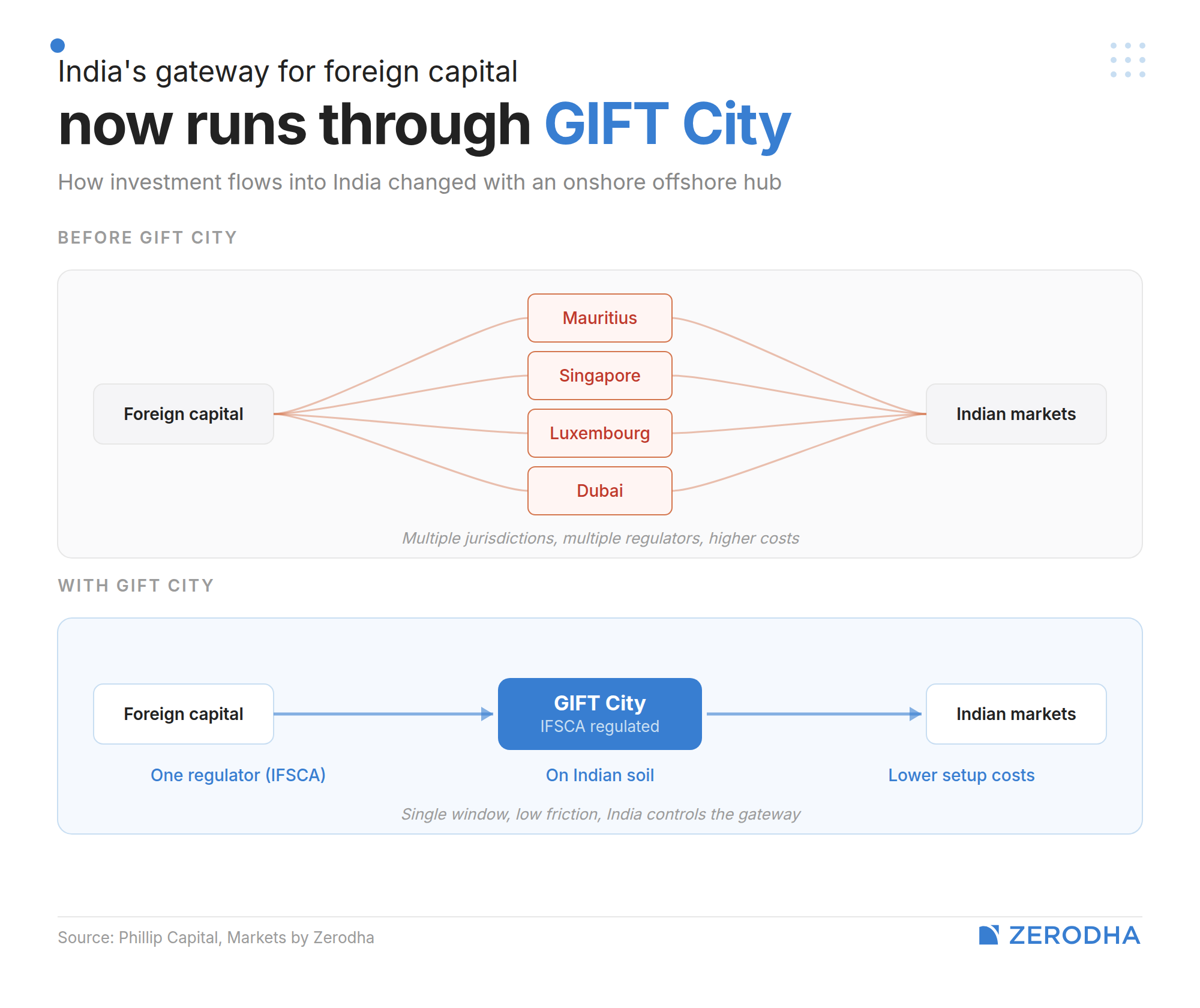
GIFT City wanted to solve that. It was originally the brainchild of Mr. Modi during his time as Chief Minister of Gujarat. When he became Prime Minister, it took real shape. The idea was straightforward — why should India’s financial gateway sit in someone else’s country?
Think of GIFT City as India’s answer to the DIFC in Dubai or the financial centres of Singapore and Mauritius. It sits physically between Ahmedabad and Gandhinagar, but legally, it operates as a Special Economic Zone with its own regulator — the IFSCA (International Financial Services Centres Authority). Though technically on Indian soil, it functions as an offshore jurisdiction.
The real problem it solves
Forget the grand narrative for a moment. The single biggest thing GIFT City does is eliminate friction.
Let us give you a concrete example from our own business. At Phillip Capital, over 30% of our PMS assets under management comes from NRI clients. To onboard an NRI through the traditional domestic route, the process takes 30 to 45 days . As we shared earlier, the client needs a PAN card, an OCI card, a savings bank account, a PIS account, a trading account, a demat account, and finally a PMS account. That’s 50 to 60 signatures across forms. If someone signs in blue ink one time and black the next, the bank rejects it. It’s a grind.
Through our GIFT City fund? Onboarding takes two to three days. No PAN card needed. No OCI card needed. No PIS account. Minimal documentation. For second and third-generation NRIs who may not even hold an OCI card, this is a game-changer.
Now scale that logic to a foreign national, say, someone sitting in London or New York who’s bullish on India. Before the inception of GIFT City, they would need to register as an FPI, get a PAN card, open local bank accounts, and start filing Indian tax returns when choosing a route to invest. Most of them look at that and say: why bother? In contrast, through a GIFT City fund structure, all of that goes away. The fund handles the operational complexity. The investor just invests.
Adding to that, in India, you need to deal with multiple regulators & authorities. In GIFT City, there’s one unified regulator: IFSCA. For operators like us, that alone simplifies life furthermore.
What’s encouraging is that IFSCA has been proactive. They’ve been allowing innovation for new products, new regulations, and studying global best practices. They’re stringent — they don’t want GIFT City to earn a bad reputation — but they’re also pragmatic and forward-looking. The traction from global banks, family offices, and domestic fund houses setting up shop there is the proof of things going well. After recent geopolitical events in the Middle East, we even saw a rush of NRIs wanting to open a bank account in GIFT City as a safer alternative.
One more operational advantage worth mentioning is cost. Setting up a fund in, say, Singapore or Mauritius means paying legal counsel in dollars. Skilled manpower is expensive and harder to access. But, GIFT City, being in India, brings all of those costs down significantly while still operating under the highest international standards.
Money going out: The outbound story
For Indian residents wanting global exposure, GIFT City has opened doors for investors to invest globally through regulated fund management entities in India, which was not possible earlier due to there being no platform for the fund managers to set up shop.
Before GIFT City, your options were limited. You could invest in a domestic mutual fund that ran an international fund-of-fund — say, a Nasdaq ETF or a Hang Seng fund. That worked until the RBI’s aggregate industry limits were breached, after which many fund houses stopped accepting fresh inflows into international schemes. Or, if you had serious money — $100,000 or $200,000 — you could open an account in Singapore or the US directly. For smaller amounts there were limited avenues.
GIFT City changes that.
Through our platform, for example, we now offer access to US-listed equities. Even with $5,000 or $10,000, you can start building a global portfolio. Previously you would have to open an account with a broker who would be having a third party arrangement with an external broker to give you access to the global markets. LRS limits still apply though — you’re capped at $250,000 per person per year for remittances — but those limits are generous enough for most individual investors.
And since your investments in GIFT City are denominated in dollars, you automatically get a currency hedge. The Indian rupee has historically depreciated against the dollar by roughly 3-4% annually on average — and over the last 15 months, the depreciation has been steeper. That tailwind adds up over time.
Beyond individual stock access, the fund management ecosystem is growing as well
Let us explain. Say, an Indian AMC sets up a fund in GIFT City, and that fund — the “feeder” — pools investor money and channels it into a larger global fund or directly into overseas securities. As an investor, your experience feels familiar, since you’re investing in a fund run by a brand you recognize, in a regulated setup. But behind the scenes, your money is being deployed globally through GIFT City’s infrastructure. It’s essentially the same idea as the Nasdaq or S&P fund-of-funds that domestic AMCs used to run, except it’s domiciled in GIFT City instead of onshore India.
And that distinction matters, because unlike domestic fund-of-funds, these aren’t subject to the same RBI industry-wide caps that forced so many international schemes to stop accepting fresh money. And as the ecosystem matures, investors should expect thematic exposure too, not just broad S&P 500 or Nasdaq funds, with narrower slices like AI, cloud computing, or medical devices that don’t have listed equivalents in India.
Money coming in: The inbound story
Local AMCs have been especially active because they already have NRI client bases and are now offering these clients a far smoother onboarding and investment experience through GIFT City structures. As we explained in the start of the article, there are multiple operational benefits for a foreign national or NRI to choose the GIFT city route to invest.
The vehicles being used are primarily AIFs — Category I, II, and III. We specifically run a Category 3 III open ended AIF. Global family offices are also increasingly setting up in GIFT City, drawn by the presence of global banks, the regulatory clarity, and — frankly — by how well India’s growth story is selling internationally right now, especially with recent valuation corrections making the market more attractive.
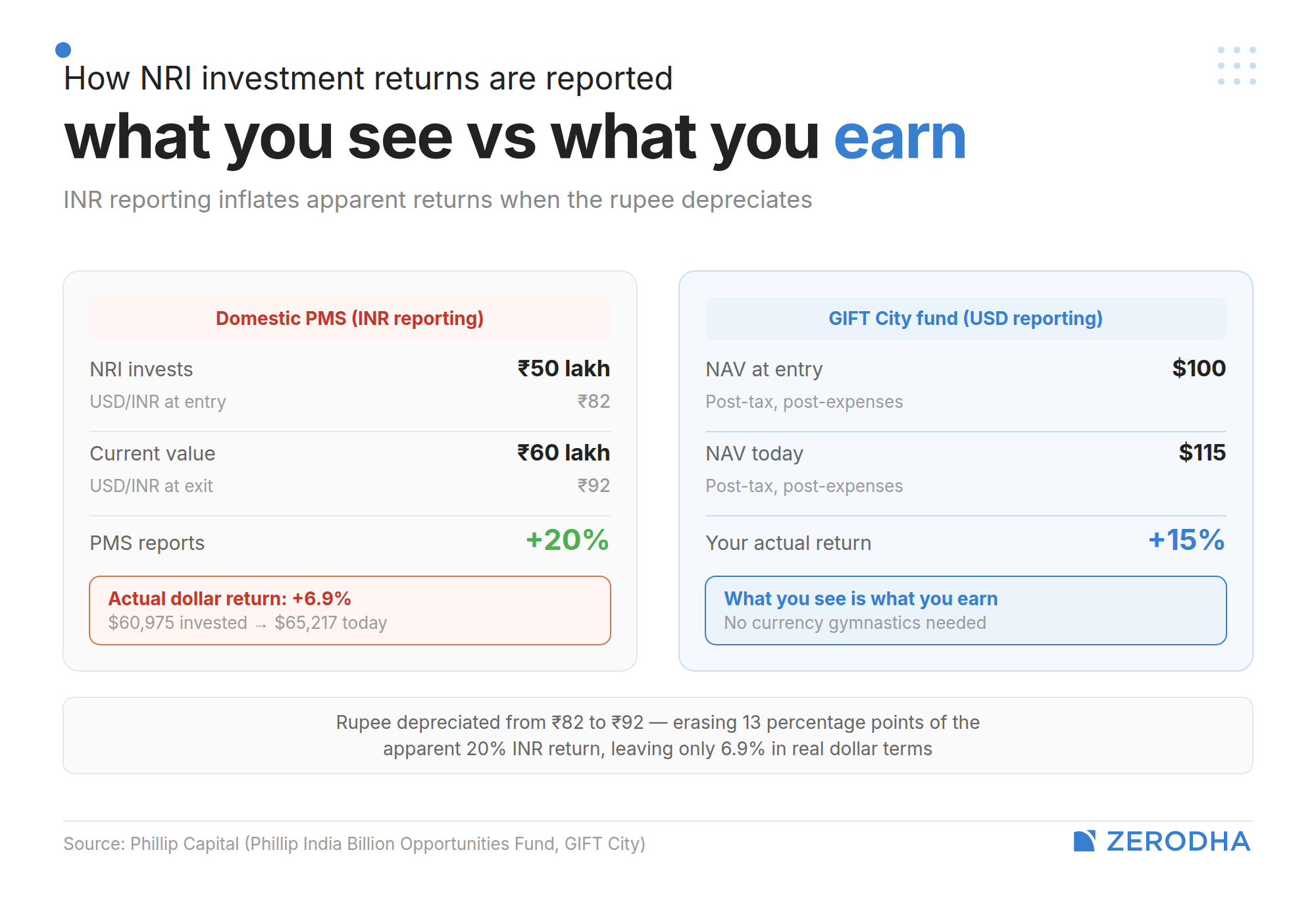
A practical advantage for inbound investors currently is reporting. When an NRI invests through our domestic PMS, we report returns in rupee terms. But the client remitted dollars. If the rupee depreciates between the time they invested and the time they exit, their dollar-denominated return is lower than what our INR reporting shows. This creates confusion.
Through our GIFT City fund, the NAV is published in dollar terms, post-tax, post-expenses. What you see is what you actually earned. No mental currency gymnastics.
The Tax Reality
This is the single biggest misconception we encounter, and we partly blame WhatsApp University for it. GIFT City is not tax-free.
If you’re an Indian resident investing through a GIFT City fund into global securities, you still owe capital gains tax in India. You must report your income and pay up, same as any other investment. What is different though, is that there’s no GST on management fees and other charges levied within GIFT City. That’s some savings for investors, but it’s not “zero tax.”
For NRIs, the advantage is more tangible. When an NRI invests directly in Indian stocks, TDS gets deducted by the bank, and they must file Indian tax returns at year-end. Through a GIFT City fund, the fund itself handles Indian taxation at the fund level. The NRI investor doesn’t need to file returns in India, but file in their country of residence.
If that country is the UAE, where there’s no capital gains tax, they effectively pay only the Indian tax at the fund level and nothing more. If they’re based in any other country, where for example the short-term capital gain tax is 25%, and the Indian tax already paid at the fund level is 20%, they only owe the 5% differential in that country as India has DTAA with several countries. This is just a broad example of how it works and clients should consult with their tax advisors for a more granular understanding.
So, Should You, a Retail Investor, Care?
Yes, but with a caveat.
We always tell our clients: it’s not India or global. It’s India and global. Over the last 15-18 months, global markets have significantly outperformed Indian markets. That’s a reminder of why diversification matters.
GIFT City gives you a regulated, accessible vehicle to get that global exposure. You can open a bank account there, hold assets in dollar terms, and invest in a growing range of funds and direct equity options. For retail investors, the mutual fund feeder route through GIFT City is probably the most practical starting point, especially since many domestic international fund schemes remain closed to new inflows.
But don’t go overboard. A small, consistent allocation to global assets is the right approach. The temptation to shift everything offshore when global markets are running is a mistake. Think of it as diversification, not a switch.
The proof of concept is established, the volumes are growing across products, and the regulator has earned credibility. There have been talks of some companies even setting up their IPOs through GIFT City. For anyone — NRI, foreign national, or Indian resident — looking to move capital in or out of India through a regulated, low-friction, cost-efficient structure, it’s the most compelling option available today.
Nishit Shah is Principal Officer & Vice President PMS at Phillip Capital India Pvt. Ltd. and has been with the firm for over 10 years. Ankush Datar is part of Nishit’s team, working in the PMS team and assisting in fund management, for over 7 years at Phillip Capital.
🎥 Watch or listen to the full conversation
──────────────────────────────────────────────────────
Full Transcript
Speakers
Kashish Kapoor — Host — Markets by Zerodha
Nishit Shah — Head of PMS, Phillip Capital India — 10+ years at the firm
Ankush Datar — PMS & GIFT City team, Phillip Capital India — 7.5 years at the firm
Kashish Kapoor
So, hi everyone. Thank you folks at Phillip Capital for doing this conversation with us. Before I start talking about GIFT City, why don’t you guys just briefly tell us what you do, what does Phillip Capital do, and how are you involved in GIFT City slightly, and then maybe we can just start talking about it.
Nishit Shah
Thanks Kashish Kapoor for this opportunity. So just to maybe touch upon what Phillip Capital is to start with. That way, of course, we are a very large global player. We are spread across 15 countries globally. We are headquartered out of Singapore. And we had our 50th, in fact, 50 plus years of operations globally. Here in India also, we are into our 25th year of operations. So that way, very large global company into financial products and services. Here in India, of course, we do a lot of business with institutional clients, HNI clients, and to some extent, with retail clients as well. So my name is Nishit Shah. I head the PMS desk out here at Phillip Capital in India. I’ve been part of Phillip Capital now for more than 10 plus years. So, been heading the PMS desk. Overall, look at the fund management part as well, as far as the business is concerned.
Ankush Datar
I’m Ankush Datar, part of Nishit’s team. And I’ve been with Phillip Capital for the last seven and a half years now. Was part of the team on the PMS and the GIFT City operations, which we are running out of GIFT City. So maybe we can touch upon the GIFT City side also, what we are doing.
Kashish Kapoor
Yeah, so maybe I’ll just start asking questions directly here. Let’s start from scratch. Help me understand why does GIFT City even exist? What problem is GIFT City trying to solve that, you know, our existing financial system couldn’t? Let’s start here.
Nishit Shah
So see, GIFT City was the earlier the brainchild of Mr. Modi when he was the Chief Minister of Gujarat. That was the earlier. So of course, till now all of us have heard about Mauritius. So a lot of money, foreign money that used to come into India, that used to be through Mauritius, Singapore, Bermuda, and all those offshore jurisdictions. So we did not have any offshore financial kind of a jurisdiction here in India. So that was what Mr. Modi’s plan was when he was the Chief Minister of Gujarat. Of course, when he became the Prime Minister, this took more shape kind of a thing, and that is where GIFT City came about. Of course, GIFT City, though technically it is in India, it is between Ahmedabad and Gandhinagar, but it’s an offshore jurisdiction. So, yeah, so it’s, though basically technically it’s an SEZ kind of a thing. So what happens there, happens through a different regulator. So in case of GIFT City, IFSCA is the regulator kind of a thing. So it is an independent kind of an, I would say, a small city kind of a thing. So basically the idea is that if money is going to be coming into India or maybe going outside India, then we need to have a certain kind of a hold over it, and that is where the entire idea about GIFT City came into place. And since it was launched, I think it has become very popular. There’s a lot of money that is coming into India or maybe going outside India as well. And of course, it is more popular for money to come into India. So yeah, it is gaining a lot of popularity.
Kashish Kapoor
So I’ll ask an even dumber question. Why is it that money coming inside of India or outside of India can happen through, you know, institutions like NSE, BSE? Why is it that we need something in offshore? Why do we need that in the first place? Can we talk about that first?
Nishit Shah
So see, basically when big foreign money that comes in, they would want a hassle-free kind of an investment vehicle. So that’s why generally a lot of money that used to come into India through FIIs or FPIs, what we call them right now, they used to use kind of countries such as Mauritius or Singapore or Luxembourg, because therein those jurisdictions have, of course, a certain kind of an advantage because you can do a lot of — it offers a lot of flexibility. Second, it also gives you a certain kind of a leeway as far as taxes are concerned. It offers you a lot of, to do multiple things under one registration. So that is what the main purpose of all this thing is. Of course, some of them became known as tax havens. But now, of course, fortunately for all of us, all of them work on the similar kind of a tax kind of a structure. So it is no longer that maybe a Mauritius or a Singapore has an advantage or a GIFT City has an advantage of anyone else. So all of them, they get taxed in the similar kind of a structure. But a lot of large money that comes in, they’d like to come through a fund structure. So if they directly come into India, then they need to get registered individually. And to get registered individually, it’s a lot of paperwork, a lot of hassles. So that’s why a platform or maybe kind of a regulator, when it comes into play, it offers them a lot of comfort.
Kashish Kapoor
So, Nishit, or maybe Ankush Datar, you could help me understand. You talked about flexibility. One specific example that you gave was that for a foreign player to let’s say invest in India, they’ll have to get themselves registered in India, which isn’t as convenient. Can you give a few more examples which helps me solidify and understand why do we need something like GIFT City in the first place? So obviously, you mentioned tax havens. Maybe just drill down a bit. How does the tax differ if let’s say we do it through offshore or let’s say if we do it through NSE, BSE? How does that look like?
Nishit Shah
So let’s take an example of an individual investor. He’s a foreign national. Now today if he wants to invest into India, he decides to invest directly into India. So he’ll first need to do a lot of paperwork. First, he needs to apply for a PAN card. Then he needs to register himself as an FPI. Have bank accounts here in India. So it’s a lot of hassle. Now a foreign national, individual investor wanting to invest into India, first he’ll think that why should I take a PAN card? Why should I start filing my tax return here in India? Say suppose today if I want to invest into maybe US, I do not need to apply for a kind of a PAN card or maybe the local tax identification number out there. So that is, it’s a very big hassle kind of a thing. So that’s why they like to come through a fund structure or jurisdictions like this. So for them, investing into India becomes quite simple. So, let’s take another example of an NRI client. Now today an NRI client also wanting to invest into India, it becomes quite difficult. Because he’ll also have to have a PAN card, maybe an OCI card, he’ll need to open a savings bank account, a PIS account, he’ll have to file for his returns and all those things. Now with GIFT City kind of a structure, all this thing goes away. He does not need any of them. Onboarding becomes quite easy kind of a thing. So that is one of the big advantages of a structure like a GIFT City.
Kashish Kapoor
Okay.
Nishit Shah
So all this entire hassle goes away. Second thing you spoke about, taxes kind of a thing. So taxation-wise also, again, when you invest directly, you have to file for your returns here in India. But when you invest through a fund out of GIFT City, the fund pays the taxes out there. So as an individual investor, you do not need to worry about taxation in India or in GIFT City. Now the tax advantage that a foreign national or an NRI have when they invest through one of these jurisdictions is, if you are doing any derivative trades, derivatives are not taxed kind of a thing. So that is something — how we Indians have to pay capital gain tax on derivatives as well. As a foreign investor, you do not need to pay any taxes if you come through one of those jurisdictions.
Kashish Kapoor
Okay.
Nishit Shah
Other advantage is, if you are investing into mutual funds through one of these jurisdictions, then also the tax advantage is there. So say suppose if you invest as an NRI into India, you invest into a mutual fund unit, you bought at 10 rupees NAV, you sold at 12 rupees NAV, a TDS gets deducted and you get the balance. Of course, you will have to maybe then show that why TDS should not be deducted and all those things, but it’s additional paperwork. But when you invest through a jurisdiction like this, the fund since it is taking care of it, and if you are investing into mutual funds, they will take care of the entire thing. So then you won’t be paying any capital gains tax. But again, I think Kashish Kapoor, more than the taxation, I think it’s the ease of investing that is more important, rather than taxation. Again, for taxation, it keeps on changing, so I would strongly suggest to always consult someone before you go ahead and make that investment decision. So for me, taxation is not a very big... See, today everyone is sold on India’s story. In fact, NRIs and foreign nationals also know a lot about India’s story than we do. It’s just that the vehicle for them to invest into India. So that way, GIFT City makes that investment process very simple for them.
Ankush Datar
It increases the number of people we can actually approach — NRIs, maybe even foreign nationals in instances. Foreign nationals, obviously if they came through individual routes, they would be having a very difficult time in terms of — some countries may not have even been allowed to invest because of multiple reasons. GIFT City kind of standardizes everything and makes it a level playing field. So say suppose we are running a PMS. Almost 30% plus of our AUM is NRI clients. Now to onboard those NRI clients, it’s a very big hassle. So generally the entire onboarding process takes anywhere between 30 to 45 days. And there is no kind of lag from our side. Because the number of signatures are 50, 60 signatures. They have to open a bank account, the PIS account, then a trading account, then a demat account, and then finally a PMS account. Of course, we handhold the client throughout the journey. But if anything is going to take such a long time — see because 50, 60 signatures, you clearly mark it for the investors to sign, but then also they’re going to make maybe, they’re going to miss out on something. Second time they might sign with a separate, maybe a different ink. First time they sign with a blue pen, second time they sign with a black pen, the bank’s going to reject the form. So it’s a very big hassle. Since we have launched our Phillip India Billion Opportunities Fund in GIFT City, onboarding of NRI clients has become very simple. Onboarding can happen as quick as in two days. So against 30 to 45 days, onboarding here is almost like two to three days at max. And very simple kind of documentation. Now a lot of second generation, third generation guys, they don’t have an OCI card. So to develop a link, if they want to open, come through the traditional route of NRE, NRO account, they need to have an OCI card and everything. But in GIFT City, that is not required.
Kashish Kapoor
So honestly, when I was reading up on it, the first thing that Google threw me was it just makes everyone’s lives easier. But I was unable to have a full grasp on what those words meant. Now that you gave examples, right? Something as simple as a process of onboarding an NRI cutting short from 30 to 45 days to two days. That is a lot of pain solved for folks like you who are trying to solve and build wealth solutions for your clients abroad and also for them. So honestly, that helps. Moving on, you mentioned about the regulator, right? Here the regulator is different. How are they different? What I’m primarily wanting to ask is, what’s the vision that they have? What’s the philosophy that they have? How do they differ from let’s say SEBI or RBI? How do they interact with them? Do they fall under SEBI or RBI’s purview or they’re totally separate? Just a bit on that as well so that I can better understand how is it being regulated?
Nishit Shah
So unlike India, wherein we have got different regulators for everything, in GIFT City, we have got a unified regulator. And they are very much forthcoming. They want to expand, they want to make GIFT City very popular. So with a lot of products and services, they are very liberal, they are also looking at global plans in many ways kind of a thing. And they are getting a lot of new kind of regulations and products and services onto the GIFT City platform. So that way, I think since it’s a single regulator, it makes life a lot easier for operators like us as well. So that is one of the biggest advantages. Of course, for an Indian resident who wants to maybe send money to GIFT City, of course, for us an RBI comes into play because we are remitting money through the LRS structure. But once you are in GIFT City, it’s only a single regulator that you are interacting with. And of course, they have taken a lot of kind of influence from maybe what is already happening in India through SEBI, RBI and all those things. And they are very stringent as well because they don’t want any — they don’t want a bad name for GIFT City. So till now, I think they have done a fabulous job. What they have been able to achieve in such a short period of time — we have seen a lot of global offices are setting up their offices in GIFT City. We saw in between, heard about how maybe a large Abu Dhabi family office, or maybe because of the recent Middle East crisis as well, a lot of NRI clients have started opening bank accounts out there in GIFT City as well. So I think that way, it’s here to grow. See, another very big advantage of GIFT City is cost. See, today when you do, say suppose if we try to do a fund structure in Mauritius or Singapore or maybe any other jurisdiction, the costs are very high. I’ll tell you the legal cost alone. Rest all, of course, itself is very high. Today if you deal with a legal counsel in maybe Singapore or something, wherein they’re going to charge you in dollars. Because GIFT City is here in India, the cost as an operator, or maybe as a fund operator, also becomes quite less. Availability of skilled manpower is also quite easily available. So these are all additional advantages of GIFT City.
Kashish Kapoor
So if I understand it correctly, and correct me if I’m wrong, before GIFT City, the way for anybody to bring money in India or outside of India, the gateway wasn’t really in the hands of India. It was more Dubai, Mauritius. But now with GIFT City, we as Indians have more control over the gateway of capital flowing in and out, therefore making everybody’s lives easier. Did I understand it correctly?
Nishit Shah
Yeah, perfect. See, gateway for incoming money, I think they are very liberal. It’s wherein outward kind of remittances, that is there wherein they will have a proper gatekeeping activity. So I think that again, a lot of money was coming into India through different jurisdictions. So think of GIFT City as maybe a DIFC of Dubai or a Singapore or a Mauritius. I think that way it makes a lot of sense.
Ankush Datar
I think it’s developed also over the years that when we would have started, we would have had to explain to fund managers, maybe possible clients, what GIFT City is. And since it’s evolved and there’s been so much information, especially by the regulator also, there’s been so much awareness activity. I think that hesitancy is not there because we’ve developed, we’ve shown proof of concept. Now it’s doing so many volumes across various products, whether it’s inbound or outbound. I think even foreign nationals are kind of more comfortable in terms of looking at GIFT City.
Kashish Kapoor
Got it. So now I’ll actually get into the nitty-gritties of the workings of GIFT City. And how I look at it is from two sides, as you explained — money coming in and money going out. Let’s talk about, you know, first money going out. So let’s say before GIFT City, obviously LRS limits still apply for GIFT City. But let’s say pre-GIFT City era, when money was supposed to go out, how inconvenient was it? What was the process like? And now what has the process been replaced with? Obviously, you mentioned the timelines have shortened, right? But if let’s say I am somebody who has enough disposable income and I want to have exposure to non-Indian equities per se. What were the options for me before GIFT City, and now what is it now?
Nishit Shah
So see, of course, before GIFT City, I think one of the easiest options for us earlier was the local mutual fund routes wherein they used to invest into global funds. So it was a fund of fund kind of a structure. So wherein maybe you invest into a Hang Seng ETF or maybe a Mirae kind of an ETF or mutual fund units. I think that was there. Otherwise, to invest into global securities was a slightly difficult activity. Until and unless you had large sums. Then if you had large money, then maybe you open an account in Singapore, or maybe in Dubai, or directly into US. But for smaller ticket size, it did not used to make a lot of sense kind of a thing. Because see, again, we are an MNC, so we used to do this before GIFT City as well, wherein if one of our investors was wanting to invest into global securities, we used to take him to our Singapore counterparts out there and help him open the accounts out there. But of course, it was still easier, but it was generally meant for higher ticket sizes. Then of course, in between we have got couple of Indian-based platforms, which had a share broking arrangement and which were kind of easing this, providing this solution for Indians wanting to invest into global securities. Now with GIFT City coming in, so again, what we have done at Phillip Capital, we are kind of offering access to US-listed equities through our platform. So it becomes quite easy for you to transfer even small money and start investing into global securities. So it has become very easy. Even for smaller ticket sizes, it now makes a lot of sense. Earlier it was maybe meant for larger ticket sizes clients only, like $100,000, $200,000. But even now for maybe $5,000 or maybe $1,000 also, you can do that.
Ankush Datar
And I think also adding on to what Nishit just said, is that there were not too many regulated asset management companies through India. Now you see, of course, Phillip as a house has a global PMS. There are so many reputed asset management companies who’ve set up their own vehicle investing into global securities, maybe directly into global securities, maybe into a feeder fund. Probably before that you would have to do it through Mauritius again, which would be a very difficult task in terms of cost, in terms of getting access. Now I believe the ticket sizes are also affordable for investors in India looking to kind of take access. It’s just about where they want to invest now. The options are all there for them.
Kashish Kapoor
Got it. So, why don’t we just double down on this feeder fund thing? I’ve seen AMCs being very aggressive launching these feeder funds. So, just trying to understand how does it differ from, I don’t know, maybe typical Nasdaq FOF or an S&P FOF that AMCs were launching in India before this. How does the structure differ? And how is it that, again, operationally, does this make the life of a fund manager or, let’s say, a wealth manager easier? How does that look like?
Nishit Shah
So see, of course, the local funds that were there, there are certain RBI limits which come up. That’s why now as of now, as we speak kind of a thing, a lot of the funds are not accepting new money because they have already hit the RBI limit. So then, but as an investor, you want global exposure. So then you would invest through GIFT City. Of course, the LRS limits apply out there, individual LRS limits, but I think those are quite liberal — $250,000 per PAN card per year. So then you can remit money. A lot of AMCs, as you rightly mentioned, are starting with a feeder structure out there. So you can invest small amounts as well, and you start getting exposure. So that way, it is a much easier route as well. And once you invest into dollars, because GIFT City, your investments are going to be based in dollars. Now, unfortunately, Indian currency is a depreciating currency. So on an average, even if your money is there kind of a thing, maybe let it be in a liquid fund or I’m just giving an example. Then also on an average, Indian currency depreciates by 3 to 4%. Of course, over the last 15 months, it’s been depreciating a lot kind of a thing. So you get that advantage, and plus, of course, you get a lot of advantage of participating in global equities. A lot of fund houses — so it’s just, I think, just a start. I think we are going to see a lot more funds coming up out there, feeder structure, wherein maybe you can have exposure to individual markets. See, in India, we have got only ETFs — Nifty 50 ETF or Nifty 500 ETF. We have got very few thematic ETFs like a banking ETF. But globally, there are so many, that even if when you talk about artificial intelligence, of course there will be an ETF on artificial intelligence, but within AI also, there will be so many of them kind of a thing. So I think as we grow, more funds keep coming up, we as a wealth manager or as an investor, we’re getting more kind of options.
Ankush Datar
And another thing is that compared to the mutual fund route, it would be more for retail individuals putting smaller amounts. Whereas for slightly more sophisticated investors, obviously as the ecosystem evolves, it will be open to a much larger set of investors.
Nishit Shah
And apart from feeder structures, there are PMSs. So we run a PMS. There are AIFs which have come up. So that way, for again, as you were saying, for HNI clients also, there will be many more options kind of a thing.
Kashish Kapoor
Again, so I still want to, you know, pick your brain on how does it operationally differ? Let’s say if I was investing in an Indian MF and they were on my behalf buying an S&P ETF, which was something that happened, I don’t know, maybe pre-GIFT City as well. But now all these investments are being routed through GIFT. How does that change the operations for a fund and life of a, let’s say, fund manager?
Nishit Shah
So I’ll take it up in two cases. As an investor, of course, when you invest into local funds, the mutual funds, it’s very simple. You just kind of open up a new folio, transfer, maybe do an SIP, it’s easy. When you want to send money to GIFT City, then of course, you have to go through the structure, you have to actually remit money kind of to GIFT City through LRS. And then, of course, the investment process journey is very simple, similar kind of a thing. Now, as a fund manager, of course, when you do launch a fund in India, there are certain rules and regulations that come up. You convert the fund from dollar to INR or maybe from some other currency to INR, then open it to local investors. But there in GIFT City, you can keep it into the same kind of a thing. So maybe cost-wise, I don’t know how much difference it would make, but my guess is it would be slightly cheaper if you run it out of GIFT City.
Kashish Kapoor
Got it. So again, if you were investing through GIFT City — like I am Kashish Kapoor, I’m trying to invest — me transferring money to GIFT City will come with those LRS limits, but once my money has reached a GIFT City entity who’s investing abroad, then it becomes, then the life becomes much easier. Compared to a domestic mutual fund folio, where it works very similar to any other investment that we make, and then how the money is being again translated from dollars to INR and eventually returns being reflected in NAVs, that’s a problem for the fund manager itself.
Nishit Shah
Yeah, of course.
Kashish Kapoor
Got it. Now, on the flip side, you know, we’ve talked about money going outside of India and the demand for dollar assets. That’s proven for sure, as you yourself mentioned that INR gets depreciated, it makes sense to have that USD hedge as well. Totally makes sense. On the opposite side, when we talk about money coming in India — my first question remains, what are the key players in GIFT City right now who have money coming in India? So, is it usually global firms who’ve also set up their offices in GIFT City? Is it domestic funds who are trying to get money in India? What does that look like?
Nishit Shah
So today as we speak, I think all the global banks and local fund houses are there present in GIFT City. Of course, the local fund houses are more kind of active as of now, because they already have an NRI client base kind of a thing. So that is where they are offering a hassle-free kind of an investment process for them to onboard into India. And I think that’s why they have been kind of more active out there on the fund side. So yeah, of course, there is everyone out there kind of a thing, but it is the local. Of course, what I also understand is a lot of family offices, global family offices have also started setting up accounts there in GIFT City because of the global banks and everything out there. See, today India’s story is quite popular, especially since the valuations are also corrected. I think it has become much more interesting kind of a thing. So that’s where interest is there kind of a thing. And till now, of course, this money was always going to come into India through some other kind of a structure. But now with GIFT City, especially NRIs are coming up in big numbers into India. So I would say that it has become one more vehicle, but it has made that life simpler. And since the popularity is increasing, it is going to increase going forward.
Ankush Datar
And I guess the structures which would be there in GIFT City to bring money would be through the alternative investment funds. The AIFs. Maybe Cat 1, Cat 2, Cat 3. We are doing specifically a Cat 3.
Kashish Kapoor
Okay. Now I want to pick your brain on the tax end of things. Currently, and I want you to give me two examples of what does tax look like, by taking an example of somebody like an Indian investor who’s let’s say investing in a US stock. What does tax look like through a GIFT City route? What does tax look like outside of that? And does that give enough incentive for an individual investor like me to prefer the GIFT City route?
Nishit Shah
I think one thing first I would start with — it’s a misnomer that GIFT City means zero taxes. I think see, the taxes are not there for the businesses for a certain period of time. The other kind of tax that is not there is GST. So whatever fees get levied to the client, the management fee or anything, there is no GST on that. But when it comes to capital gain tax or maybe income tax, that still applies. Now let’s take an example. For example, Kashish Kapoor, you have invested into a GIFT City fund which invests into global securities. So whatever income is there, you have to report here in India and you have to pay your capital gain taxes and income taxes. So there, there is no difference kind of a thing. So when you invest into, say suppose, a Hang Seng ETF kind of a thing, you’ll have to pay capital gain tax. Long term, short term, it would depend. So similarly, when you invest into a fund in GIFT City, and there is a capital gains, you’ll have to pay those taxes here in India. So it is not that you don’t have to pay taxes. Now let’s take another example. Let’s take an example of an NRI client investing directly into India. In this case, what happens? Say suppose for example, he is investing into stocks. He invested 100 rupees in one particular stock, he sold that stock at 150 rupees. What the bank will do, because when you are investing directly in India, you’ll have to open a PIS account with a bank. So the bank will deduct the TDS. For example, let’s say it was short-term capital gain tax. On 50 rupees, 20% is the tax. So the bank will be deducting 10 rupees and remitting back the 140 to the client. Now at the end of the year, that particular client will have to file for his income tax here in India. And say that, okay, I had to pay 10% short-term capital gain tax, which has already been deducted. And these are my certain other interest income and this is the tax filing that I am doing. So this is what an NRI investing into India directly looks like. Now an NRI investing through a GIFT City fund in India. For him, all the taxation would be at the fund level. So the fund would be paying the taxes here in India — the capital gain tax, whatever it is, long term, short term. The client does not need to file for any taxes here in India. The client will have to file for his taxes in the country that he is originating from. For example, he is from Dubai, that NRI client. In Dubai, there is no income tax on global income. So he does not have to pay any taxes out there. But say for example, he is from US. The short-term capital gain tax here in India is 20%. If the fund is also registered in US — say suppose our fund is, we have already taken a registration with SEC, IRS and with individual states. So we’ll be able to provide him a K-1 statement. And wherein the tax in US is 25%. Then in that case, he’ll have to pay a 5% difference.
Kashish Kapoor
Okay.
Nishit Shah
In US. But here in India, that entire hassle of TDS, filing for his return at the end of the year and everything goes away. The other big advantage, Kashish Kapoor, that is apart from the onboarding and the taxation, is reporting. See, when a client is directly investing into India, his reporting is going to be in INR terms.
Nishit Shah
For example, an NRI client invests into my PMS through a direct route. So I’m going to report to him in INR terms — that you invested 50 lakhs, today your 50 lakh has become 60 lakhs, so your returns are 20%. So we report in INR terms, that 20% is your return. But for the client, he’ll say, boss, I transferred you the money when the dollar was 82, today it is 92. So my returns actually, dollar returns are not 20%. Dollar returns are maybe lesser than that. But when he invests through a GIFT City fund, his reporting is in dollar terms. So it becomes much easier for him to track his investment as well. So suppose the NAV that we publish for our Phillip India Billion Opportunities Fund, it is post-tax, post-expenses and in dollar terms. So it takes into consideration the dollar appreciation as well. So for him, it becomes very easy to monitor his performance. Like my 100 rupee NAV is today 115. So I made 15%.
Kashish Kapoor
I think that pretty much sums up everything I wanted to know, at least for the starters. I’m pretty sure there are so much more nuances around GIFT City. Before we close, let me ask you a blunt question. If I’m a retail investor, should I care about GIFT City today? If I’m a retail investor, let’s say, who can’t afford to invest a 50 lakh PMS ticket size, but who’s actively investing through mutual funds, should I care about GIFT City today?
Nishit Shah
See, I always say this, and especially Indian markets over last 18 to 20 months has proved this, that India is going to do very well, but it is not a question of an “or” — that I have to invest into India or global. It is a question of an “and.” So you have to do everything. Last 15 to 18 months, global markets have done very well. Indian markets have not done that well. And that’s why actually it has become more popular. Wealth managers are also pushing it. Japanese markets have done so well. US, even European markets, they have surprisingly done very well. So you have to invest. GIFT City offers you a very good investment vehicle. You can open a bank account there in GIFT City as well. I will give you three reasons why one needs to invest globally. One, of course, is dollar diversification. We spoke about the currency depreciation benefit. Second is global diversification. And third, there are many themes which are not available in India. Today artificial intelligence, cloud computing, medical devices, all these themes are not available in India. So that’s why you need to invest globally. And GIFT City offers you that very good structure. You can open a bank account also out there, keep your assets in dollar terms as well, and then invest globally.
Ankush Datar
And for the retail investor, obviously because the RBI limits have been breached for so many funds, there are very few options where you can actually invest into the global markets. So again, if you have the ability to, you can access GIFT City and then you can access these — which have a lot of options, apart from the benefits that Nishit spoke about.
Nishit Shah
Again, I think what is more important, Kashish Kapoor, is you have to invest a small portion. Today because global markets are doing well, you do not shift everything from India to global. But that is what unfortunately sometimes happens. So you have to invest a portion of it. And I think GIFT City, that way, it’s one of the best investment vehicles if you want to invest in global securities.
Ankush Datar
And current markets, as of today, we’ve learned asset allocation a lot more than we should have.
Kashish Kapoor
Okay, so one dumb question again, but the industry limit for MFs to invest, we’ve reached that, and which is why a lot of MFs have stopped inflows into their schemes wherever they had international exposure, right? Or they’re just cutting exposure there. That thing does not impact if the same AMC was setting up a fund in GIFT City.
Nishit Shah
Yeah. Correct.
Kashish Kapoor
Fair enough. Okay, one last question before we wrap up, and I expect both of you to give your separate answers. Since both of you have been interacting with clients on both sides, money coming in, money going out — what’s one thing that most people misunderstand about GIFT City? And after having these conversations, few things that have always popped up which has confused people about GIFT City. And through this platform, maybe you’d want to clarify that once and for all.
Nishit Shah
I think taxation is one thing. A lot of, because sometimes of WhatsApp universities and everything, they think that it’s tax-free. So I think that is one misconception a lot of investors have kind of a thing as far as GIFT City is concerned. But yeah, otherwise, I think there is no issues that we face when we talk about GIFT City. In fact, a lot of these guys already know about GIFT City, both about inbound and outbound opportunities kind of a thing. So that way, I think it’s just a start. From here on, it’s going to go up multi-fold.
Ankush Datar
And just to, of course, add on to Nishit’s point — taxation was one. Secondly, I think people used to, because it was an evolving ecosystem, people would take time to kind of adapt, to understand what it is. But one could say that GIFT City is probably the safest and most secure way now to invest into India if you’re someone looking to invest from outside the country, which was not actually available earlier. So now it’s a clear fact. People earlier used to take time to get kind of warmed up to the entire ecosystem.
Kashish Kapoor
Why do you say it’s a much safer and secure option for outsiders? How does it compare to — and I’ve been meaning to ask this question — but how does this compare to earlier structures that used to exist through Mauritius or Dubai?
Ankush Datar
Because we have our independent regulator, which we spoke about, right? Who regulates all the activities of all the asset management companies, wealth managers. The Mauritius route, of course, would be through various different kinds of routes. Here it’s a unified regulator who’s regulating all of the activities, who safeguards all the investors. And it’s very easy to deal with.
Kashish Kapoor
Got it. And also on the tax front, you mentioned how earlier money used to come in through tax havens. First of all, why were they called tax havens? What was the tax advantage there? And when you said that due to WhatsApp University, there’s misinformation that taxes don’t really apply here, but that’s definitely not the case, as you clarified earlier. How does that compare to a GIFT City structure?
Nishit Shah
I think taxation is same everywhere. Today you come through Singapore, say suppose an Indian investor investing into a Singapore fund or maybe a Mauritius fund, he still has to file for his returns in India. He has to pay his taxes. So there is no way that you can escape this — you know, you cannot escape two things, death and taxes. So that is always there. So those countries were called tax havens because a lot of family offices were also setting up their structures out there. So their incomes were global, they used to get those monies out there and then invest. Kind of a thing, they used to save on taxes. But otherwise, I don’t think there is any issue. Today, I think globally everyone, all the countries have become quite strict. We have got FATF as well. As soon as you do some kind of — you get into a grey list or a black list. So a lot of countries now don’t want to kind of get into all those things. And each individual country is also asking for a lot of data.
Kashish Kapoor
So if I am an individual who’s earning a decent salary in India and who wants to, let’s say, have an exposure outside, this tax haven tag doesn’t really benefit me because I can’t evade those taxes regardless.
Nishit Shah
Absolutely.
Kashish Kapoor
Fair enough. I think that’s all the questions I had. If there’s anything you think that I missed asking about GIFT City that would do justice to the audience, the floor is yours, and then after that, maybe we can wrap up.
Nishit Shah
I think Kashish Kapoor, your questions were quite exhaustive. You have covered most of the things.
Kashish Kapoor
Perfect. Thank you so much for your time, Nishit, Ankush Datar. It’s been a pleasure. Looking forward to doing more of these.
Nishit Shah
Thanks, thanks, thanks Kashish for this very interactive session. We look forward to doing more of this.
Kashish Kapoor
Thank you, guys.
Ankush Datar
Thank you.
Transcribed & corrected with AI assistance

Very well explained!
It's unfair from Government side by not allowing mutual fund limit to increase citing foreign exchange limit, but allowing individuals to route 2,50,000 usd through gift city.... Unfair and biased rules